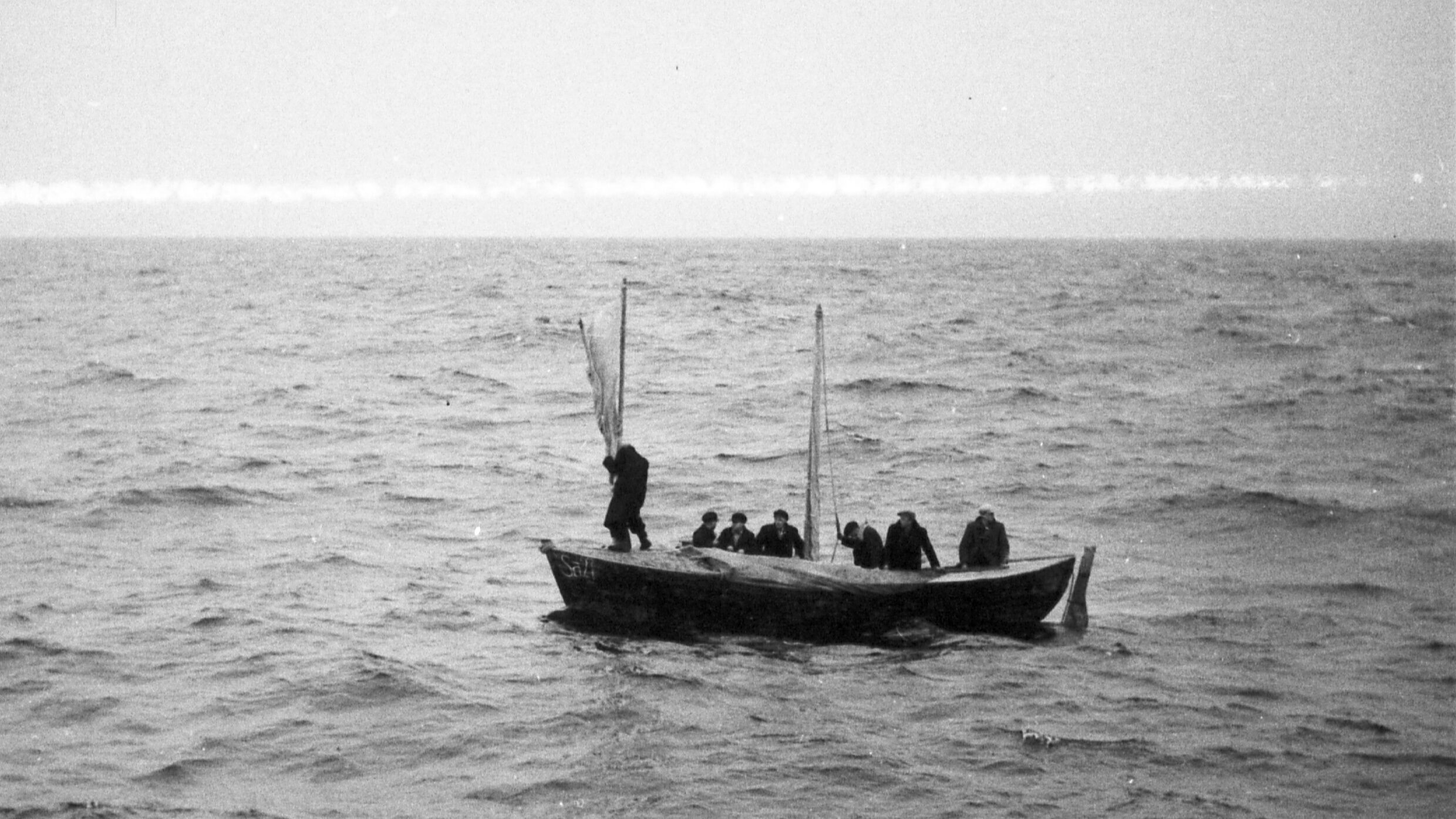
Yet over 27,000, crammed on their small boats for two or more days and nights, survived the journey and landed on Swedish shores. They disembarked into an uncertain future, but feeling heaven-blessed for their deliverance. The escapees hoped that the war would soon come to an end and envisaged a return to their homeland and to their loved ones left behind. But this was not to be. The lives of those escapees were irreversibly diverted and a return to the homeland would not be possible for decades … The drama of their Great Escape would be indelibly remembered by the escapees as a life-altering event.
The Great Baltic Escape (or as it is referred to in Estonian “Suurpõgenemine”) was commemorated this past September in several countries. An all day “Suurpõgenemine 1944 ja Meie” conference was held on September 19 in Tallinn at the parliament convention center. A summary of that conference’s presentations and forums was presented in Eesti Elu’s September 23 edition.

This past July, the BaltHerNet (Baltic Heritage Network) summer school in Hiiumaa featured several presentations on the archival research and exhibitions of the Great Escape. One of the presentations was by Dr. Mirja Arnshav, Research Coordinator at the National (Swedish) Maritime Museum. Dr. Arnshav’s interest in the Great Escape and her ongoing research is particularly fascinating and noteworthy.
Dr. Arnshav’s personal connection to the Great Escape can be traced back several years to a serendipitous encounter that she had with what turned out to be the wreckage of a small escapee boat. Over the years, Arnshav spent her summer holidays on the Swedish island of Gotland, and during those sojourns she realized an interest in history, the sea and boats. Old boats are seemingly everywhere on the shores of Gotland, as there is a tradition of leaving boats to disintegrate by the sea after reaching the end of their service. While strolling along the shores during one of her visits to Gotland, she noticed a boat unlike the other abandoned boats due to its construction. Based on her growing maritime knowledge, she suspected the boat was built in eastern Europe, and subsequently an elderly local confirmed that the boat had been beached and abandoned by Estonian escapees in 1944. Arnshav’s curiosity about the boat revealed that such refugee boats were not listed by the maritime heritage agencies. Although Arnshav does not have family roots to Baltic escapees, she felt that the legacy and stories represented by such escapee boat wrecks were important and worthy of research and documentation.
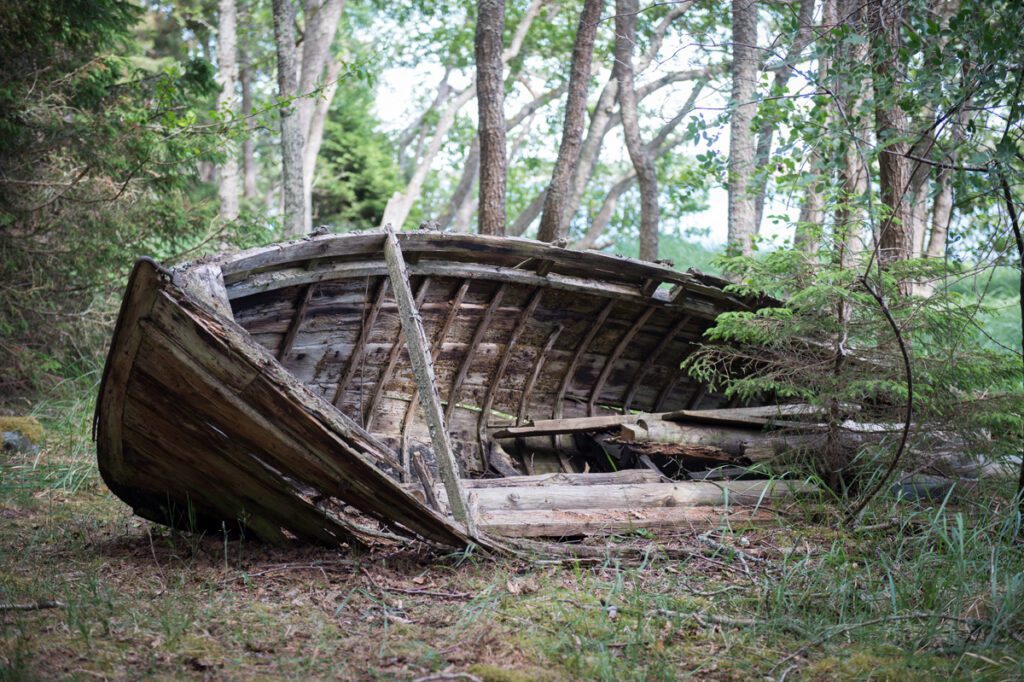
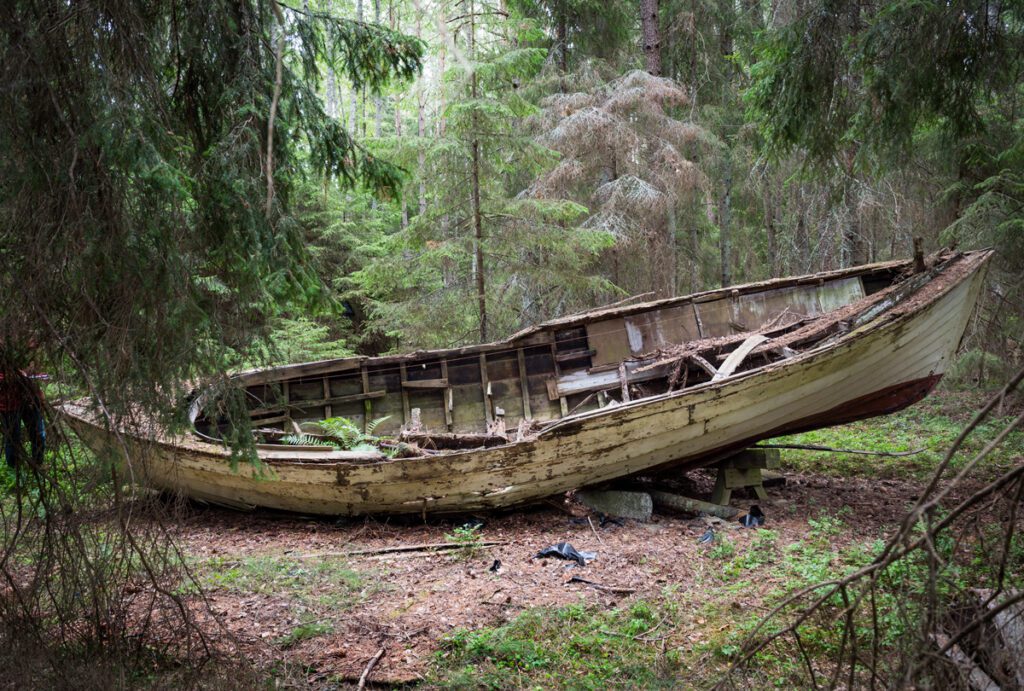
Arnshav’s formal research into the refugee boats began with her PhD thesis at Stockholm University in 2017. Her extensive research of the refugee boats for her 2020 dissertation has been documented in a book entitled “De Sma batarna och den stora flykten” (The small boats and the Great Escape).
The scope of Arnshav’s research work was to seek and identify as many Baltic escapee boats as possible that still remain on Sweden’s shores, and to document their condition. This research is not only an archaeology of the escape and its aftermath based on these escapee boats. The forsaken boats also quietly evoke stories, images and memories of those escapees who stepped out of those boats in 1944 onto Swedish shores.
Arnshav’s research examined 34 boats that have been confirmed as Baltic escapee boats. They are located on a number of shores, on Swedish islands and the mainland, and are aging in varying degrees of degradation.
In her role as Research Coordinator at the National Maritime Museum, Arnshav commenced a second and broader research project on “The Materiality of the Great Escape”. This three-year project investigated, documented and archived hundreds of essential and cherished items brought along by the escapees on their boats. In addition to the collection of items, interviews were held with several of the 1944 escapees or their descendants – all of which was compiled into a compendium for the museum. A book on this research, “Foremal pa flykt” ((Personal) Objects of the Escape), has also been published. Exhibitions, public lectures and school education programs have been organized to share the research results and the stories of the escapees. This past June, many Estonian diaspora in Sweden were in attendance at the Maritime Museum forum where Arnshav’s book was presented along with various panel discussions. Dr. Arnshav’s research work and the two books were originally written in Swedish. There is interest in having the works translated into English and Estonian. A recent Estonian TV news clip of Dr. Arnshav and her research can be viewed on https://jupiter.err.ee/1038522/uudishimutippkeskus (clip number 2: “Mis on teisel pool vet”.
This research work and interest in the Great Escape is timely, recognizing that the 80th anniversary of the 1994 Escape will be commemorated in 2024. There are steps being taken to formally recognize September 19 as the Day of Remembrance of the Great (Baltic) Escape. In leading up to the 80th anniversary, there may be interest in preserving at least a couple of the escapee boats on the Swedish shores and to erect suitable plaques at those sites, inscribed with the historical context and a recounting of the Great Escape. Such memorial sites on Swedish shores might be a fitting complement to the Puise, Estonia statue “Minna et taha, kuid jääda et saa” which commemorates the Great Escape departure from the shores of Estonia.