PhD = Patience, Humiliation, Distress
You know the old joke that a PhD is an academic who has learned more and more about less and less, until they know everything about nothing? I used to think that doing a doctorate degree would mean working within a very specialized field and topic until you know about it more than anyone else in the world. While that might hold true in some disciplines, the past three years working on my Doctor of Education (EdD) at OISE, University of Toronto, have taught me something else. Yes, we are reading countless research papers on our chosen topic but you don’t get your doctorate done only by reading. There are a lot of other skills and abilities you need to develop to get the job done.
I recently saw a nice drawing showing what people think is learned in a PhD program, versus the reality. The credit for the visual goes to Elena Hoffer, who founded the company Alma.me to help students and recent graduates navigate their career paths from academia to “the real world.” All that in addition to working on her PhD in medicine at Karolinska Institutet in Sweden. So one thing pursuing a PhD clearly teaches you is multitasking.
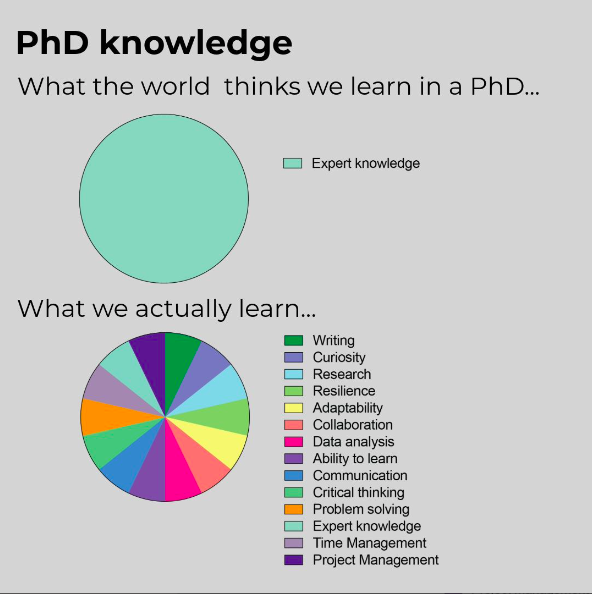
As she indicates in the image, in doctoral studies you actually learn about research methods, curiosity, critical thinking, data analysis, problem solving, resilience, and adaptability. Effective time-management and organizational skills are definitely a must for achieving a doctorate in any field. As are communication and writing skills. As I’m currently in the writing phase of my thesis, I’m really thankful for all of the academic writing skills courses the university has to offer.
Einstein: “Once you stop learning, you start dying”
For me, pursuing a doctorate relates to both individual and societal goals. I’m of the opinion that any research should benefit society in one way or another. The task of doctoral students is to choose topics that have not been explored in depth and provide new knowledge that is significant for their field of study. Therefore, one of the most important and difficult tasks in doctorate programs is designing a research project that is relevant, original, and — most of all — feasible. In our EdD program, we are supposed to concentrate on resolving problems or issues that educational practitioners are struggling with. With this in mind, I hope my study on global and sustainability education in Estonia will help to promote and improve that field in the future.
At the same time, pursuing a doctorate is a form of life-long-learning. Learning new things can naturally be done at any level. It doesn't have to happen at school or university. I’m also enjoying trying out new cooking and soap-making recipes, reading books, and listening to educational podcasts. But studying at this level has opened up a new world of education research which I find to be crucial for the future of humankind. Thus, despite all the challenges, long-hours, and moments of self-doubt and anxiety, I don’t think I will regret my doctorate studies once they are done.
More than ever, it has made me believe that we should live by Mahatma Gandhi’s saying: “live as you were to die tomorrow, learn as you were to live forever.”