Telli Menüü

Garage talk: Erik Hess’ custom cars in Hamilton

They’re sculpted. They’re loud. They’re fast. And they have all left a searing hot mark of a time and place on their drivers’ memories. Hot rods, street rods, rat rods, muscle cars—no matter what variation a driver owns, custom classic cars become a subject of devotion for each driver.

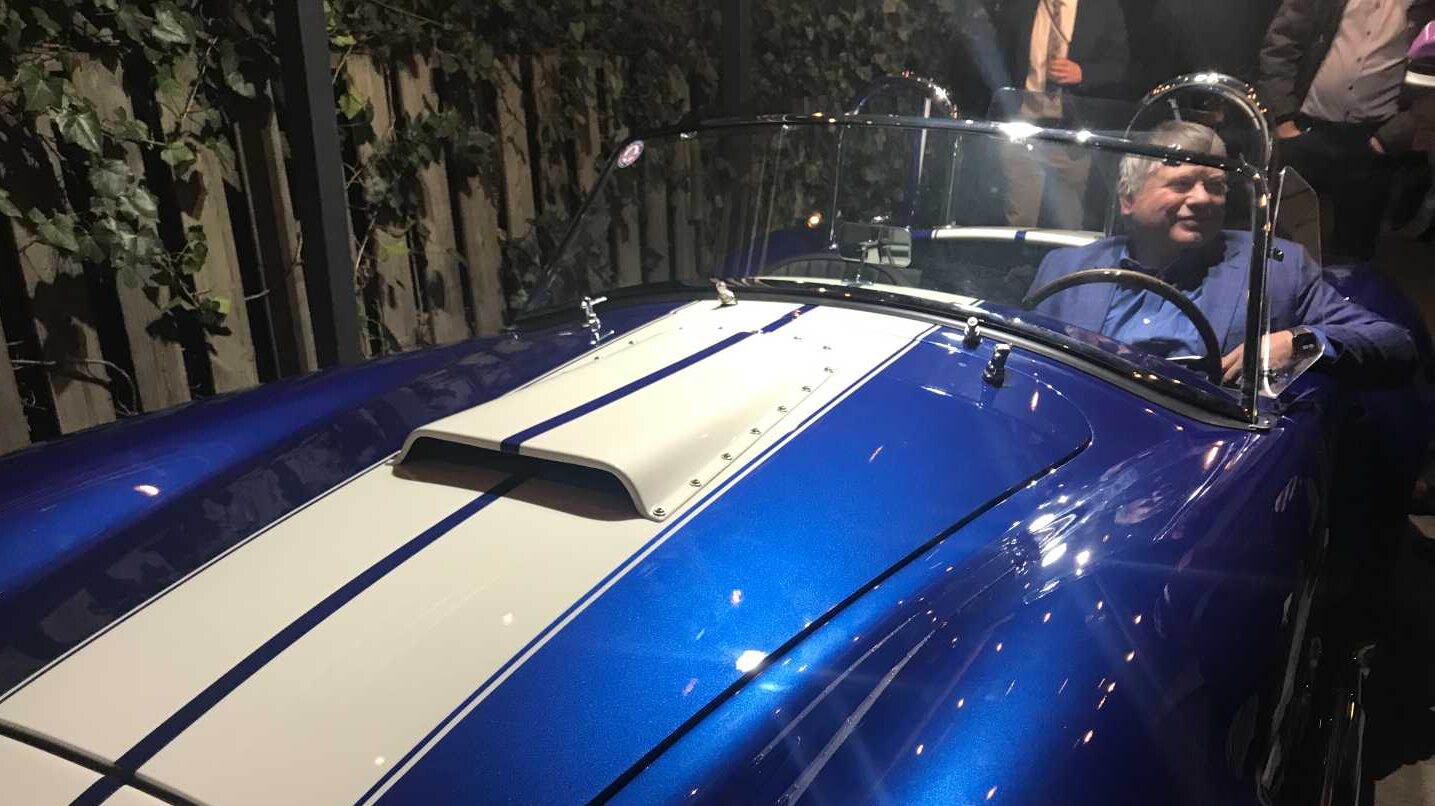
Erik behind the wheel of the Shelby Cobra 427

They first arrive as a mass of disparate parts: a chassis, a body, an engine and its individual components, seats, and more. The driver will put it all together over several years, maybe race with it for a few more, or maybe just put a couple thousand miles on the car before selling it and moving on to a new challenge.

For Erik Hess, each car he has owned is immortalized in a mural on one wall of his garage in Hamilton. From the red dune buggy he built when he was 16, his very first build, to “OL FLAME”, the yellow 1940 Ford Deluxe Coupe that sits on a lift in the garage. Also starring on the mural are a couple of his friends' and family's cars, including an old teacher's 1961 Ford pickup truck. All of these vehicles converge in a scene in front of a charming diner in Magnetawan, in the District of Muskoka. Over the course of an evening, he described not only the role automobiles have played in his life, but their progression from the end of the Second World War onward.

Every small part of a car can enhance or inhibit its performance, and with Erik Hess, you are given an education on all of these fine details. Hess is a retired landscape architect, so one is left to wonder how this hobby came to be. Perhaps it's the contrasting scale of these two sets of skills that makes building and fixing cars so appealing.

Either way, he's made the perfect space for it. After bulldozing the former garage, he built a bigger garage and workshop by himself, with more room to get around vehicles.

From the garage to the driveway, he stores two cars that span across two eras. The first is the aforementioned 1940 Ford, a classic hot rod with a flame paint job, for which Hess bought the steel body in Florida in 1998.

Erik Hess' 1940 Ford Deluxe Coupe hot rod

Delving into the history of this era, he describes how, “When the Second World War ended, all these GIs came home, and there were a ton of old Ford cars. 275,032 Fords were made and 185,000 of them had the Flathead V-8 in them.” The engines produced a reasonable amount of power and the lightweight cars were cheap and pretty fast. From here, dirt tracks sprung up all over North America, and races started almost immediately.

The flathead engines of this era are unique because they have valves next to the cylinders, as opposed to valves being above the cylinders in overhead valve engines. These were the first real modern V-8 engines produced in large quantities, capable of being manufactured with just one simple casting.

Moreover, Hess' hot rod has an Offenhauser Cross Ram intake manifold, part of an experiment to get more horsepower back in the day. In the end, more horsepower could have been achieved, but aesthetically, what you see poking out of the hood is just too cool to change.

The car uses the same engine block Ford used to beat Ferrari at the 1966 24 Hours of Le Mans race. It sits on an old chassis and weighs about 3000 pounds, which is almost equally distributed between the front and rear axles. This is because Hess cut the firewall back and moved the motor and the seats back. After lots of sweat and frustration, it was finally ready to hit the road in 2003.

All in all, it's such a rare setup that Ford engine builders were compelled to approach Hess when his car was at the Performance World Custom Car and Truck Show in Toronto, saying that they had never seen anything like it.

Through Hess' description of the people and history behind these automobiles, one is reminded of how cars of the era, and technical specs like those mentioned above, were embedded into the culture of the time. Take, for example, the “little deuce coupe” that drag racer John Milner drove in the film American Graffiti. The same car was also described in detail by The Beach Boys in 1963. Then there's the song “The Little Old Lady (from Pasadena),” by the duo Jan and Dean. The song describes her “super stock Dodge” with a “four speed stick and a four-two-six,” referring to her car's gear shifter and beefy Chrysler 426 Hemi engine.

Hess reminisced about the life around classic cars: from songs to drive-in diners. He says, “This was still part of the music, part of the songs, part of the culture, where we would just hop in the car and go cruising as teenagers.”

Further back on the driveway is the Shelby Cobra 427 that he built for his wife—the licence plate reads “LIA H.” This car leaves behind the hot rod era and moves into the muscle car era of the 60s. Before, there was an unwritten rule that big body cars must have big engines and small body cars must have small engines. With the big engine and small body of the '64 Pontiac GTO, however, the rules were broken. And so, the muscle car era began.

Genuine Cobra bodies were made in England and then shipped to the US, where racer, designer, and chicken farmer Carroll Shelby put them together with a Ford V-8 engine and chassis that he built. Shelby had won at Le Mans in an Aston Martin, and so Ford Motor Company approached him to design a car that they could sell in showrooms. It was an era of more powerful cars than had ever been seen, but one that would not last for more than 10 years. Hess lists a number of factors that contributed to the end of the muscle car era in the early 70s. Part of it was legislation put in place by the Environmental Protection Agency in the United States. Car manufacturers couldn't meet standards for efficiency and pollution at the same time as maintaining high horsepower. There were also the oil crises of 1973 and 1979.

In a way, then, his cars are really artifacts. He turned the keys and let the Cobra, the blue and white beast, roar. The side pipes turned purple with the heat. It's a spectacle. But also a chance to fine-tune the car's performance. In place of a carburetor, Hess monitors the fuel pressure, ignition timing, engine RPM, and more with a Sniper EFI (electronic fuel injection) device.

For both the Ford and the Cobra, it took a lot of patience to get to this point. Sourcing parts was slow and laborious. Hess did 90 percent of the sanding work, and the body shop did the rest. At times, the guts of the Cobra were built with the body floating above from the ceiling, because of limited space. And, as building kit cars is not legal in Canada, “every nut and bolt and wire and ribbon on that car we had to put on. You start from nothing.” Once completed, driving has been met with disruptions, too. The breakage of a poor quality flat tappet cam required Hess to rebuild his whole motor one winter.

But the final result is still thrillingly satisfying. For one thing, the Cobra is geared for 200 mph (325 kmph), although Erik Hess adds that it “technically is aerodynamically unstable at speeds over 170 mph without a splitter.”

And he doesn't hesitate to express how rewarding the whole experience is. Especially when it's “a family affair,” where everyone is involved, where everyone comes out to help and watch.

The culture around cars may be different today, but as everyone gathers around in his garage, it's evident that cars are still a very social pursuit.

Loe edasi