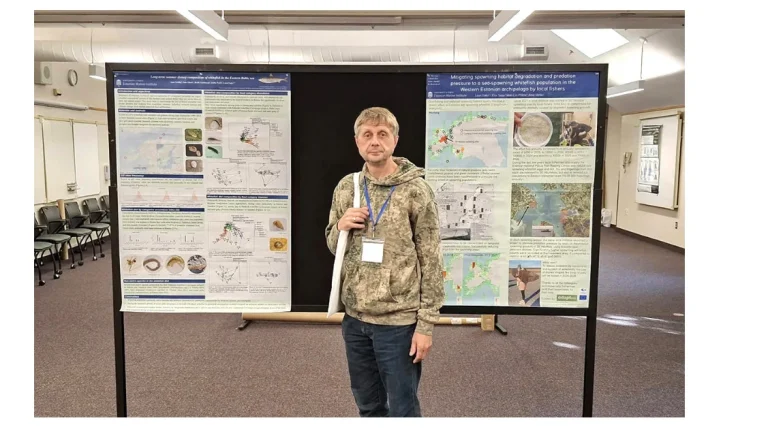
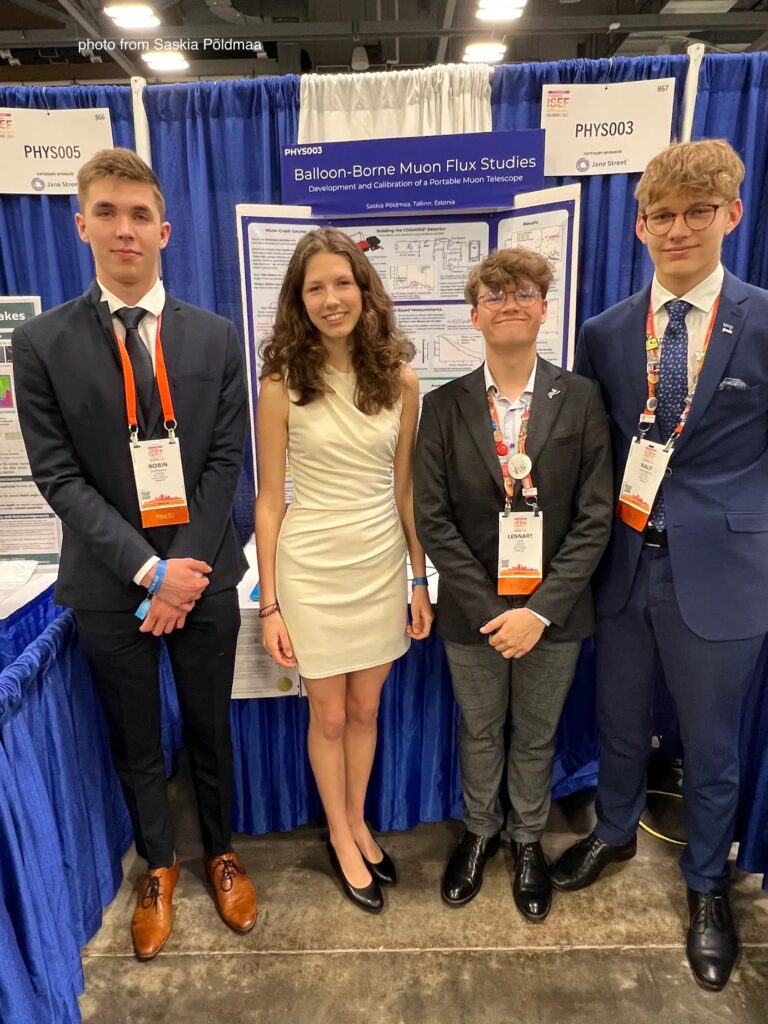
Congratulations to Saskia Põldmaa (PHYS003) and team Lennart Luud/Robin Õunamägi/Ralf Saarmets (TECA001T) for representing Estonia at this year's Regeneron International Science and Engineering Fair (ISEF) in Columbus, Ohio, USA.
Regeneron ISEF is not only a very prestigious international science competition for high school students, but it is also the world’s largest, with over sixty countries participating. It is held once a year in different cities across the United States and is known to have a relatively large percentage of participants going on to receive the Nobel Prize or other prestigious honours in their later careers.
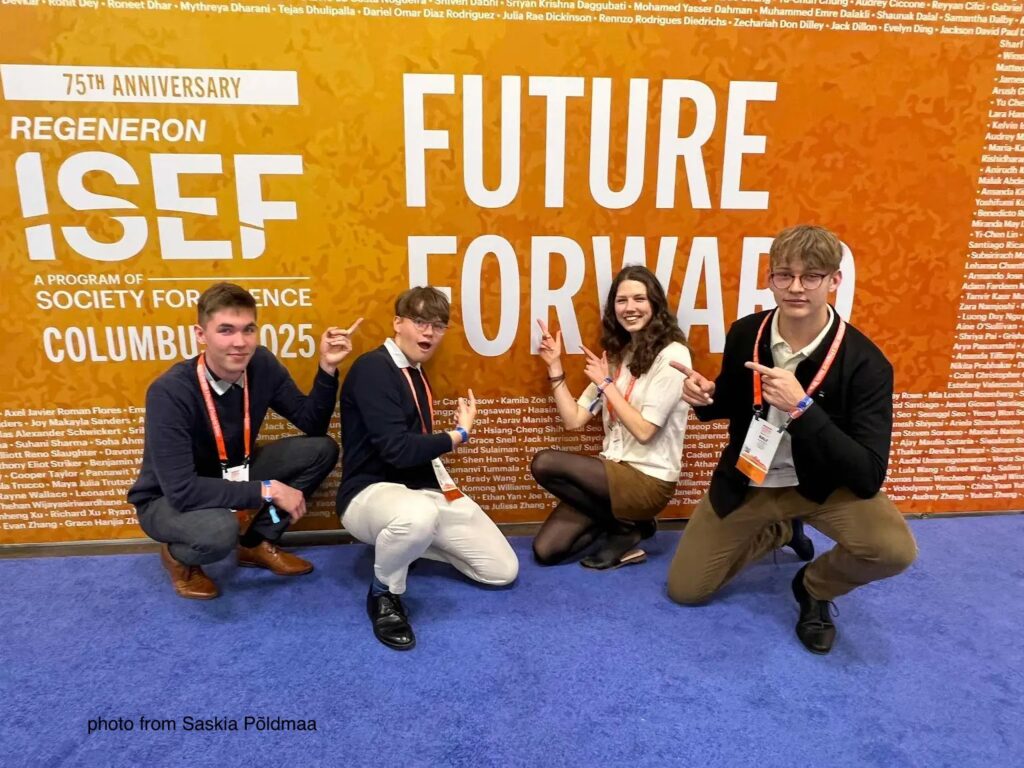
This year, Saskia Põldmaa from Tallinn Secondary School of Science (Tallinna Reaalkool) won third prize in the Physics/Astronomy category.
Her project studied cosmic ray muons, which are produced by interactions between high-energy cosmic rays and the Earth’s atmosphere. Her study presents the development and deployment of a self-constructed scintillation detector system for measuring atmospheric muon flux and angular distribution. The detector, including custom-designed electronics, was launched on a high-altitude balloon and the variation of muon flux with altitude was measured.
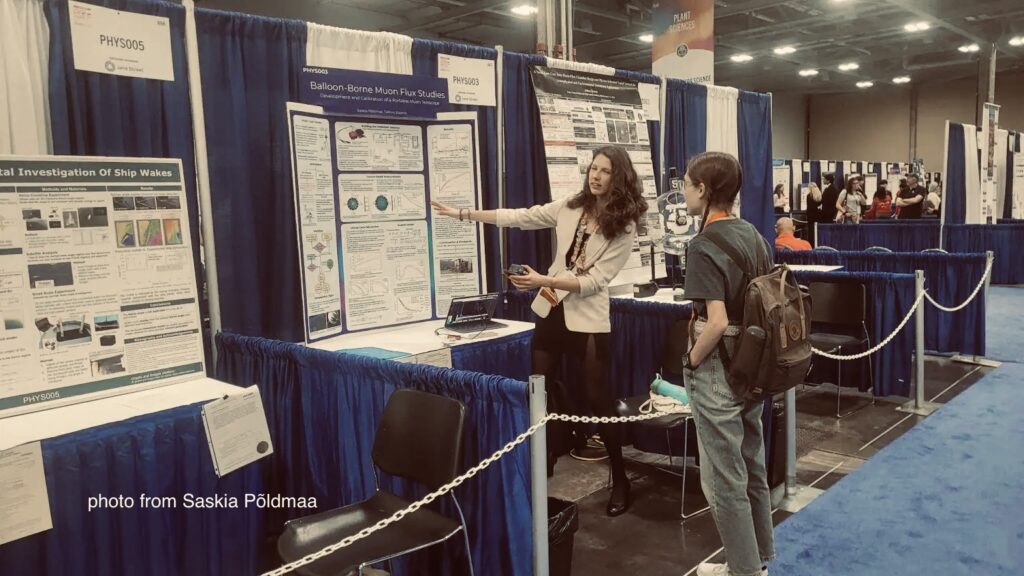
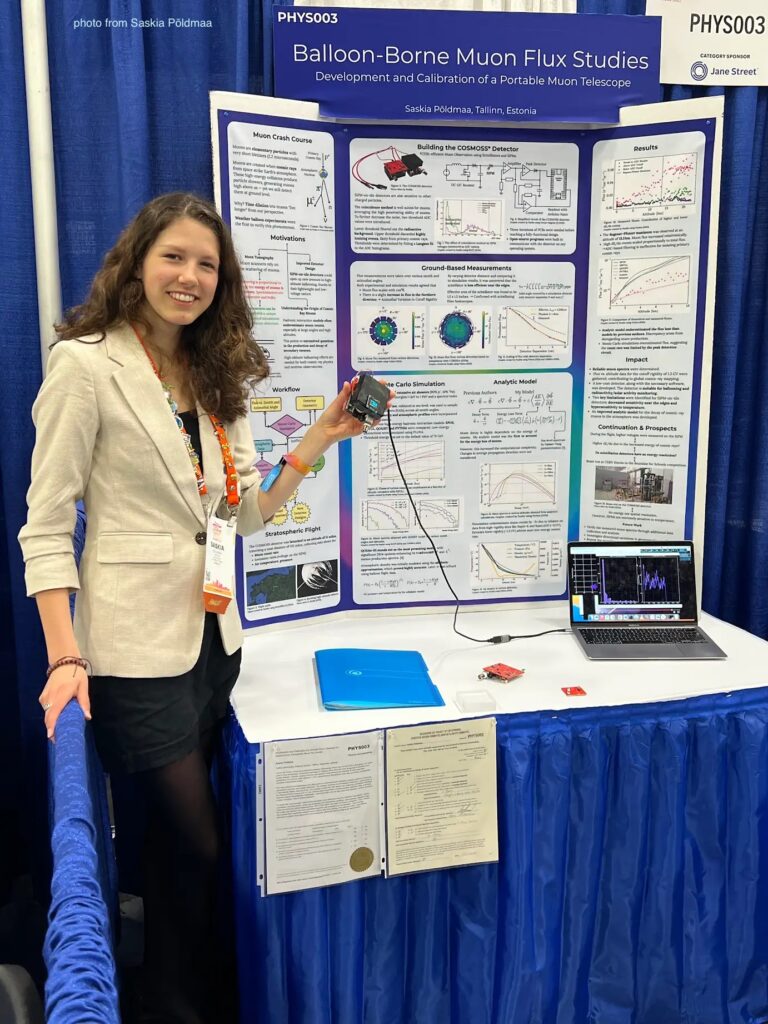
To extract the muon spectrum, Monte Carlo simulations [which “rely on random values and repeated sampling to produce potential outcomes of random processes” as defined by Encyclopedia Britannica] were performed using the CORSIKA 8 framework with CORSIKA 8 software. Various parameters, including primary cosmic ray composition and atmospheric conditions, were iteratively adjusted to best match the measured altitude-dependent flux. The FLUKA model was used for hadronic interactions.
Once a realistic flux profile was obtained, the muon momentum spectrum was extracted from the simulation. Her findings demonstrated that a scintillation detector can be used to infer muon spectra and offers a cost-effective alternative to obtain muon spectra for muon tomography, without the need for large-scale spectrometers. Her full project abstract and presentation video can be found on the ISEF website.
We were very happy to be able to connect with Saskia after the ISEF awards were announced on May 16th. Here is a short summary of her advice to students and her future plans.
Future plans in the field:
“I definitely plan to continue in physics. This fall, I’ll begin my undergraduate studies at MIT, where I intend to major in physics with a slight focus on its more mathematical side. While I’ve greatly enjoyed my current subfield—particle physics—and feel that a research environment like CERN would be a perfect fit for me, I’m also eager to explore other areas of the field. Unlike many European or Estonian universities, MIT has a strong culture of undergraduate research, offering exceptional opportunities to get involved in nearly any area of physics. For now, I’m especially looking forward to starting a project in cosmology—but I’m excited to see where my undergraduate journey will ultimately lead.”
Advice for students interested in physics careers:
“My advice would be to try participating in olympiads. Physics is often taught in schools in a way that strips it of its creativity and intuition, reducing it to just memorizing formulas. Olympiads helped me keep my passion for STEM alive. They allowed me to build a strong technical foundation and gave me the confidence I later drew on in science fairs.
Also, don’t get discouraged if the problems seem too abstract or engineering-heavy at first. I wasn’t particularly interested in them when I started, but over time, as the problems became more conceptual, I began to see their elegance. The deeper I dove, the more I appreciated not just the elegance of the problems, but also the passionate community of peers and mentors they connected me with.”
“I never expected that I’d end up contributing to the field by building my own detector or constructing simulations. Start with something small and experimental and just see where it leads.”
(Saskia Põldmaa)
Advice for future ISEF participants:
“For students hoping to participate in ISEF, I’d say: don’t be intimidated by how polished or advanced other projects might appear. More importantly, avoid an all-or-nothing mindset. In my case, I found my topic simply by diving headfirst into a challenge—I read about muons being used to verify special relativity and set out to replicate the historic experiment. I never expected that I’d end up contributing to the field by building my own detector or constructing simulations. Start with something small and experimental and just see where it leads.”
Saskia is also working on creating educational resources based on her work, which she is thrilled to share on the site saskiapoldmaa.github.io . It includes a copy of her paper (“Intrinsic Energy Resolution of Plastic Scintillator Tiles: Muon Beamtest Results”) from her recent work at CERN.
You can also view the YouTube video presentation for team Lennart Luud/Robin Õunamägi/Ralf Saarmets below: