Estonia’s pavilion, titled “Let Me Warm You,” critiques architecture that prioritizes profit and regulatory compliance over quality of life. More specifically, it questions whether Estonia’s building insulation renovations are merely a means to meet European energy targets, or if they can also serve to meaningfully improve residents’ living conditions, according to the exhibition’s website.
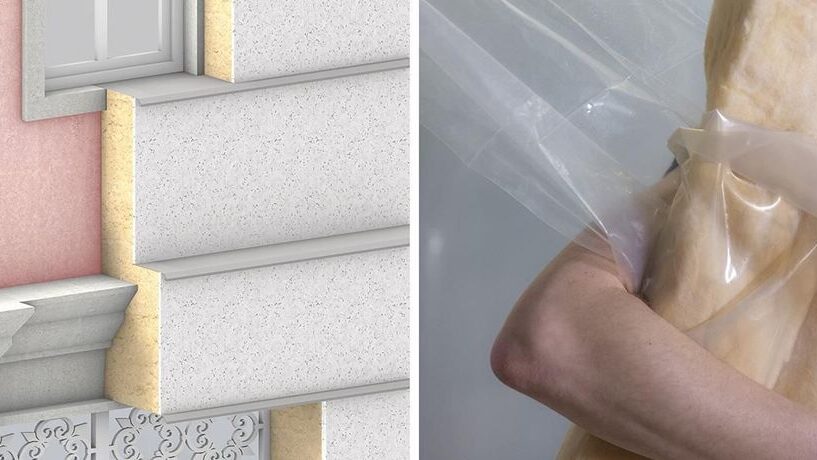
Architects Keiti Lige, Elina Liiva, and Helena Männ curated the pavilion, which combines an indoor exhibition and an outdoor façade. Both elements are housed in a waterfront building located at Riva dei Sette Martiri 1611. The pavilion’s website notes that, inside the building, the ground floor is wrapped in plastic film, hosting an exhibition showing how social dynamics between different stakeholders have an effect on spatial solutions. On the outside, the building’s façade is clad with insulation panels made from the same material commonly used in Europe for renovating housing blocks.
Both of these components were designed within the context of how Estonia is reaching its climate goals. To meet the EU’s target of transitioning to climate neutrality by 2050, Estonia has pledged to renovate its apartment buildings built before 2000 to at least energy efficiency class C—or, in other words, to upgrade 14,000 buildings by 2050, according to the pavilion’s website.
It also adds that the upkeep of these buildings is often left to the responsibility of the individual owners who form apartment associations. To meet climate targets, insulation is commonly put at the centre of these renovations for its ability to effectively reduce energy costs amidst rising temperatures.
The stark contrast between the ornate and historical Venetian architecture and the banal, newly renovated façade is a provocative critique of band-aid solutions used for regulatory climate compliance, according to the architects.
However, these renovations are purely pragmatic and come as a “quick fix.” “Decisions are typically driven by figures on an Excel spreadsheet, where euros dictate the course of renovation,” says the pavilions website. “While utility bills may fluctuate after the renovation, the overall spatial experience often remains unchanged.” The concern here lies in the fact that a lack of architectural involvement in these renovations will lead to buildings that disregard both context and character (World Architecture).
Estonia’s pavilion brings this tension to life. As a satirical commentary on climate-driven insulation renovations, the visual dissonance in Estonia’s outdoor installation is intentional. The stark contrast between the ornate and historical Venetian architecture and the banal, newly renovated façade is a provocative critique of band-aid solutions used for regulatory climate compliance, according to the architects.
As Johanna Jõekalda, advisor on architecture and design at the Ministry of Culture of Estonia, and Commissioner of the Estonian Pavilion, said: “This year’s head theme offers good ground to discuss what happens to architecture when the Architect is excluded from the process. Renovation processes that are planned by residents themselves according to their best knowledge, provide a good example of how collective intelligence, or lack of it, affects our spatial environment.” (World Architecture).
You can view more images of Estonia's pavilion on the website of the Biennale.
PAVILION CREDITS
Curators: Keiti Lige, Elina Liiva and Helena Männa
Production: Mari-Liis Vunder
Dramaturgical texts: Märten Rattasepp, Elina Liiva
Sound installation: Kirill Havanski
Graphic design: Aadam Kaarma
Concept photos: Joosep Kivimäe
Photos: Paco Ulman, Päär Keedus, Karel Koplimets,
Kaarel Nurk
Interior structural design: Neeme Külm (Valge Kuup Studio)
Organised by: Estonian Ministry of Culture
Co-organised by: Estonian Museum of Architecture
Commissioned by: Johanna Jõekalda
Text editor: Anu Rooseniit
Translation to Italian: Kristel Käär
Collaborators: Neeme Külm, Margus Tammik, Dénes Farkas, Robert Männa, Markus Puidak, Randel Pomber
This article was written by Natalie Jenkins as part of the Local Journalist Initiative.