From the 60s to the 90s, there was columnist Gary Lautens. These days, his son, lawyer and writer Stephen Lautens, continues the column tradition. Stephen’s brother, photojournalist Richard Lautens, captures high impact moments in sports and Toronto news. And now the young generation is moving up: Richard’s children Annika and Kristjan both work in journalism. Annika has recently concluded her time as the Fashion News and Features Director at FASHION magazine, during which she won an award at the 2025 National Magazine Awards for her article “Pocket Change.” And of course, journalists are very busy people. Even so, Kristjan graciously took on a slew of questions to illuminate the newspaper world, in between writing and publishing breaking news stories within the GTA: everything from crime and events to sports, health, and transit.
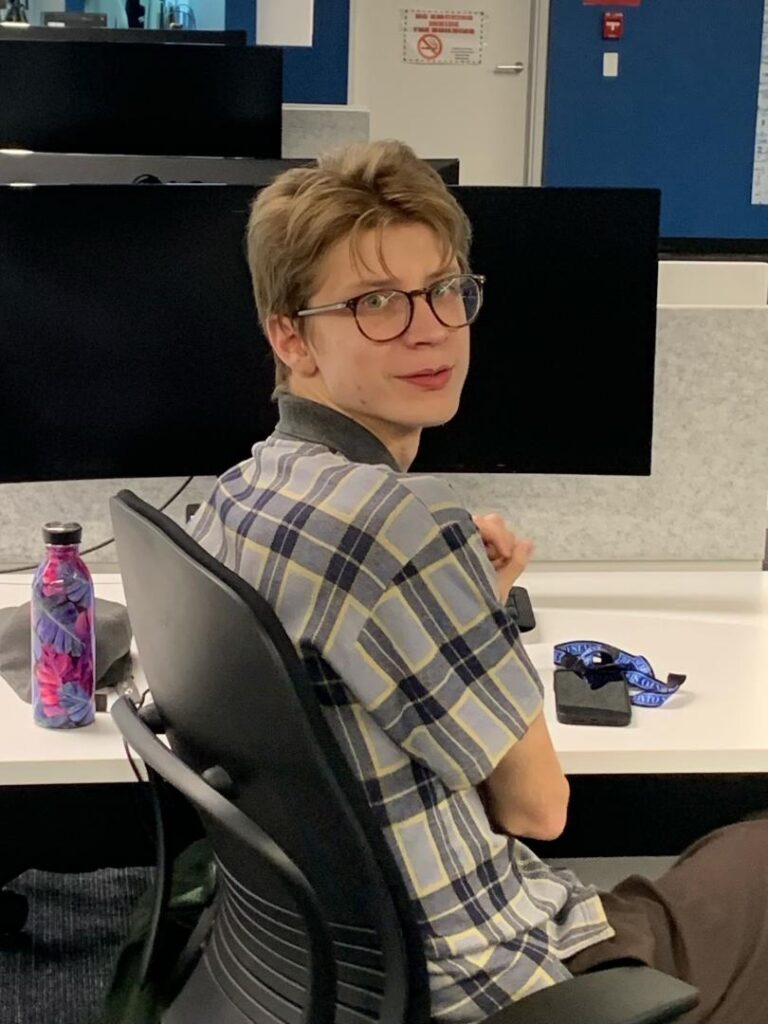
For Kristjan, storytelling is a cornerstone of his professional identity, cultural roots, and personality. “I’ve always been obsessed with stories and knew storytelling had to be part of my life in some way, which is why I’ve been so enamoured with journalism,” he explains. His Estonian heritage, through his mother Sirje Järvel, has also shaped him. Values like egalitarianism, care for community, closeness to nature, and the value of work-life balance. Values that ground him.
A connection to Estonia is also partly thanks to this very newspaper you’re reading. Reminiscing about the copies of Eesti Elu that were regularly spread across the table at home, he notes how he“always appreciated that there was a way to connect with the Estonian community in Toronto,” Traditions played a role, too: pouring wax (a substitute for molten lead) to tell fortunes on New Year’s Eve. Celebrating Christmas on the 24th, rather than the 25th, by going to the cemetery before church. And also gathering with the community at St. Peter’s church. “As a child, it made me feel part of a big, welcoming culture and connected me to my grandparents, who lived in Eesti [Estonia].” Even the food remains memorable—though he jokes that blood sausage and sauerkraut were “always tough sells.”
If partaking in one’s heritage is gentle and comforting, the newsroom of the Toronto Star where he worksis anything but. Reporting from this hive of activity, Lautens describes its “buzz of reporters rushing around phones ringing, sprinting out the door when something big breaks.” His beat is crime and breaking news, which often means long days of chasing details, balancing official sources with eyewitness accounts, cold-calling strangers, and quite literally knocking on doors. “You can never predict when something big, like the Pearson plane crash, will happen, which can be both exciting and anxiety-inducing.” Having been at the paper for a year, Kristjan recently signed a new contract that will expand his role into different sections of the Star and longer-form stories.
“Newspapers should always aim to give a voice to the voiceless—and I think that’s why most reporters get into the industry.”
(Kristjan Lautens)
It takes a specific personality to thrive within a tornado of time-sensitive news, but evidently Lautens is hooked, stating “There is a real rush in covering stories that are breaking in real time and trying to decipher what’s true and what’s noise.” In that coverage, he most enjoys speaking to people and giving them a chance to share their stories with a larger audience. He doubles down on the meaning of it all, with an egalitarian mindset: “Newspapers should always aim to give a voice to the voiceless—and I think that’s why most reporters get into the industry.”
With a surname that denotes a legacy in Canadian journalism, one wonders how much family influenced his choice of career, and of his sister at that. Kristjan says, “I think everyone is influenced by what their family does in some way… Growing up, my family had lots of discussions about current events. I was always drawn to my dad being able to attend whatever the biggest talking point of the city was—whether it was a G20 Summit, a major crime, playoff hockey, or TIFF. He always talked about how everything he did was interesting on some level because someone had to read it.” With that in mind, what niche would he cover as a writer if he was given unlimited time and resources? One theme that first piqued his interest at Carleton University is the intersection of politics and sports, which showed him how much policy impacts the sporting world and its athletes.
“Around the dinner table, there was lots of pressure to spin your yarn in an entertaining way before people moved on, so you had to learn to be quick.”
(Kristjan Lautens)
Lessons from a lineage of storytellers continue to guide him. From his grandfather Gary, it’s brevity and wit. “Get to the point and do it in a funny way,” Kristjan insists. “In journalism there’s a big emphasis on writing short sentences, short paragraphs, short stories… that’s something my grandfather spent his entire career pursuing. Around the dinner table, there was lots of pressure to spin your yarn in an entertaining way before people moved on, so you had to learn to be quick.”
But while Lautens honours tradition, he’s also open about the future of the craft and his craving to push things forward. “I’ve always been passionate about journalists being transparent about where they stand,” he says. The expectation of pure neutrality, in his view, is unrealistic. “People have inherent biases and leanings. It’s more important to be forthright about what those are rather than trying to hide them. Perfect journalism is fair and accurate, not necessarily neutral.”
At a stage in media history when the veracity of information we consume has to be questioned more than ever, there’s a sense of relief that an up-and-coming journalist like Kristjan is all at once a realist, in touch with humanity, and a communicator who bases his writing on unshakeable principles.