
In Tallinn, there are eight city districts. See the table below. The number of eligible voters in a district determines how many seats or mandates arise from that district. If one looks at the table below, one will see, for example, that in the district of Haabersti (the first entry), there are 37,000 eligible voters, with all voter numbers rounded to thousands. The voters of Haabersti will send nine council members to the Tallinn City Council. Think of this as a parliament, if following the aforementioned analogy.
| City district of Tallinn | Number of Eligible Voters | Seats in Tallinn City Council |
| Haabersti | 37 000 | 9 |
| Kesklinn (city centre) | 49 000 | 11 |
| Kristiine | 25 000 | 8 |
| Lasnamägi | 78 000 | 14 |
| Mustamäe | 49 000 | 11 |
| Nõmme | 29 000 | 9 |
| Pirita | 15 000 | 7 |
| Põhja Tallinn | 43 000 | 10 |
| TOTAL: 79 |
In the end, it is simple math. For a party or a coalition of parties to govern, they need to have at least forty seats to govern in Tallinn, as there are seventy-nine total seats in the Tallinn City Council.
Compared to the last local elections that were held in 2021, the term “eligible voters” has been changed by the Estonian Riigikogu (Parliament). Previously, all registered local residents could vote in local elections (although not in state elections). However, according to amendments made in 2025 to the election law, starting with the local elections in October 2025, only Estonian and European Union citizens could vote in the local elections. Russian citizens who are resident in Estonia can no longer vote. This had the greatest impact on the district of Lasnamägi, where in the 2021 municipal elections, there were 91,764 eligible voters, but in the October 2025 elections, there were only 78,176 voters in that district.
During the country-wide local elections held on October 19th, 2025, there were 1,003,829 eligible voters and 59.2% of eligible voters voted (compared to 54.7 % in 2021 and 53.3% in 2017). 46% of votes were cast using electronic voting and 54% by paper ballots. In Tallinn, 60.5% of eligible voters voted, and 45% voted electronically. In other words, voter activity was slightly higher than in the past, and the voter activity and the method people used to vote was very similar across Estonia, including in Tallinn.
The results of the municipal elections in Tallinn were as follows:
| Party (in Estonian, “erakond”) | Number of seats in Tallinn City Council |
| Eesti Keskerakond (Centre Party of Estonia) | 37 |
| SDE (Social Democratic Party) | 17 |
| Isamaa (Fatherland) | 11 |
| Reform Party of Estonia | 8 |
| Parempoolsed (Right leaning party) | 6 |
Of the eight districts, six were won by the Centre Party (the other two by the Social Democratic Party). In the district of Lasnamägi with a large Russian-Estonian population (by far the largest of the electoral districts), the Centre Party won overwhelmingly, with 73.5 % of the total vote, taking nine of the eleven seats.
It was a surprise to many observers that EKRE (the Estonian National Conservative Party) did not obtain enough votes to pass the threshold to enter the Tallinn City Council (it obtained only 4.5% of the votes of residents of Tallinn, while it needed 5%). It should also be noted that Eesti200, the party in the state-wide government coalition, and previously a member of the governing coalition for the city of Tallinn, did not pass the minimum threshold of votes needed to enter the Tallinn City Council (it obtained only 2.8% of all votes given in Tallinn).
At the time of writing, it is more likely that the latter option will prevail (a coalition of the Centre Party and Isamaa). There has not been any discussion about who would be the next mayor of Tallinn.
As of October 27th, 2025, the five parties that will form the Tallinn City Council are in “horse trading” to see who will rule the City of Tallinn. No one party has a majority of seats in the Tallinn City Council to rule by itself. Two options are being discussed. One is a grand coalition among all parties except the Centre Party of Estonia. The idea is to keep the Centre Party, which ruled in Tallinn from November 2005 to April 2024, out of power. The other is a coalition between the Centre Party of Estonia (Keskerakond) and Isamaa. At the time of writing, it is more likely that the latter option will prevail (coalition of Centre Party and Isamaa). There has not been any discussion about who would be the next mayor of Tallinn.
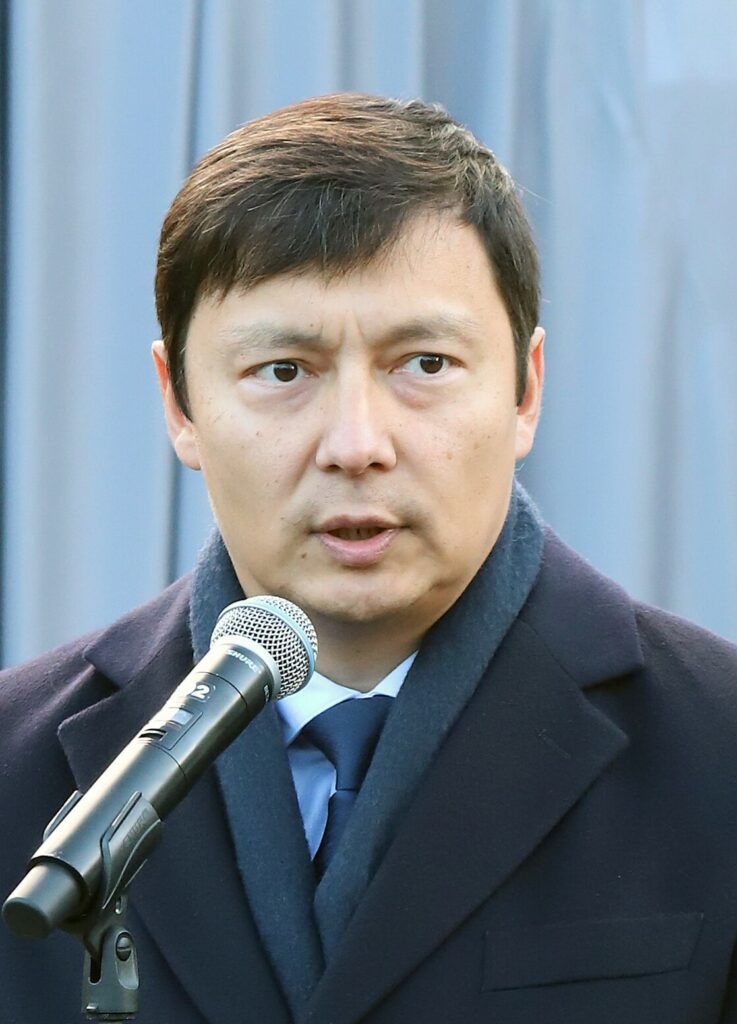
The Centre Party’s present leader, Mihhail Kõlvart, was Mayor of Tallinn from April 2019 until April 2024. In these municipal elections, he also received the most votes of any politician in Tallinn. He received 26,531 votes (in the district of Lasnamägi).
The Centre Party was at its peak (or perhaps nadir is a better word) of corruption when it was run by Edgar Savisaar (1991-2017).
Isamaa faces a difficult choice in deciding whether to form a coalition with the Centre Party. Isamaa’s motto is (taken from their homepage and translated into English): “Isamaa is a political party that is based on a national-conservative worldview, democratic principles, and carries patriotic and Christian values.”
The last three general secretaries of the Centre Party have all been convicted of corruption, including most recently, Mihhail Korb, who was general secretary of the Centre Party when Mihhail Kõlvart was Mayor of Tallinn. Although Mihhail Korb was criminally convicted of corruption, the Centre Party did not revoke his membership. The examples of corruption convictions or corrupt practices by Keskerakond are too numerous to list here.
Those with a longer memory will recall how the 2012 yearbook of the Estonian Internal Security Service (“KAPO” or Kaitsepolitsei) stated that “Kõlvart actively co-operated with the Russian Federation and the Russian Embassy in Tallinn, to work against the Estonian Government’s position to reduce Russian language teaching in Estonia. This allegation was actively discussed at a KAPO press conference in April, 2013. Kõlvart sued KAPO for the allegations in the yearbook and the discussion at the press conference. Kõlvart lost at trial, and on appeal (and leave was not granted to appeal to the Estonian Supreme Court).
So Isamaa and its leader Urmas Reinsalu must decide: spend the next four years trying to work with an unruly four party coalition (very similar to the problematic four party coalition that presently exists and has existed since April 2024), or to hold one’s nose at the stench of the Centre Party, but be in power. Perhaps the bigger question is: how will Isamaa’s patriotic voters react to “signing a pact with the devil,” and will Isamaa be punished for this “sin” in the next federal elections, to be held in 2027?
Good readers, stay tuned for how Isamaa decides.