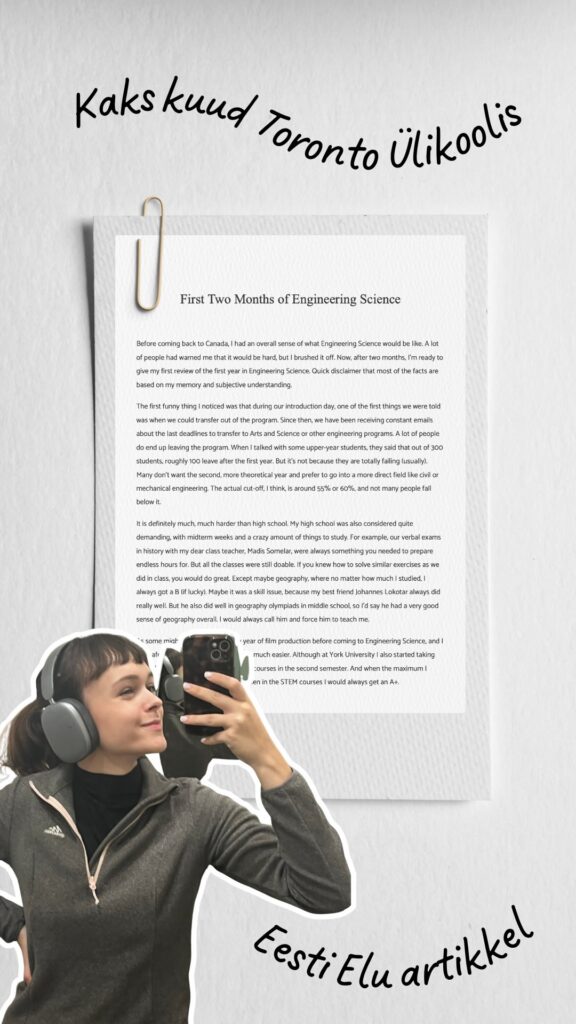
The first funny thing I noticed was that during our introduction day, one of the first things we were told was when we could transfer out of the program. Since then, we have been receiving constant emails about the last deadlines to transfer to Arts and Science or other engineering programs. A lot of people do end up leaving the program. When I talked with some upper-year students, they said that out of 300 students, roughly one hundred leave after the first year. But it’s not because they are totally failing (usually).
Many don’t want the second, more theoretical year and prefer to go into a more direct field like civil or mechanical engineering. The actual minimum passing grade, I think, is around 55% or 60%, and not many people fall below it.
It is definitely much, much harder than high school. My high school was also considered quite demanding, with midterm weeks and a crazy amount of things to study. For example, our verbal exams in history with my dear class teacher, Madis Somelar, were always something you needed to prepare endless hours for. But all the classes were still doable. If you knew how to solve similar exercises to the ones we did in class, you would do great. Except maybe geography, where no matter how much I studied, I always got a B (if I was lucky). Maybe it was a skill issue, because my best friend Johannes Lokotar always did really well. But he also did well in geography olympiads in middle school, so I’d say he had a very good sense of geography overall. I would always call him and force him to teach me.
“… there have definitely been many days where, in addition to being in classes from nine to five, I spent more than six hours studying and still felt behind on many projects, simply because there are so many.”
As some might know, I also did one year of film production before switching to Engineering Science, and I can safely say that film production was much easier. Although at York University I also started taking many STEM courses instead of my film courses in the second semester. And when the maximum I could score in film courses was an A, in STEM courses I would always get an A+. In the Engineering Science program, getting good grades is much harder. The tests are built to challenge you and to measure intellectual capability. I’ve heard that the faculty aims to keep test averages in the 70s, and when, for example, a midterm has a median score in the 80s, then the final exam will have to be very hard to bring the scale back down. I don’t remember the exact numbers, but I think about 50% of questions are similar to what you do in class, a smaller portion requires a bit more thinking, and the last differentiator between an A and an A+ is something that really distinguishes students who are strongest in the subject.
The workload overall is pretty daunting. In the beginning of the year, I used to ask upper-year students, “How much do you usually study every week?” and they would just give a general answer like, “It depends on the person and time and blah blah blah.” But now I’ve seen that it can get very bad very quickly. I was tracking the hours I studied each day in the beginning of the semester, and there have definitely been many days where, in addition to being in classes from nine to five, I spent more than six hours studying and still felt behind on many projects, simply because there are so many.
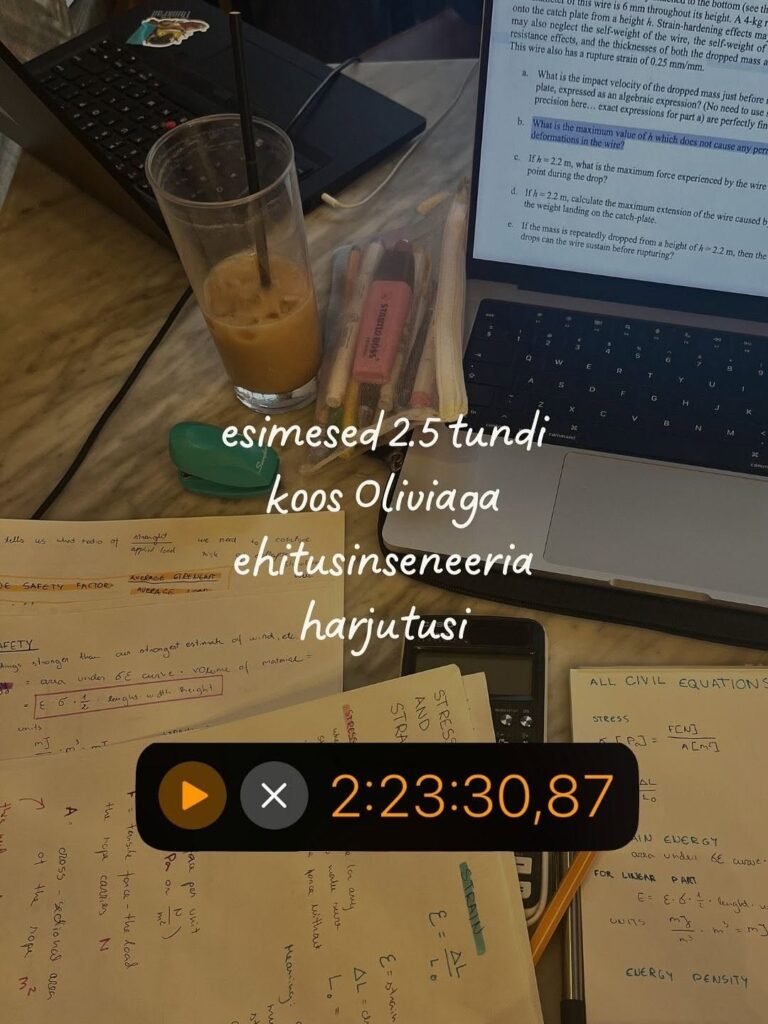
In high school, I really thrived in extracurricular activities, but now I’ve been trying to keep them to a minimum, because the worst feeling is doing poorly in all the things you’ve promised to do because you don’t have time for any of them. I think I still need to work on creating a life plan that fulfills all of my goals, because many of these outside-of-school activities build skills much more than knowing different calculus proofs (which are also very interesting). There is no definite conclusion yet about the best balance between school and extracurriculars, so maybe I can give more advice after this first year.
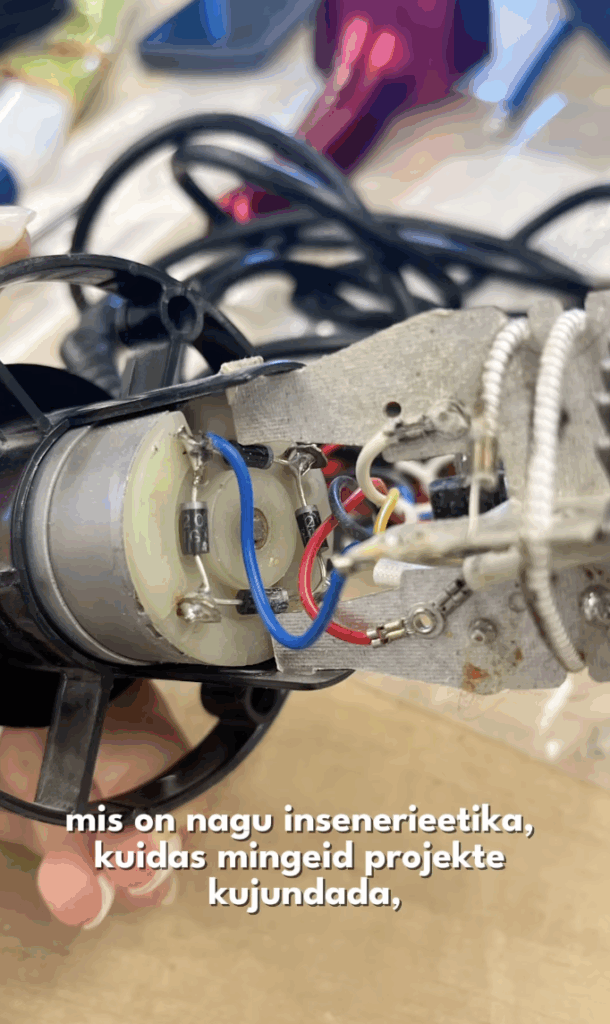
I joined the NeuroTech UofT neuroscience subsystem, where we are researching different motor rehabilitation systems for after strokes, specifically on how to make gloves that make rehabilitation quicker and the hardware team will build it. I also really enjoy my job at VEMU, and the team is so sweet that I’m always happy when we have events and team days together. My coworker Maiki is someone I often study with. She even took care of my plant in the summer when I was in Estonia. There are lots of positive connections within the Estonian community.
Overall, I would say that I’m really enjoying Engineering Science. We had a meeting with many people who manage the program and some students who gave feedback, and it’s comforting to see others are in the same place as you. The professors are all super amazing. For example, my physics teacher gave a whole motivational talk about resilience after the first midterm, and the overall vibes are really high.
Sometimes you do hear “jokes” that make you roll your eyes. One professor said something like, “What do you mean you don’t have enough time? There’s plenty of time between 12:00 a.m. and 8:00 a.m.” Another one said that maybe it’s not possible, but we should try to sleep at least five hours a day. Is the expectation really that we study so much every day that we can only sleep five hours? That’s a bit crazy.
One of our teachers always says, “Don’t worry, you’re not supposed to understand what I’m talking about in this lecture anyway. There’s not enough time. But at least you’ll know what to look into when you get home.”
Another teacher called our reading week a “study week” and said that we should try to catch up on everything during this week. He said it’s probably not possible to get ahead, but at least we should catch up.
It’s fun. There’s a lot of joking about the workload, but the teaching team is really sweet. All our lectures are funny. One of our teachers always says, “Don’t worry, you’re not supposed to understand what I’m talking about in this lecture anyway. There’s not enough time. But at least you’ll know what to look into when you get home.”
We’ve definitely covered more material in two months than I thought was possible. It’s very interesting as long as you keep up. I’d say that pre-reading and watching pre-lectures should be mandatory for everyone, because otherwise it gets confusing very fast.
I feel like this article has focused a lot on how big the workload is, but overall, what I want to say is that I’m really happy I ended up in Engineering Science. Maybe the overwhelming joy about the program comes from the fact that it’s the first Monday of reading week or “study week,” and during a week full of exams I might be a bit more grumpy. But I really feel like the program is pushing me a lot and making me value my time, structure, and activities more.
[Keep up with Monika’s videos about her program by following her page @monikastudies on Instagram!]