Interview by Natalie Jenkins
How did you first discover Plixid and what made their music stick with you?
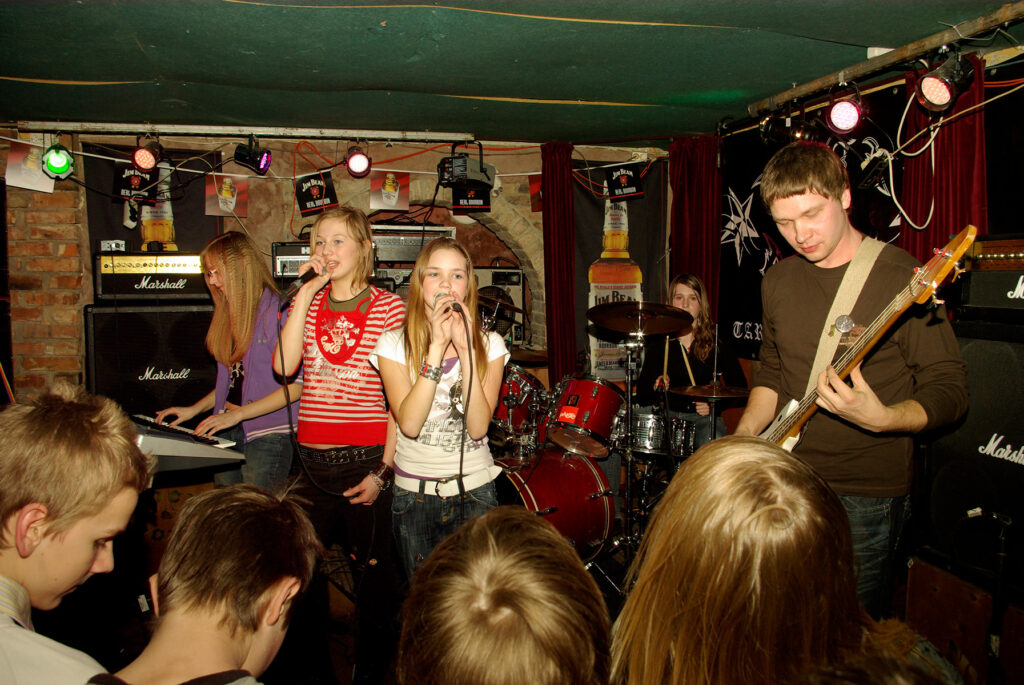
I discovered Plixid when I saw the performance on Estonian national television in 2008. At the time, I was already twenty years old. I was studying art history at the Estonian Academy of Arts, where I did my undergrad. And of course, as an art school girl, I was immediately drawn to Plixid’s whole aesthetic because it was so unique and funny. It was ironic; sort of self-referential. They really didn't seem to care what anyone thought of them. I just loved the whole vibe, especially because they were performing on a regular morning TV show; you don’t often see something so out of the box.
Of course, Plixid were represented in a context where these Estonian underground music promoters were advertising their upcoming event, which was also an underground experimental music event. So on that note, I definitely was not the person who discovered Plixid by any means, because they already had many fans—some Gen X music critics, for example, or people maybe about ten to fifteen years older than me who were organizing events at the time. I will say, though, that they were mostly all men, because Estonian underground music, especially back then, was more male-centric.
So I'm very excited and also proud that, as a fellow female artist, I was able to recontextualize this work and sort of bring it back. But at the time, I was just blown away by the fact that they were on TV, and I was like, “where did these girls come from?” And then it turned out that they’re from a village about ten minutes from where my grandma used to live, in Otepää in southern Estonia. So the project is personal for other reasons as well, because I’m also Southern Estonian.
“… it doesn't really matter what scene you participate in. If you have an idea, sometimes it’s easier than you think to make it happen. It’s just about saying the idea out loud, or daring to say it out loud, even if it’s something obscure or niche.”
(Maria Minerva)
What made you decide that now was the right time to bring Plixid’s songs back to life?
I wanted to bring back the music because I had just been thinking about it for a long time. I think people who live and breathe music, like myself and my friends, never forget something that really struck them. I guess the right time could have been sooner, but I started graduate school at UCLA, and I realized that in the business world—or the underground music world—it doesn't really matter what scene you participate in. If you have an idea, sometimes it’s easier than you think to make it happen. It’s just about saying the idea out loud, or daring to say it out loud, even if it’s something obscure or niche.
Jokingly, I will say that in business school we focus on things that actually turn a profit, and underground music is not one of them. But of course, I’m not in it for the money—never really have been. I guess it must have been one of those nights where I was re-watching their old songs on YouTube and thinking, “why is this not on streaming?” That was probably my number-one question, because there was nothing on Spotify except one song that came out on a compilation in 2010. I was like, how can we fix that? Or who should fix that? And I was like, “I guess it’s going to be me.”
I reached out to the girls on Facebook. We developed a group chat over the course of one evening. Then we met on Zoom, and I presented my idea along with a professional marketing plan, because I was pretty realistic from the get-go that this was not going to be a Billboard Top Ten-type release. It was always going to be underground. I wasn’t going to make any promises regarding profits or the kind of coverage we were going to get. But what I could promise was that I 100% believed in this release. I think the music is legendary and iconic.
Were there any challenges in restoring or mastering the material while preserving its DIY sound?
We remastered all the songs because they were of varying quality, especially in terms of different volume levels, so that was a problem. But other than that, we didn’t really do much with them. You can hear that they’re lo-fi recordings, although some of the tracks were recorded at a professional studio in Tartu. I think that speaks to the fact that Plixid were active for a long time—about five years—playing shows and even getting some music recorded.
But in terms of the era when the music was made, it was right before social media blew up, right before digital streaming and alternative publishing platforms. There was no digital infrastructure, really. At the time, they never put out a release.
Getting the songs themselves wasn’t that hard, because they were recorded at a time when people were already using computers daily, and they had hard drives with old files and things like that. So it was easy to get my hands on the files. For the remix I made for the song “Lifestyle,” I used AI, because we didn’t have the stems. I had to extract the girls’ vocals from the song using AI. So in that sense, I was able to use modern technology.
What were the roles of your collaborators?
This release would not have been possible without my friends and collaborators. Number one would be Kadri-Ann Kivisild, who did the graphic design and came up with the iconic artwork for this release. I think it’s really evocative. In her work, she tried to evoke that early-2000s Windows XP operating system era, but also the aesthetic of children’s drawings—the sky, the ground, bold colours. I think it turned out really well, because it captures something essential about the spirit of the release.
I also worked closely with my mastering engineer, who really helped us fix the quality of the songs. I bounced ideas off my father, who’s a writer and an Estonian music critic. He has done a great job promoting the music now that the release is out. He encouraged me to do it, because he’s had a public-facing media career his whole life and knows that whatever you do, some people are going to love it and others are going to criticize it. Doubt aside, you should just do your thing.
Ines Daferrari was also essential to the project. She makes really catchy pop, she raps, and her lyrics are so funny. I feel like that’s something she has in common with Plixid: the attitude, the lyrics, and the fact that the music is a bit irresistible because it carries so much spirit. So when I was thinking about who would be a good remixer, I immediately thought of her. I was really excited that she agreed to be part of this project, because she brings it into the present and closes the loop generationally. I think it’s really cool to have different generations of Estonian women artists involved in this project.
The Plixid members are not interested in doing media or being in the public eye—they’re focused on their lives, and I completely respect that. I’ve been happy to let the music speak for itself, and I think it actually adds to the mystique and mystery of the release.
Switching now to your label—can you talk about how Viis came to be?
For my label, I don’t have super-ambitious plans, although I already have two releases planned for next year, hopefully. I’m busy with work and graduate school, so I want to focus on projects that are really meaningful to me and that genuinely warrant the emotional and financial investment, because putting out music is a lot of work, even if it’s a small release.
The label was really born out of necessity. I was like, well, if I’m putting out this Plixid release, there needs to be some sort of platform for it. We’ll see where it goes. I’d love to have a combination of my own releases and maybe other interesting reissues. Of course, I’d love to focus on Estonian or Eastern European artists, women, or underrepresented artists—geographically, but also in terms of who they are as producers.
If anyone reads this article and wants to send me a demo, I’m really open to that. I don’t think it necessarily matters when the music was made or who made it. It would be an honour to find more projects like this, or for people to reach out. Until then, I’m going to pace it and see what’s realistic.
“I 100% think Plixid belongs in Estonian feminist punk history. I would go as far as to say that Plixid are legends, similarly to artists like Onu Bella or other Estonian pop-music heavyweights who had humour in their work and have become national treasures.”
(Maria Minerva)
Brigitta Davidjants described Plixid as “pure riot grrrl.” How do you see their place within Estonian feminist or punk history?
Brigitta was involved in this project in the sense that I asked her to provide commentary and a quote for my press release, which she happily did. I love that she framed the music as part of the riot grrrl universe, because I think it’s very fitting. I 100% think Plixid belongs in Estonian feminist punk history.
I would go as far as to say that Plixid are legends, similarly to artists like Onu Bella or other Estonian pop-music heavyweights who had humour in their work and have become national treasures. I would honestly say Plixid are a national treasure.
It also makes sense because there’s a broader Y2K revival going on. For someone like me—I’m 37 now—it’s funny, because in 2010 or 2011 the whole 2000s vibe felt so out of fashion. Everything about it seemed goofy as we exited that era. But now it’s back. Being back in graduate school and hanging out at UCLA with undergrads and younger people, everyone is basically dressed like Plixid. Everyone looks like a Y2K influencer.
I think Plixid fits perfectly into this revival. Younger generations are much more accepting—culture has moved away from mocking women or young women. Instead, people are saying, “Wow, this is so cool.” I love that there’s less judgment and more appreciation for uniqueness, beauty, and different kinds of music.
Back in the day, Plixid did receive a lot of criticism. So I’m really excited to see how today the reception is overwhelmingly positive. It shows that culturally, we’ve moved forward in how we talk about young women’s self-expression.
How has working on this project changed how you think about the Estonian DIY scene?
I hope young artists see that the internet offers plenty of opportunities to showcase their work internationally, even if you don’t live in a major music hub like New York or London. But overall, I think Estonia has a very high concentration of amazing artists. I would mention Ajukajar, Raul Saramets, Mart Avi, Lolina, NEW YORK, Robert Nikolajev, Ruutu Poiss, Music For Your Plants, there’s so much… If anything, I hope Plixid’s reissue makes someone think, What’s going on in Estonia? Who else is coming out of there? And maybe they’ll look up more music from there, too.
~~~
Plixid is available to listen to on any major streaming platform!
Responses have been edited for clarity and length. This article was written by Natalie Jenkins as part of the Local Journalism Initiative.