(Interview by Natalie Jenkins)
What have you been up to since growing up in the Estonian community?
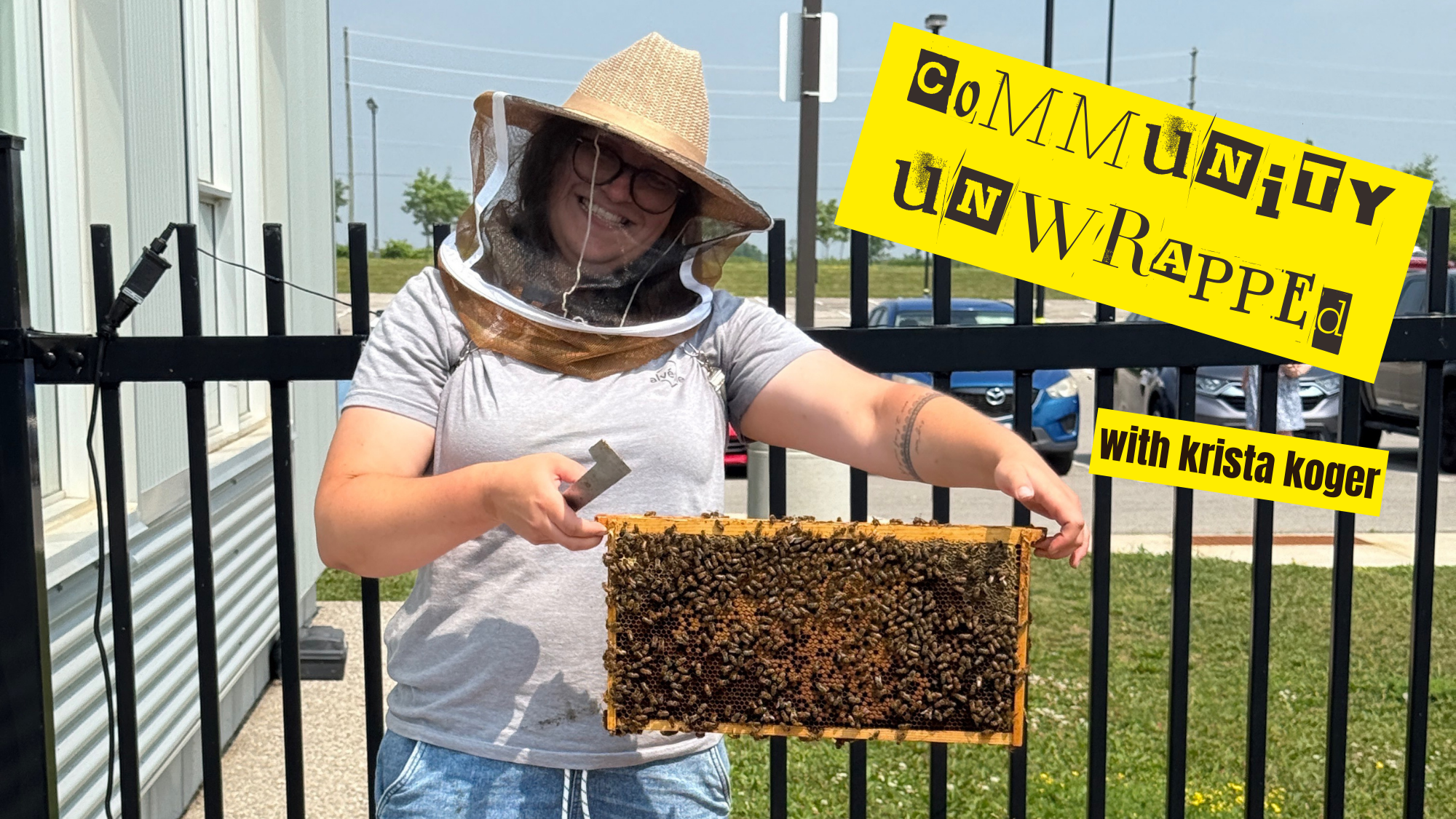
I was working in film for the last eight years, and now I’ve transitioned to beekeeping. So, in 2019, I was on the board of directors at Seedrioru and got a late-night email that they’d found bees in the wall of the Red House, where the toddlers sleep. They hired a beekeeper to cut them out, and the email said, if somebody shows up while they’re cutting them out, they can keep the bees. So I said yes. I went on Amazon and ordered Beekeeping for Dummies. I had bees in my yard before the book arrived. Then, I was asked if I’d be willing to become the beekeeper of Seedrioru, and over the last six years I’ve slowly expanded to the point that it’s now my full-time job and career.
Did you have an interest in bees before that?
No. I had to learn everything from scratch, basically overnight. When those bees arrived, I was just trying to stay one chapter ahead in the book, learning as I went. And luckily the following year was 2020, so I had the time to really dive headfirst into it.
How long did it take to get the hang of it?
The more you work with bees and are around them, the more you understand them. My first year, I fully admit, I had no idea what I was doing. I got lucky with good mentors and great land for my bees to forage on. You can’t just put a hive in your backyard and forget about it anymore. It won’t work. You have to learn from others. I’m now on the board of directors of the Ontario Women’s Beekeeping Network—a Facebook group of about 2,800 women—and we also get together once a year for a women’s beekeeping camp.
In many Canadian regions, you’re looking at about a 50-50 survival rate. But bees replicate quickly: you can boost colonies and split them into two, three, or four colonies. Then it’s caring for those hives, and finally the harvest.
What does a typical day look like for you?
I work for an urban beekeeping company called Alvéole. We put beehives in urban spaces, mostly on rooftops around the city. In Toronto, there’s a little over 350 beehives that nobody knows are there if you just look up. My clients range from corporate properties like malls to libraries, business plazas, condo buildings, apartment buildings, and retail buildings. In the spring, I make sure everything survived winter. In many Canadian regions, you’re looking at about a 50-50 survival rate. But bees replicate quickly: you can boost colonies and split them into two, three, or four colonies. Then it’s caring for those hives, and finally the harvest. I’m not in it for the honey. I’m in it for the bees. Pollination and the environmental factors are what make me want to do this. Honey is a bonus. I typically leave them with more honey than necessary, because I’d rather them do well. I usually don’t harvest until June or July and it’s small, but by August/September it can be hundreds of pounds coming in per week.
Wow! How many hives is that coming from?
Personally I was sitting at ten hives last year, and I also had twenty-six hives for work, so thirty-six total. From about thirty-six hives, I got over 900 pounds of honey. But last year was an awful year, as we had a drought from June through September. Everything looked okay from the outside, but it was so dry that plants weren’t producing nectar. Colonies were still growing because it’s the babies that eat the pollen, but there was just no honey coming in for most of the summer.
Can you explain the pollination process?
Flowers produce nectar specifically to attract pollinators like bees, butterflies, and moths. I like to say, “the fuzzier the bee, the better the pollinator.” When honeybees climb deep into flowers, their bodies get covered in pollen, which they spread from plant to plant. This process supports not only fruit and vegetable production but the reproduction of many plants. Of the 200 most-eaten crops, about 150 are bee-pollinated, so bees are truly a staple in our food chain. If we continue losing these species, the food chain falls apart with them. Some foods rely on very specific pollinators. For example, the wasp that pollinates vanilla is now nearly extinct, meaning all vanilla must be hand-pollinated in a lab.
Some species rely on environments we’ve unintentionally destroyed. For example, many queens overwinter in the hollow stems of plants. When people rake their lawns and remove that material, there may be no solitary queen left in the spring, which means no bees.
I’ve heard the phrase “Save the bees.” What’s happening to them?
In a nutshell, bees have a lot working against them, and it’s difficult to pinpoint a single cause. One controversial factor is that honeybees are actually an invasive species and there’s ongoing debate about whether they outcompete native bees. However, they’re also the only bees willing to live in hives, which makes them easier to study and turns them into an indicator species for the health of other pollinators.
A lot of the decline comes down to habitat and the ability to breed. Some species rely on environments we’ve unintentionally destroyed. For example, many queens overwinter in the hollow stems of plants. When people rake their lawns and remove that material, there may be no solitary queen left in the spring, which means no bees. Quite frankly, some people are even burning yard waste without realizing it’s full of bumblebees.
My company samples honey to analyze a two-kilometre foraging radius, allowing us to identify plants, environmental contaminants, heavy metals, and larger issues like monoculture or invasive species. It’s incredible how much data honey can provide.
One great example was the Cotton Factory in Hamilton (where the Hamilton Estonian School does their programming). They had bees on their roof, and the bees produced a very strange-smelling, almost dark black honey they’d never produced before. Lab samples were taken and they figured out the bees had gotten into a vat of root beer syrup for making soda. They consumed it and converted it the same way they do with nectar… producing a very strange honey.
Do you think the honey would taste like root beer?
I did taste it—and it did. The flavours were definitely weird, because honey is developed in the enzymes of the gut of the bees. So when something that’s already a finished product like root beer undergoes another chemical conversion, the flavour changes. It was extremely unique.
What’s been the most rewarding part of this work?
Seeing the kids at camp get excited in the morning to put fresh honey from 200 feet away on their toast, and seeing them lose their fear of bees. Growing up, I was terrified of bees. My first time ever handling bees was walking into the Red House while they were being cut out of the wall and there were, you know, 80,000 of them going crazy in a small room—from under the floorboard to up into the attic. It wrapped around the room. They’d filled the entire cavity of the wall. The full depth of the wall was completely full of comb. We figured they’d been there for about ten years. It was one of the largest colonies that the bee researcher had ever cut out. And that’s something people should know: if you see bees flying out of a crack in your wall, call a beekeeper. That’s a service I provide, too.
Do you teach people, too?
Yes. At Seedrioru, at first it was photos and story time. Then we bought extra suits and had the older kids suit up and open the hive with me. Now, with more hands-on workshops, we’ve ditched the suits. Last year, every kid at camp that wanted to was able to hold a frame of bees—no gloves, no veil, no jacket—just bare hands, dressed in their own clothes, big smiles. It comes down to handling, confidence, and reading your bees. I’ve done dozens of public workshops, and I don’t have a single sting during a workshop.
You also make products. How did that start?
I was forced into starting a line of cosmetics because after a few years of harvesting honey, I realized I had a surplus of wax building up. The first year I made a thyme-flavoured lip balm so it smelled like Seedrioru after a fresh mow. The community loved it, so I kept going. Over the past year, I’ve gone from lip balm and honey to making soaps and salt scrubs, and I’ve started making candles. I have a company and a website: MolotovKitten.com. I have a page about beekeeping, and I’m developing it more in the next couple weeks so there’s more of a bee-centric vibe.
~~~
Responses have been edited for clarity and length.
This article was written by Natalie Jenkins as part of the Local Journalism Initiative.