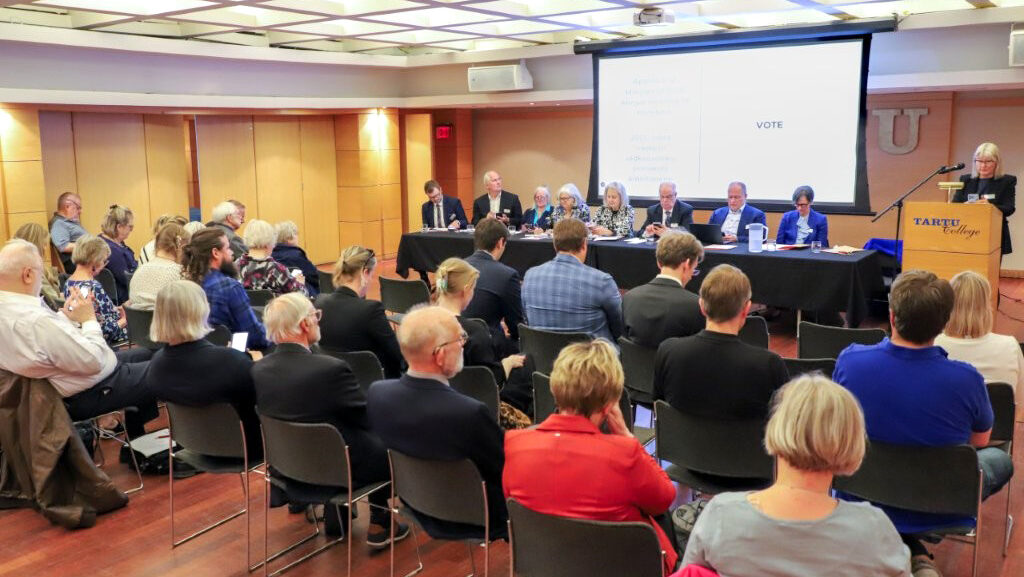
The Tartu College Annual Meeting of Members, held on the evening of April 29th, 2026, provided a comprehensive overview of Tartu College’s (TC) financial health and its ambitious plans for infrastructure renewal.
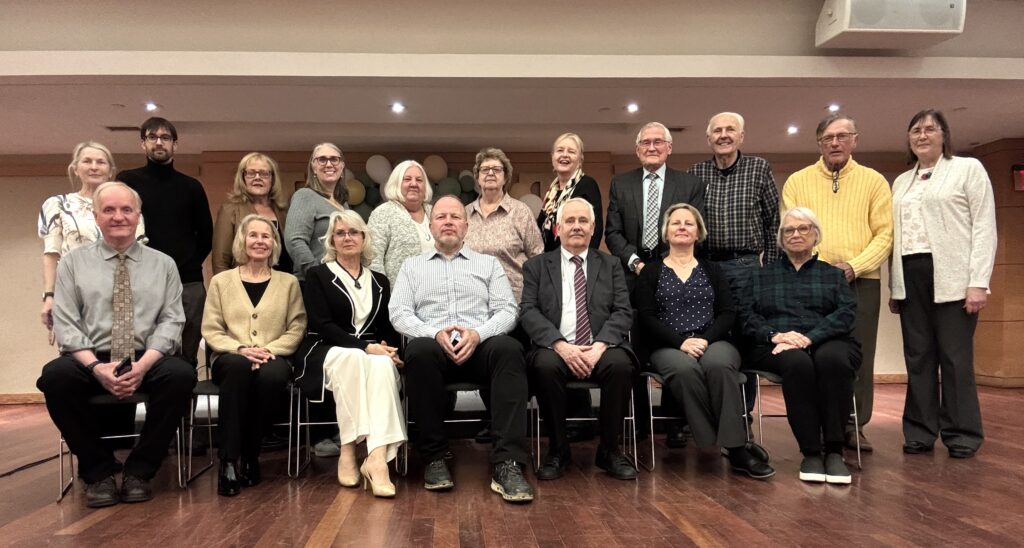
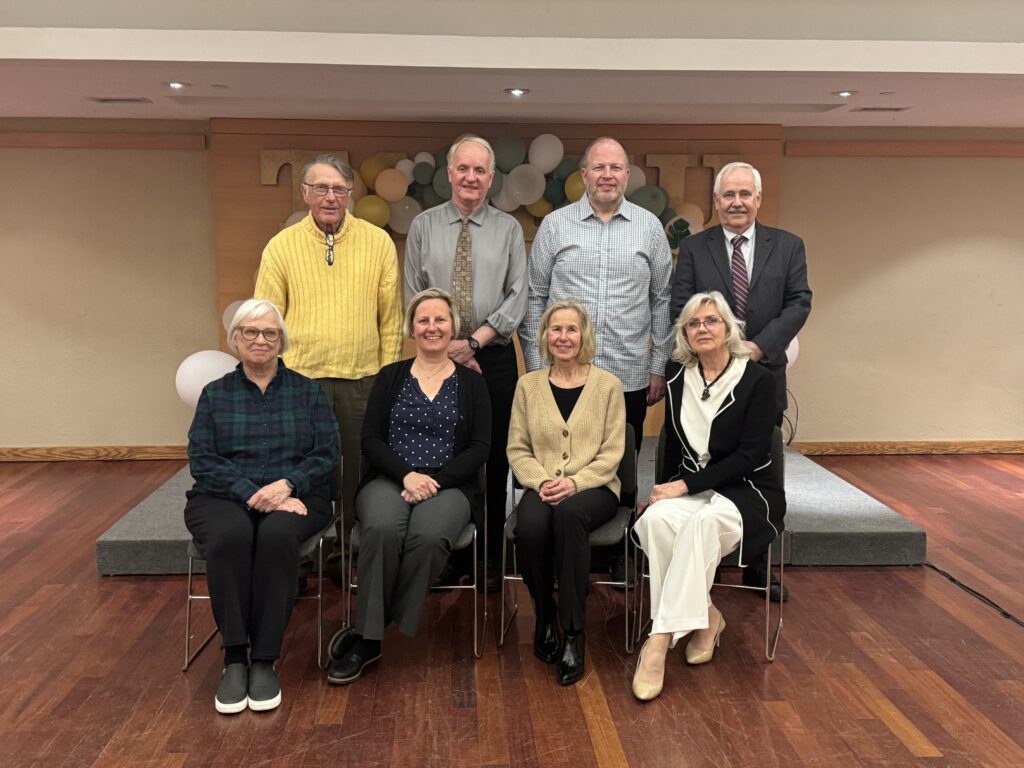
Board of Directors Members Vello Keelmann and Riina Hess (photo by Ellen Valter)
To pay respects to two past and present Board Members who have recently passed away, President Allan Meret opened the proceedings with a moment of silence for Anne Agur and Peeter Einola, whose contributions were remembered by those gathered in the main hall.
In his remarks, Meret reflected on TC’s history since its 1970 opening, noting how the building has evolved into a vital hub for many Estonian organizations including the Estonian Foundation of Canada and Northern Birch Credit Union. He emphasized that the last decade has been defined by a concerted effort to replace aging infrastructure, ranging from plumbing stacks to electrical and HVAC systems, and shared the long-awaited news that the accessibility lift is waiting for the final inspection approval.
TC General Manager Linda Karuks followed with operational remarks that emphasized both the stability of the revenues, particularly from the student residence and the external challenges faced. While the residence remains at approximately 99% occupancy during the academic year, surprisingly, revenues were significantly constricted during the summer of 2025. Karuks explained that demand from language school groups, which in more recent years accounts for half of the summer business, declined by 70% following the implementation of new federal government policies regarding international student visas. Despite an intense marketing campaign, the summer occupancy average fell to 43% compared to 70% from the year before. To manage these fluctuations and the rising cost of capital, the institution renewed its mortgage in July 2025 for a two-year term, increasing its borrowings by $2.5 M.
Significant attention was given to current and upcoming capital projects, which are essential to maintaining the building’s infrastructure for the building’s long-term viability and recent valuation of $52.5 M. Karuks detailed the Phase 8 renovation project of five residence suites on floors twelve through seventeen, a project that created a new “Superior Room” type. This $327,500 investment per suite included the replacement of plumbing, new HVAC and electrical systems, and updated aesthetics, including new lighting, window and floor coverings. Furthermore, Karuks announced that the sorority room (G6) on the G floor had been renovated with reupholstered furniture and they are commissioning artwork from women within the local Estonian sorority community. In total, together with the 2026 project, Tartu will have invested almost $20 Million into upgrading the building in the past five years.
The goal is both clear and urgent: to rebuild and secure the VEMU Archives for generations to come. The cost is $4 Million. This is a community effort—and every contribution matters.
The next large capital project in the Tartu building will see a major four-million-dollar renovation of the deteriorated VEMU’s archive spaces beginning this year. This is a VEMU project being led by Tartu College management. This project involves lowering the floor by 1.5 feet to increase ceiling height and provide comprehensive flood mitigation systems, levelling the floor to install large movable shelving units, ultimately almost tripling the storage space. This work will transform the VEMU archives from a vulnerable storage space into a state-of-the-art, climate-controlled preservation facility – worthy of the stories it holds. It is also the essential first step toward the future VEMU Museum. Without properly safeguarded collections, no museum can responsibly exist. Fundraising through VEMU to secure the VEMU Archives has already begun. The goal is both clear and urgent: to rebuild and secure the VEMU Archives for generations to come. The cost is $4 Million. This is a community effort—and every contribution matters.
The presentation of the 2025 financial statements, audited by MNP LLP, confirmed that the financial statements present fairly, in all material respects, the financial position of the Organization as at December 31, 2025. The audit report highlighted a strong final Debt (or Key) ratio of 1.69, well within the bank’s requirements. Following the review, members voted to re-elect MNP LLP as the external auditor for the 2026 financial year. The governance portion of the meeting also included the election of directors to the board. Raul Sinimäe of Korp! Rotalia, Allan Seim of Korp! Frat! Estica, and Riina Hess of Korp! Amicitia were re-elected to a second three-year term.
Members were introduced to the 2026 financial budget, which projects the highest total revenues in the history of Tartu College at over $7 M. Karuks noted that while expenses are also on the rise, particularly interest payments on debt, the institution maintains a healthy cash flow from operations estimated at $1.4 M for the coming year. This financial stability allows Tartu College to continue its tradition of strong community support, spending around $500,000 to $1 M on Estonian-related activities, $5,000 as an annual contribution to the Student Council and resident activities and the awarding of academic scholarships. The 2025-2026 scholarship winners were Monika Siim, who received $2,000 for her “Like-Minded” interview series with female professionals, and Jason Tang, who was awarded $700 for a wildlife and biodiversity workshop.
The meeting concluded with an update on the progress of Eesti Elu / Estonian Life newspaper, which has seen significant growth in its digital presence. While print readership remains stable at 2,150 weekly readers, the publication has seen a 15% increase in monthly website visitors and a 67% surge in social media followers. Karuks highlighted that online content engagement has grown by 500% since January 2025, validating the newspaper’s strategy of shifting toward a multichannel distribution model. This digital success has been bolstered by partnerships with major organizations like the Estonian Song and Dance Festival.
As the meeting adjourned, members were reminded of the upcoming VEMU fundraising dinner scheduled for Saturday, May 23rd, an event critical for the continued realization of the museum’s state-of-the-art facilities.