The article had been posted online two days earlier, coincidentally on the 34th anniversary of Latvia regaining independence after being illegally occupied by the Soviet Union in the prelude to WWII, remaining so after war’s end. Unfortunately, two errors were to be found online. The first line of the opinion piece stated that the infamous document that resulted in millions of deaths was signed on August 24th, 1939. The second error online—stating that the Baltic states regained independence in 1993, when it was actually in 1991, while the Soviet Union was threatened by a putsch—was thankfully caught by the editors of the print issue. But surely, in this age of instant communication and info transfer, the first error should also have been caught and corrected.
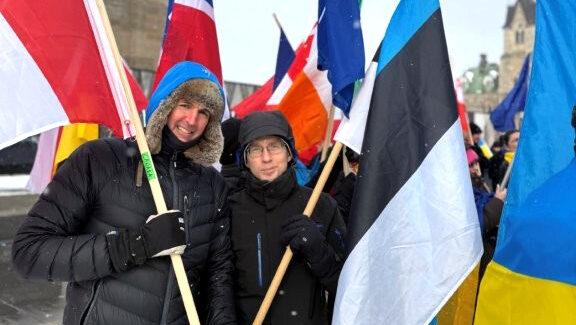
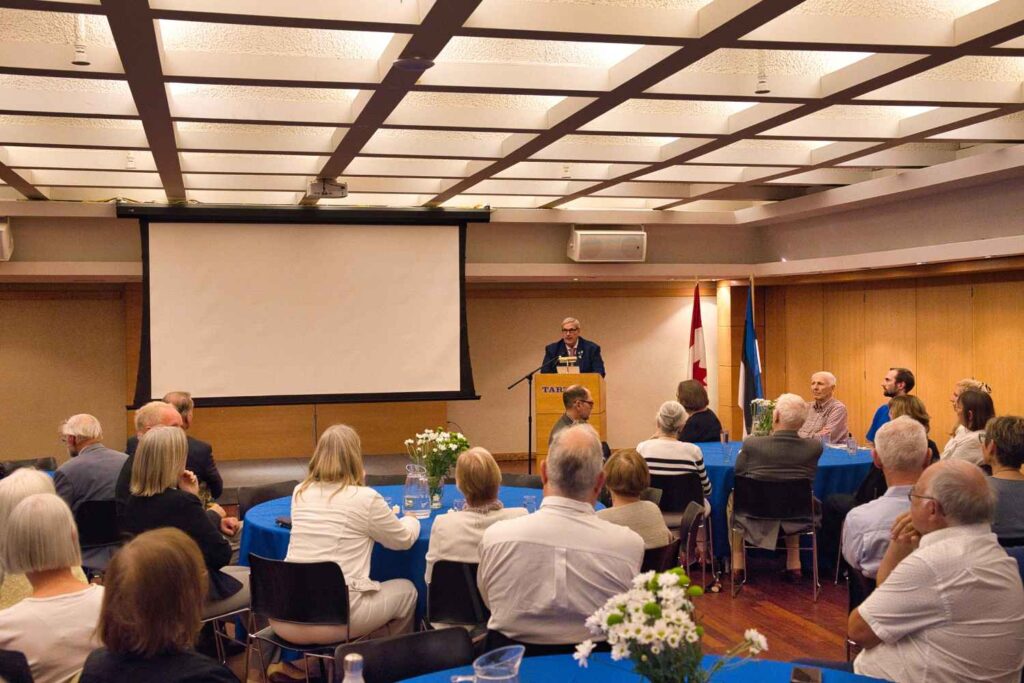
Dr. Kristbergs was one of the speakers at an event on August 21st at Tartu College honouring the victims of totalitarian, communist, and fascist regimes through commemorating International Black Ribbon Day. That event was founded by Markus Hess to draw attention to the infamous MRP.
This is in view of the recent closed-door meeting in Alaska between U.S. president Donald Trump and Vladimir Putin, for twenty-five years the head of the Russian regime, a president in name but a dictator in fact. Lines were drawn, comparing historical events such as the Munich Agreement of 1938 which permitted the German annexation of Sudetenland…
The evening also celebrated the restoration of Estonian Independence on August 20th, 1991. It was organized by the Estonian Central Council in Canada in partnership with VEMU Estonian Museum Canada and Tartu College. President of the Lithuanian-Canadian Community Kazimieras Deksnys was the first speaker after introductory remarks given by ECC Chair Reet Marten Sehr, who emceed the evening. The keynote speaker was Professor Andres Kasekamp of the University of Toronto Department of History and Munk School of Global Affairs. All three speakers warned that the lessons of MRP should never be ignored. And stressed the threat that Russia poses today.
This is in view of the recent closed-door meeting in Alaska between U.S. president Donald Trump and Vladimir Putin, for twenty-five years the head of the Russian regime, a president in name but a dictator in fact. Lines were drawn, comparing historical events such as the Munich Agreement of 1938 which permitted the German annexation of Sudetenland, emboldening Hitler to continue with plans that led to the MRP, which divided Europe into spheres of influence between Germany and the Soviet Union and then to WWII. That non-aggression pact was broken by the Nazi regime in 1941 with Operation Barbarossa opening the eastern front.
As Dr. Kristbergs and Dr. Kasekamp emphasized, in today’s world it is not far-fetched to contemplate an MRP-like scenario developing. The continuing war of aggression launched by Russia against Ukraine has Moscow making no secret of wishing to restore the “glory” of the Soviet Union. In fact, Putin’s right-hand man, Foreign Minister Sergei Lavrov wore a t-shirt with the letters CCCP [the Cyrillic equivalent of the USSR acronym] prominently emblazoned on it upon his arrival in Alaska. Add to that reports of increased military movement by Russian troops on NATO’s eastern border, repeated violations of Baltic airspace by Belarusian drones, the cutting of communication cables under the Baltic Sea by ships owned by Russia operating under false flags and there is considerable cause for concern. This past weekend, drones were spotted above Lake Peipsi, close to the Estonian border.
Coupled with Trump’s repeated remarks of making Canada the 51st state of the USA, it would not be a surprise if the secret Alaska talks, not addressed at the press conference at the end of the meeting, also included discussion of spheres of influence. In this case—perhaps just as with Sudetenland, a place that British then-PM Neville Chamberlain said few could find on a map—the Baltics. All the while allowing for further aggressive Trumpite policy in North America.
Things are markedly different today. The Baltic states are members of NATO, an alliance committed to collective European defense. Article Five is the cornerstone of the alliance. An attack on one member is an attack on all. And the USA and Canada are key NATO members. Article Five has been invoked only once, in the aftermath of the 9/11 attacks on the United States. But just as the MRP was ignored by Hitler, who is to say that without the USA, the backbone of NATO militarily and the main reason Germany was defeated in WWII, NATO would proceed with Article Five in Estonia?
The message is clear. We must, as Estonians and Canadian citizens, do our level best to tell others not only about the MRP and its legacy, but warn of the historic duplicity of Russia and the threat that the Kremlin still presents to the present global order.
That is why Ukraine’s desire to become a NATO member is rebuffed by Lavrov and Putin. The Budapest Memorandum of 1994, promising to maintain Ukrainian sovereignty and borders, was ignored by Russia in 2014 with the Crimean occupation, and from 2022 to now with full-out warfare.
The message is clear. We must, as Estonians and Canadian citizens, do our level best to tell others not only about the MRP and its legacy, but warn of the historic duplicity of Russia and the threat that the Kremlin still presents to the present global order. Reminders such as Dr. Kristbergs’ article are key to this goal. Those with a Globe subscription should, with the date correction, send it to our Canadian friends. (And also the editorial cartoon in the August 23rd Globe, depicting Putin as a large cat toying with a tiny, mouse-like Trump.)
We must also continue the mission of Black Ribbon Day. Among the goals is to emphasize that the Soviet Union had twelve, not fifteen Soviet Socialist Republics. Estonia, Latvia, and Lithuania were occupied, and their independence de jure was continuously recognized by key Western democracies, among them the USA and Canada. The restoration of independence was a legal action passed by democratically elected bodies that took place before the collapse of the Soviet Union, a fact often ignored by the mainstream media.
Today’s global events are a confirmation that realpolitik as a system of practical political consideration still exists, rather than one which follows moral or ethical premises. A fine goal but rarely achieved. One would think that realism and pragmatism would rule the day. But as history has proven time and time again, plus ça change, plus c’est la même chose.
TÕNU NAELAPEA