When Toronto opened its first new public transit line since 2002 last December, it was meant to mark a step forward for the city’s transportation network. Instead, the sluggish Finch West LRT (Line 6) fell short of the public’s expectations. Meanwhile, across the Atlantic in a very different city, policymakers in Tartu, Estonia are also confronting mobility challenges—not with trains, but with bikes. Though their issues are distinct and unique to their local contexts, the tale of these two cities is tied together by a common thread: data, and how it powers “smart” technologies that work for us, not against us.
Toronto: slow traffic, slower trains
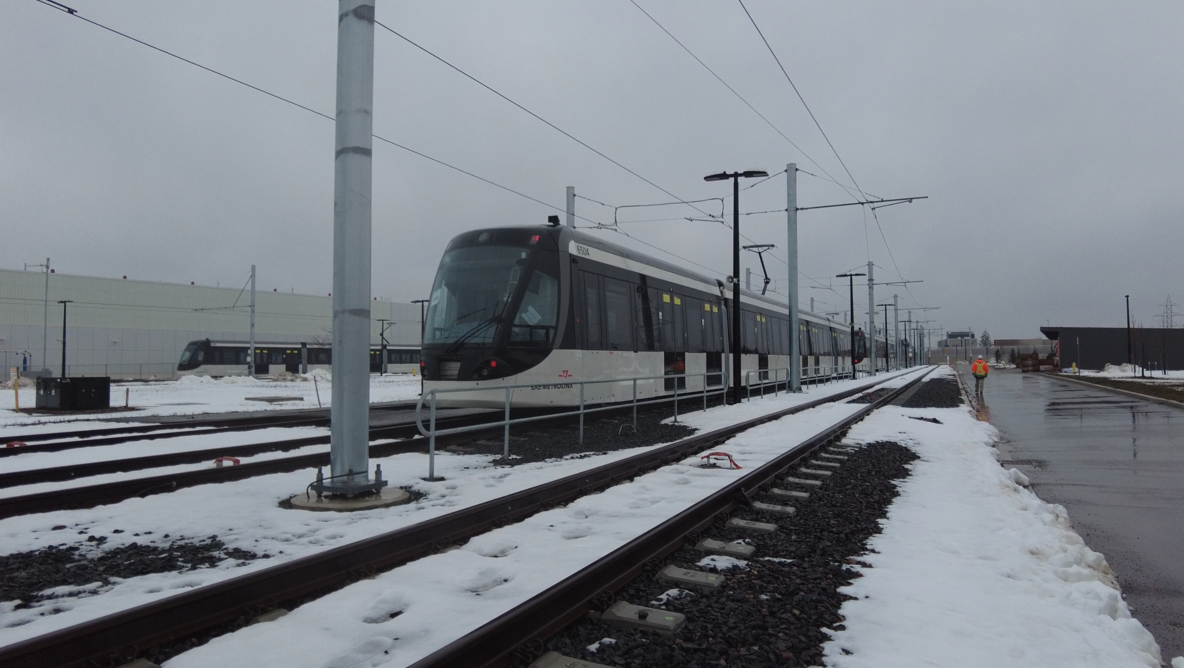
Toronto’s new LRT is the newest addition to the TTC’s three existing transit lines, running from Finch West Station on Line 1 going all the way to Humber College Station (near Hwy 427). Built by Metrolinx and operated by the TTC, the line was intended to serve as a faster alternative to buses and cars travelling along the busy route.
A separate study conducted in 2025 confirmed Toronto’s troubling reality, claiming that the city’s streetcars are 30 percent slower compared to the global average.
However, that promise quickly unravelled. While Metrolinx originally projected an end-to-end travel time of roughly 33 minutes, it takes a train just under 50 minutes to travel the entire distance, according to TTC Chief Strategy Officer Josh Colle, speaking on Toronto Today.
The problem is not unique to Line 6. A 2024 study found that Toronto's streetcars are some of the slowest in the world. Among the fifteen systems analyzed, Toronto’s performance ranked last, “standing out as a laggard.” A separate study conducted in 2025 confirmed Toronto’s troubling reality, claiming that the city’s streetcars are 30 percent slower compared to the global average.
At its core, Toronto’s transit shortcomings stem from its urban planning decisions, particularly the city’s long-standing reliance on car-centric infrastructure.
This means that while top-performing streetcars operate in dedicated right-of-way lanes, Toronto’s share lanes with other traffic. “The LRT likely won't ever reach the promised average speeds because of the number of stops and the need to slow down when approaching stops and across intersections,” said Colle in Toronto Today.
In response to these criticisms, Toronto Mayor Olivia Chow introduced a motion, passed in December 2025, that grants LRT vehicles transit signal priority (TSP) over regular traffic. TSP systems are considered a form of smart technology, as they automatically collect and transmit data to enable real-time adjustments. In this case, TSP uses sensors to detect approaching streetcars and LRT trains and adjusts traffic signals to give them priority over other vehicles.
Tartu: modelling before building
Meanwhile, Tartu is dealing with somewhat of a reverse situation.
In December, ERR reported that Tartu will launch a €100,000 assessment (about $160,300 CAD at the time of writing) to study traffic flows, including those of cyclists, before moving ahead with new bike lane infrastructure. Maintaining the modeling software is expected to cost an additional €25,000 per year.
Unlike Toronto, where the TTC adopted smart technology only after delays and political pressure, Tartu is holding off on building certain bike lanes until the software can map traffic dynamics and guide a broader strategy. The goal, city officials say, is to create a “comprehensive plan to ensure smooth traffic flow and the safety of all road users” (ERR).
“Not everything that is desired simply fits into the street space, and if we make one or another choice there, how will that affect the ability of different road users to move around the whole city?”
(Priit Humal, Tartu Deputy Mayor)
In the ERR article, Tartu Deputy Mayor Priit Humal emphasized the need for careful planning: “Not everything that is desired simply fits into the street space, and if we make one or another choice there, how will that affect the ability of different road users to move around the whole city?”
The decision stems from a new coalition agreement between the Reform Party and Isamaa, which places a priority on traffic efficiency and road safety. Reviewing bike infrastructure was a core campaign promise for Isamaa. As a result, several planned cycling routes, including a proposed lane on Lai tänav in the city center, have been paused pending the results of traffic modeling.
While this may be seen as a responsible approach, critics argue that relying solely on new models without considering existing data could cause unnecessary delays in building cohesive cycling infrastructure.
A tale of two cities
Data underpins everything. Though we may not often think about it, the streets and roads on which we wander have, at some point or another, been meticulously engineered, shaped by information flows. It is the invisible language that gives meaning to how our cities function and how we move within them. As Toronto and Tartu show in different ways, when data is collected and used with public interest in mind, it powers technologies that help cities move not just faster, but smarter.
This article was written by Natalie Jenkins as part of the Local Journalism Initiative.