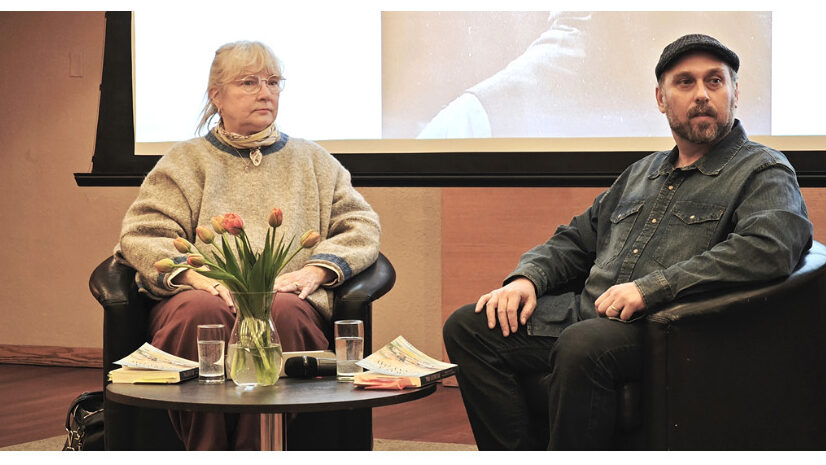
In December 2022, Vaiko Eplik spoke on Eesti Elu and VEMU’s podcast, EstoCast, during which he told the tale of playing “Eighties Coming Back” with his band Ruffus at the Eurovision Song Contest in 2003. He also spoke of how eventually, he switched to writing and performing in Estonian, noting how the language offered him more interest and creativity. There are things that can be sung in Estonian that haven’t been said or heard before and that don’t quite work in the same way in English.
By the same token, there are things that can be sung in English that are a bit hard to relay in Estonian. In 2021, electronic musician NOËP (Andres Kõpper) made a funny video with Piret Laos and Robert Rool of the show Õhtu! with that in mind, translating his English-language music into Estonian. The result is quite literal and hilarious. Translating lyrics takes a lot of smoothing out to keep the same rhythm and feel.
When it comes to singing in languages other than their own, Scandinavians seem to have a particular talent. Folk duo First Aid Kit is one example, with a country twang that would make you forget they were from Sweden. Peter Bjorn and John pulled out clandestine American accents on their 2006 indie hit “Young Folks.” And we can’t forget ABBA.
Why sing in English? For NOËP, the language, with all its characteristics and sounds, can be used like an instrument. You might not consider it a “beautiful” language for singing, in the way languages like Estonian, Italian, or Portuguese typically are. But English has rhythm and texture.
The best example of this has to be “Prisencolinensinainciusol” by Adriano Celentano, which is entirely crafted with English-sounding gibberish. It simulates the power of English-language funk vocal delivery, even if there is no intrinsic lyrical meaning. Though, as Celentano put it, “… I thought it was appropriate to make a song… developing the theme of incommunicability… I wanted to develop this theme of incommunicability, leaving as a reference just one word, which is precisely ‘prisencolinensinainciusol,' which means ‘universal love'…”
Scottish musician Ray McClelland made the point on guitarguitar that “1.5 billion people can speak and understand English… Many artists use it in order to engage with the biggest potential audience… so many artists grow up listening to music sung in English. British and American rock is something of an evergreen influence, so it may be that this type of music is always somewhat ‘English’ in vocal delivery. Certain scenes have a ‘vocal sound’ (for example, English punk is as much to do with the accent as anything else), so people who love those scenes will want to adopt the vocal inflections too, regardless of where they are from.”
It goes even deeper. Even the birthplace of English is not impervious to change. English pop singers often lose their accents for American ones, though some exceptions exist including Kele Okereke of Bloc Party or Britpop frontmen Damon Albarn of Blur and Liam Gallagher of Oasis.
Maybe, then, an Eplik-esque migration to Estonian singing is the most rock ‘n’ roll way to go about it for those outside of the Anglosphere. It rejects the ubiquity of the English language that has been growing since the end of the Second World War. It’s striking out on one’s own path, doing things your own way, with a language that can reflect one’s own lived experience better.
Of course, English-speaking fans of classical music and the many distinct genres that make up “world music” (a pretty silly label if you think about it), are already open to languages other than English in music. And pop musicians who sing and write in multiple languages are numerous in the Anglosphere.
But is it possible for languages other than English to obtain the same level of visibility in the sphere of major artists?
Polaris Music Prize-winner Lido Pimienta comes to mind, with four albums in Spanish. In a 2019 Red Bull Music Academy lecture, Pimienta said about singing in Spanish, “I’m more confident when I do it, which means that the performance is better. It’s more true to who I am.” At the same time, she says “It’s not like I am so proud to represent the Spanish language. I’m not Spanish. I’m not. Spain is the boogeyman too. It’s another colonizer language. What I want to do is… an album in Wayuunaiki, the language of my people, the Wayuu.”
Her remarks capture something many musicians are reflecting on: the importance of authenticity and emotional connection over market expectations.
That same instinct could be said to be emerging among Estonian artists. jonas.f.k., who has backed up Erki Pärnoja and NOËP on electric guitar and released English-language tracks like “Rockenrollah’” and “LondonParisChicago” in 2020, gravitated to Estonian in 2022 for his album Suve and the chill, clubby track “Nädal” (“Week”). The switch didn’t make the music any less accessible. If anything, it sounds more natural and grounded.
Once again speaking of NOËP, Estonian folk quartet Curly Strings translated his Tartu 2024 anthem “Young Blood City” to Estonian, replacing the line “young blood city” with “linn on vaba” (“the city is free”). The lyrics tie the song even more to the namesake place.
It seems the dominance of English is no longer taken for granted. Global audiences are becoming more open to multilingual music, helped along over the years by the success of artists like Shakira, Stromae, and BTS (along with the associated K-pop explosion). For all the criticism music streaming and social media are due, algorithm-based growth and marketing makes fitting into an English-language box much less relevant.
Artists who feel that their best expression lives in Estonian might find that the world is now more ready than ever to listen.