Subscribe Menu

Arvo Pärt and Vox Clamantis’ Subtle Offerings in an Academy Award-Winning Italian Film

Twelve years ago, Paolo Sorrentino’s film La Grande Bellezza (The Great Beauty) came out. It was nominated for the Palme d’Or at Cannes Film Festival, where it premiered. It won an Academy Award, as well as both the Grand Prix and Jury Prix at the Tallinn Black Nights Film Festival. Among the student population in Italy, in a position of observing their seniors and critiquing “the system,” excess, and society on the whole, it swept everyone up into heated discussions. Not everyone had glowing opinions of the film, of course.

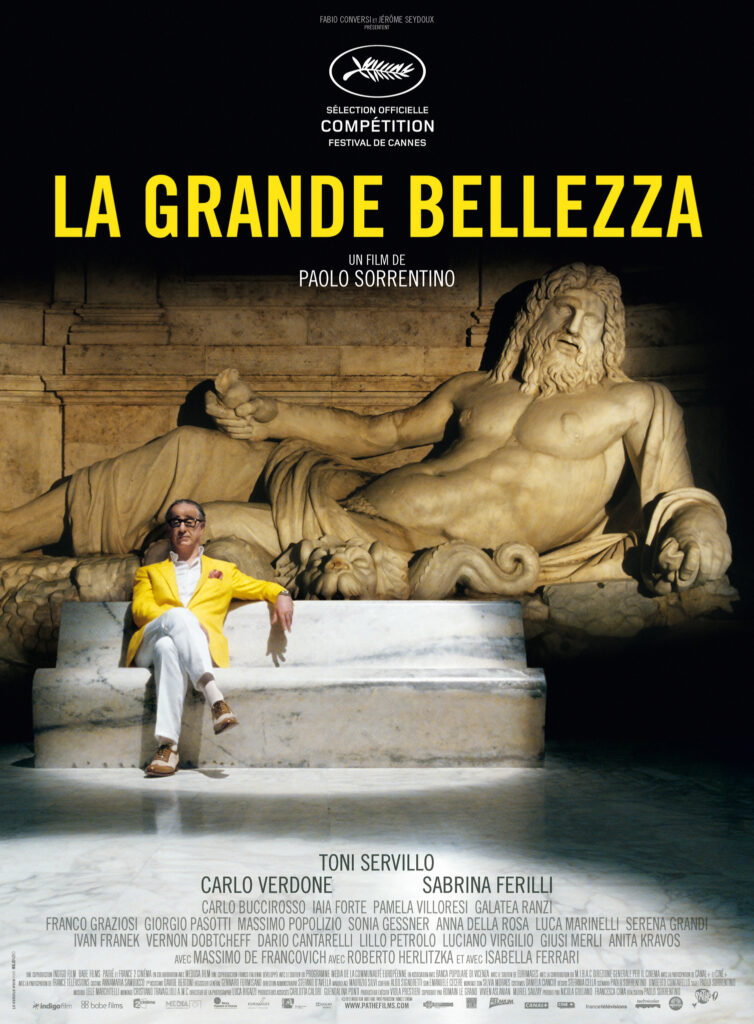
Poster for "La Grande Bellezza" (source: imdb.com)
Poster for “La Grande Bellezza” (source: imdb.com)

It might have passed by all those who watched or even just heard about the film, however, that there was a significant inclusion of Estonian music in the film. In its rawest, most humble scenes, Arvo Pärt’s “My Heart is in the Highlands” (set to a beautiful Robert Burns poem) and Pérotin’s “Beata viscera” (“Blessed Womb”) as performed by Estonian Music Week veterans Vox Clamantis are heard. La Grande Bellezza is a film full of mysteries, colliding sensations that are eventually better understood through the instant impressions they make rather than piecing it together intellectually. But here’s how we get to those scenes with Pärt and Vox Clamantis.

Jep Gambardella is a journalist and high-level Roman socialite who rests, uncomfortably albeit, on the success of a novel he wrote in his 20s. Now turning sixty-five years old, continuing the raucous life of partying he’s always pursued—replete with rooftop DJ parties, dancers, a mariachi band, booze, and shocking contemporary art—is something he’s made to question. He drifts through the streets of Rome by night (and day if he’s not catching up on sleep from the night before) in a daze. Time has worn down the grandeur of being at the top and knowing lots of famous people. He sees them, just like himself, for the flawed human beings they really are. He sees the shame and sadness hidden behind his friends’ masquerades.

In his eroding emotional state, he catches glimpses of what once made him happy, like running around in the garden as a boy. Cue “My Heart is in the Highlands,” a longing piece of music that alludes to Jep’s desire to return to what he has lost. As Burns wrote “My heart’s in the Highlands, my heart is not here / My heart’s in the Highlands a-chasing the deer / A-chasing the wild deer, and following the roe / My heart’s in the Highlands wherever I go.” However high Jep has ascended, it’s the simple life before that he misses.

… musically, it’s an approach that demands us to consider Arvo Pärt’s influence on contemporary film music.

Similarly, hearing of the death of his first love, Elisa, from her distraught husband shows him the depth of his folly, failing to realize the special love she had for him. The sharpest jab we get from this film isn’t a critique of upper-class living—although this provides some absurdly comedic blips and witty banter—but a critique of letting beauty escape us as we chase what we falsely believe to be beauty. As Jep himself says, while speaking to Sister Maria, a nun who has devoted her life to serving the poor, “I was looking for the great beauty. But… I didn’t find it.”

The protagonist is returning to the fundamentals, which reminds one of the journey of Arvo Pärt himself in a way. In a documentary about his life shown at the Arvo Pärt Centre in Laulasmaa, one sees a shift from his avant-garde days, a “chipping down,” and a spiritual awakening as a composer and person. Simplicity provides many with happiness. And musically, it’s an approach that demands us to consider Arvo Pärt’s influence on contemporary film music. (Along these lines, it’s worth reading Kaire Maimets-Volt’s Mediating the ‘idea of One’: Arvo Pärt’s pre-existing music in film.)

On the other hand, it would be frustrating to assert that simplification is the only path to happiness. Sister Maria has found serenity in her life direction, which we witness most vividly in a scene with Vox Clamantis’ voices in the background and numerous religious leaders kissing her hand, her legs dangling softly from a chair. At the same time, Jep Gambardella has found his own path, acknowledging his past and moving forward to create a new book. Moreover, as he states, “The most important thing I discovered a few days after turning sixty-five is that I can’t waste any more time doing things I don’t want to do.”

The movie takes you up, down, and all around both in its visuals and sound. And sonically, the Estonian music we hear is profound and heartbreaking. Once again, though, you really must watch the film for yourself and let the drama, provocations, and music flow, because it will leave with you a desire to discuss and ponder what the great beauty is indeed.

You can watch The Great Beauty on Apple TV and hear the soundtrack on various platforms, including Spotify.

Read more