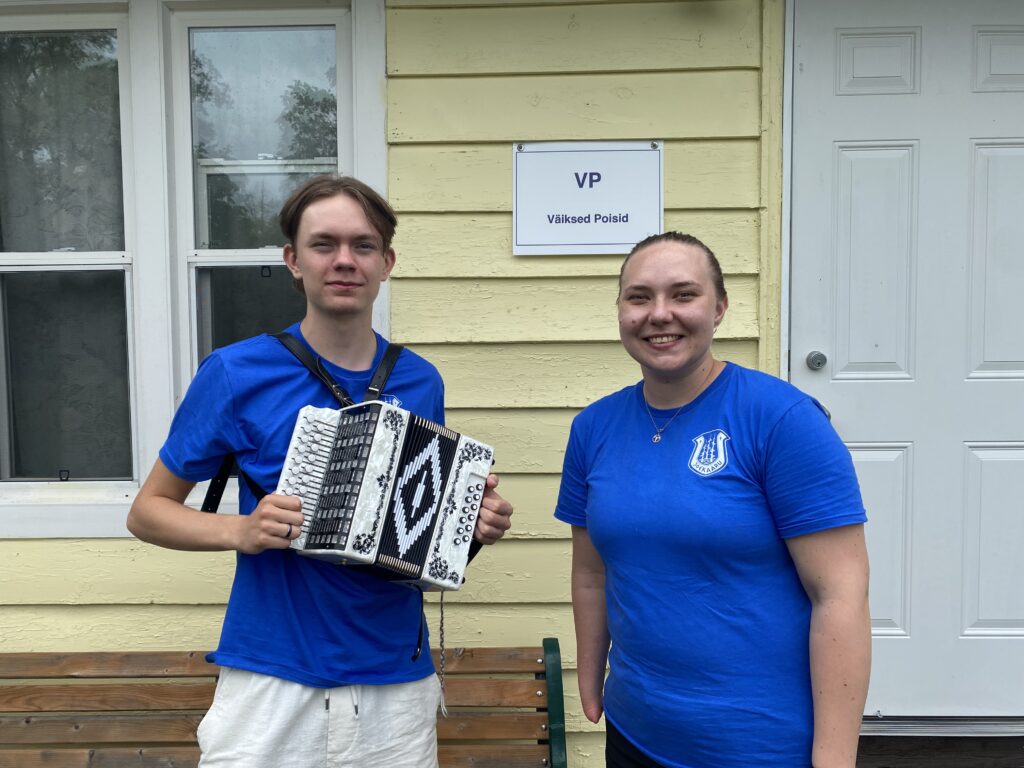
Each year, Jõekääru summer camp welcomes campers and counsellors from all over the world, including Estonia. Johanna Oll and Rasmus Mattias travelled from Tartu and Kiili to be kasvatajad (counsellors) this year. Eesti Elu spoke with them about their experience so far, impressions of the Canadian-Estonian community, and the importance of preserving cultural traditions.
Coming to Canada
Both Johanna and Rasmus have relatives in Canada. However, despite those family ties, neither had visited the country before. So, when they learned about Jõekääru, they were excited by the new experience.
“In Eesti, people only really talk about singing and dancing during Laulupidu (The Estonian Song Festival). I think it’s really cool that Estonians here are actively keeping those traditions alive. I’d say that’s the biggest difference between eestlased in Canada and in Eesti.”
(Rasmus Mattias)
So far, Johanna’s time at Jõekääru has proven her expectations of the Estonian-Canadian community wrong. “I knew that Estonian culture and language are very important here, but I didn’t know if the younger kids would understand Estonian very well,” she said. “I was very pleased to see that they’re speaking more in Estonian than I anticipated—even the youngest kids can understand. I was expecting to be speaking in English more.” Even for the campers whose instinct was to respond in English, Johanna said that with encouragement, they are more willing to practice Estonian than they let on.
Jõekääru’s nature also surprised the counselors. “When I got here, I didn’t feel like I was in Canada,” she said. “My father’s side of the family is from Saaremaa, and looks so similar! The other kasvatajad felt the same. We went for a walk and found wild strawberries, which are popular in Estonia. I did see a raccoon, which we don’t have back home. But otherwise, it's exactly like Estonia.”
Finding connection abroad
What surprised Johanna and Rasmus the most was how Estonian culture is practiced and maintained in Canada. In their view, there’s more emphasis on preserving traditions and keeping in touch with your heritage. At Jõekääru, campers understand the importance of that connection.
“Here, people know the traditional folk dances and songs,” said Rasmus. “In Eesti, people only really talk about singing and dancing during Laulupidu (song festival). I think it’s really cool that Estonians here are actively keeping those traditions alive. I’d say that’s the biggest difference between eestlased in Canada and in Eesti.”
Johanna and Rasmus believe that youth in Estonia often have a different view of their cultural identity. “We're trying to find ourselves again in Estonia, and now we are exposed to so many other influences. It can be hard to find our own voice,” said Johanna. “In Canada and at Jõekääru, I see the traditions preserved so well, and I remember what it means to be Estonian.”
“I feel like Estonian youth are not talking about Estonian history as much as we should. It’s important to remember how and why we got our independence, to take it more seriously, and be mindful about our traditions.”
(Johanna Oll)
Rasmus, who studies Estonian folklore and heritage at school, also brought up the importance of respecting cultural traditions. “At school, we don’t really talk all that much about our heritage,” he said. “But I think that’s sad. It’s important to talk about it and to practice those old traditions.” Otherwise, he said, young people take Estonia’s independence for granted. “Some people think that just because we have it now we’ll always have it, and that we don’t need to talk about the past. But history does repeat itself, and we need to understand that.”
Johanna agreed: “I feel like Estonian youth are not talking about Estonian history as much as we should. It’s important to remember how and why we got our independence, to take it more seriously, and be mindful about our traditions.”
Rasmus does this by playing his karmoška, which is a type of accordion. Although it originates from Russia, it's been a staple in traditional folk music within the indigenous Seto culture of Estonia. “I’ve been playing it for eight years now,” he said. “It's really easy to start, but really hard to master. The väiksed (juniors) really enjoy me playing it. It’s really sweet.”
~~~
Quotes have been edited for clarity and length.
This article was written by Natalie Jenkins as part of the Local Journalism Initiative.