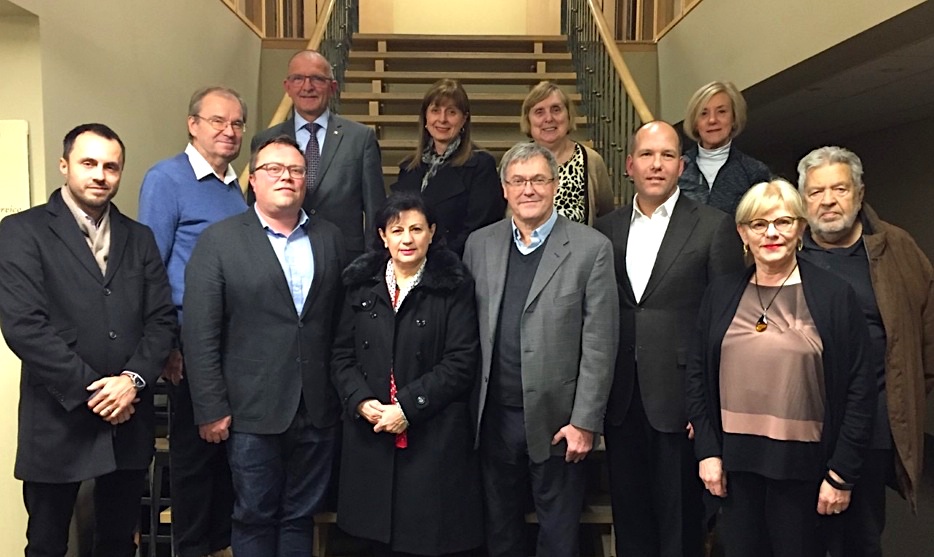
Outgoing CEEC President Markus Hess was thanked at the meeting for his commitment to the organization and serving as chairman for the past 7 years.
Andris Kesteris, President of the Latvian National Federation of Canada, was elected as the new President of CEEC. Teresa Berezowski, member of the Board of Directors of the Canadian Polish Congress, was elected VP Finance and Secretary. Ruki Kondaj, Albanian-Canadian Community Association Honourary President, was elected VP Membership. Marcus Kolga, Estonian Central Council President, was elected VP Communications.
The CEEC adopted the following five policy priorities for 2017:
1. Magnitsky Legislation
With a new Minister of Foreign Affairs, Canada may be closer than ever to adopting Magnitsky legislation which would ban Russian and other human rights violators from entering and hiding their assets in Canada. The CEEC will continue to urge and support the Trudeau government to honour its election commitment to adopt Magnitsky legislation to help support and protect global human rights.
2. Ukrainian Sovereignty
We must ensure that Canada and our allies do not recognize Russia's illegal annexation of Crimea and continue to maintain sanctions until Crimea is returned to Ukraine and Russian troops end the occupation and its attacks in the Donbas region. Support NATO MAP for Ukraine and additional training and support for Ukrainian forces. Provide increased assistance to support reform efforts and humanitarian relief in Ukraine.
3. Support for NATO and Baltic Sea region Reassurance Missions
We must continue to provide ongoing public support for NATO and Canada's participation in the reassurance mission in Latvia. Russian propaganda in Canada regarding NATO, collective defense and the reassurance mission beginning in the Spring has accelerated. CEEC needs to work to present the truth and counter narrative to Russian misinformation.
4. Increased diplomatic presence and resources in Eastern European region
Canada must take a leadership role on the international stage to stand against Kremlin aggression in the region. This includes additional resources to embassies and consulates in Ukraine, Poland and Latvia and placement of full time ambassadors in Estonia and Lithuania.
5. Media advocacy and monitoring of Russian disinformation in
Russian disinformation campaigns are extremely well funded and have deep resources. The manipulation of the US election is an example of this, and Canada is not immune to attempts by Moscow to distort facts in Canada. CEEC communities must raise awareness of Russian disinformation attacks in their communities by increasing media literacy and among politicians in Ottawa. Canada must develop its own National Center for Strategic Communications to help counter the narratives emerging from Moscow, Beijing, Tehran and similar centers. CEEC calls on Canada's cable providers to ban Russia Today (RT), Russia Channel One, NTV Canada, RTVi and other Russian media channels that are under the direction and control of the Kremlin and engage in disinformation.
6. Monitoring the Sovereignty of All States in the CEEC region
The CEEC will actively monitor the integrity of national sovereignty of CEEC nations and any threats that they may come under. This includes recent threats against Kosovo by Serbia; an attempted Kremlin back coup in Montenegro; further encroachments on the sovereign territory of Georgia by Russian military and Russian backed militias from illegally annexed parts of Georgia; and efforts by The Kremlin to influence elections abroad.