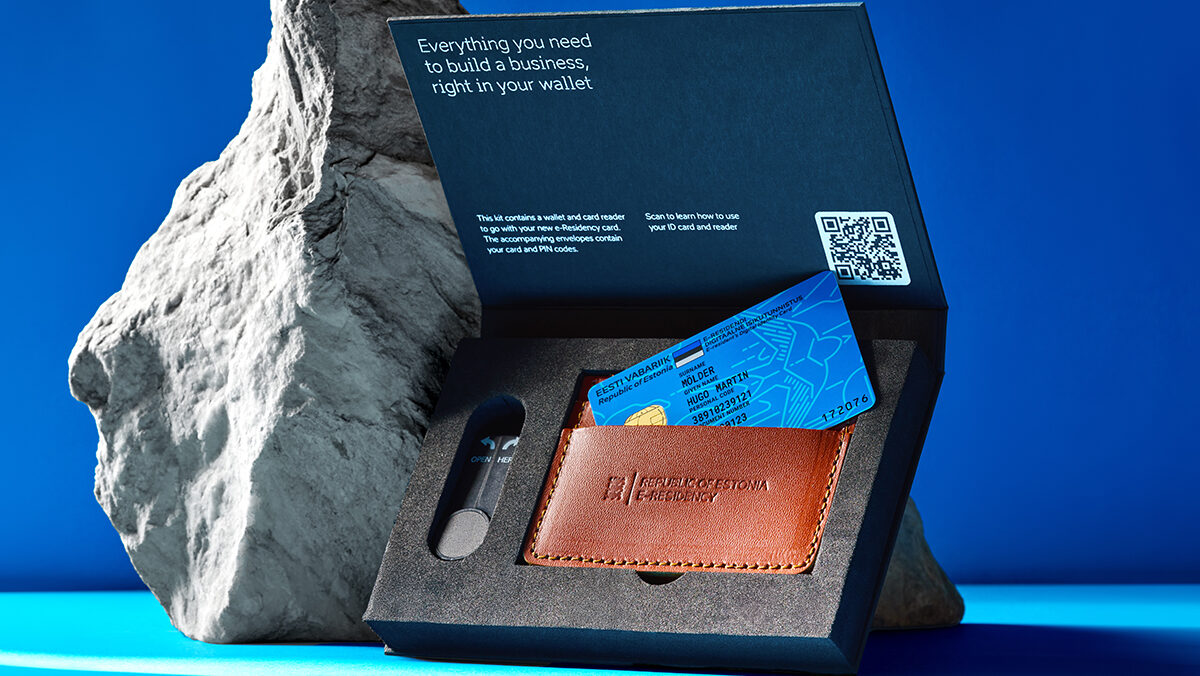
Since its inception in 2014, e-Residency has been popular among all kinds of professionals, from nomadic solo entrepreneurs to startup founders who want to grow fast and scale big, access the European market, and run their companies completely remotely and online. More than 136,400 people have become e-residents from 185 countries, some out of enthusiasm for the pioneering digital state, forming a global community of digitally-minded individuals. And the country has benefitted, and not only by rising the ranks of the most founder-friendly business environments out there. In 2025 alone, the programme generated €125 million in state revenue, resulting in a return of more than €12 for every euro invested into developing and running the programme by the state.
Estonian e-residents have also established about 40,000 companies to date. Every fifth Estonian company is started by an e-resident, and 40 percent of startups involve at least one. Among their ranks are unicorns such as Glia, a financial services provider cofounded by an American Dan Michaeli. The company's co-founders use the benefits of e-Residency to run their business from wherever they are, which comes in handy since Glia has offices in the US, Estonia, and Canada.
Michaeli is not the only North American to take advantage of e-Residency. To date, more than 4,500 Americans have become e-residents and, at last count, 1,461 Canadians.
Among them is Miranda Miller. Originally from Ontario, Miller has worked as a tech and marketing writer for international clients for many decades and decided to apply for e-Residency after looking for a way to better manage her business. As a solo entrepreneur who is frequently outside of Canada for different assignments, Miller says she encountered obstacles familiar to remote workers before becoming an e-resident.

“I'd run into nearly every friction point online business owners face,” she says. These included complex cross-border tax and reporting requirements, high currency conversion costs, and payment processing fees, as well as limited support for a small Canadian company with a global footprint.
E-Residency offered her a solution. With all state services available online, Miller has been able to run her business from wherever she happens to be, which, at the moment, is in France.
“Estonia’s tech-forward business infrastructure offered something I wasn’t finding at home,” she says, “a streamlined, digital-first environment designed specifically with remote founders and solopreneurs in mind.”
From legacy to leading edge
E-Residency has its roots in the digital services developed by the Estonian state. In the early 1990s the country moved quickly to adopt emerging technologies, and by 1998, as part of the successful Tiger Leap Programme, all Estonian schools were connected to the internet. At the dawn of the century, the country began introducing digital state services based on electronic identity (e-ID), which enabled Estonians to authenticate themselves across the state and private sector. This allowed for new milestones, like the rollout of online voting in 2005. As of 2025, all state services, even divorce, are available online.
The benefits are numerous. All tax declarations and communication with government bodies can be done remotely. Companies established by e-residents also obtain a registered address in the EU, allowing them to invoice and receive payment in euros. They are also available for Estonian and EU government grants…
This same infrastructure enabled Estonia to launch a fully digital, borderless business environment as early as 2007, with an API-connected company registry (e-Äriregister). Estonian innovators decided in 2014 to make their state services accessible to entrepreneurs outside Estonia, provided they undergo a thorough vetting process. By setting up a company through e-Residency, e-residents gained the ability to run an EU business with ease and to join a thriving community of global entrepreneurs. Today, Estonia has one of the highest enterprise birth rates in the EU. Half of those companies come from fellow EU member states, and every fifth business registered in Estonia is now launched by an e-resident.
The benefits are numerous. All tax declarations and communication with government bodies can be done remotely. Companies established by e-residents also obtain a registered address in the EU, allowing them to invoice and receive payment in euros. They are also available for Estonian and EU government grants, as well as eligible for local and European programs.
To obtain e-Residency, applicants just need to visit the official website and complete an application, making sure to select a pickup point. Canadians can pick up their card at the Estonian Embassy in Ottawa. All e-residents receive a card, a reader, and PIN codes. With an activated card, an e-resident can register their company online and get things started.
Additional services to simplify business operations are also on the way. During 2027 and 2028, e-Residency will gradually roll out a biometric identity verification app for applicants, as well as a fully cardless, mobile-based solution requiring no physical document at all.
Soon, new e-residents won't need to go to a pickup point at all. This will benefit applicants for whom it might not necessarily be so easy to travel to an Estonian consulate or embassy to pick up a physical card.
Simplicity matters
Miller, for her part, will soon return to Ottawa to pick up her new card, which will be valid for the next five years. She says there are numerous benefits to becoming an e-resident, listing online management of company formation, compliance, and reporting as top priorities.
“For someone building a location-independent business, that simplicity matters,” she says.
Having access to skilled legal, administrative, and accounting support through Estonian service providers has also been helpful to Miller, especially as she has moved into publishing books, among them 2025's Estonian e-Residency: Build Your Borderless Business From Anywhere.
“That grew out of both my personal experience and conversations I’ve had with other founders navigating cross-border business structures,” says Miller of the book.
She underscores that Estonian e-Residency is not a shortcut around taxes or regulation. Miller notes that Canada and Estonia have a dual taxation agreement in place. She pays corporate taxes in Estonia and income taxes in Canada. In Estonia, she points out, corporate profits are not taxed if they are reinvested in one's business. “You can grow more wealth inside the business to fuel your goals,” she says. “It’s all quite seamless.”
While Miller is often outside of Canada, she is also the managing editor of The Owen Sound Current, a news publication.
“I travel about eight to ten months of the year,” says Miller. “Estonian e-Residency makes it a lot easier.”


