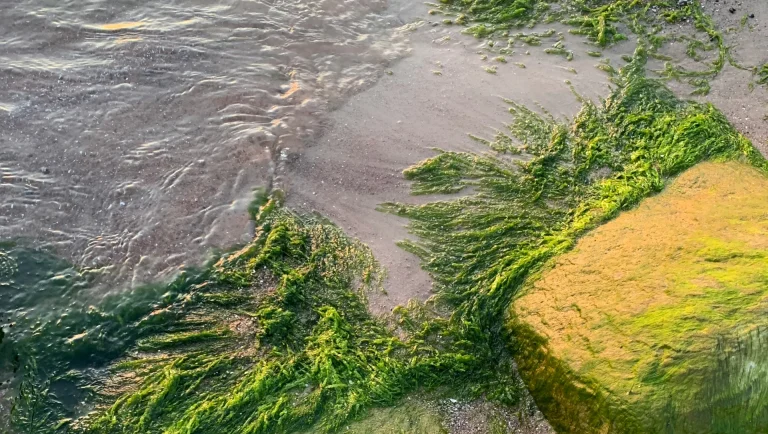
In recent years, however, this perception has begun to change. From nutritional supplements and skincare products to experimental textiles and medical materials, seaweed is attracting attention for its remarkable versatility.
Seaweed is often described as a superfood, and for good reason. Depending on the species, it can contain substantial amounts of dietary fibre, vitamins, minerals, and other biologically active compounds. Some varieties also contain antioxidants and substances with anti-inflammatory potential. The health and wellness industry has embraced these properties, incorporating seaweed-derived ingredients into moisturizers, face masks, and nutritional supplements. But beyond this, scientists and designers are increasingly asking a more unconventional question: what if seaweed could help us heal wounds, rethink clothing, or even reduce our dependence on conventional materials?
Beyond the food and cosmetics industries, artists and designers have also joined the seaweed movement. One such creative is Estonian artist and designer Kärt Ojavee, whose work explores the boundaries between materials, technology, and the natural world. Rather than treating seaweed merely as something to eat or discard, Ojavee experiments with its potential as a resource for creating new materials. A particularly striking example is Dissolving Hat, a work combining elements of a sewn and woven pirate hat with a fisherman’s hat. Its leather-like material, derived from marine resources, challenges the assumption that fashion must rely on familiar materials such as cotton, wool, or animal leather. The work also raises an intriguing question: could materials inspired by the sea become part of a more sustainable design future?
Consider that conventional textiles and leather can have substantial environmental footprints, depending on how their raw materials are produced and processed. Seaweed-based materials offer an alternative worth investigating because seaweed can grow without the agricultural land required by many terrestrial crops. Some production methods also require fewer freshwater and fertilizer inputs. However, the environmental benefits depend on the species, harvesting methods, processing techniques, and eventual lifespan of the finished product. A material being seaweed-based does not automatically make it sustainable.
Nevertheless, projects such as Ojavee’s demonstrate the value of approaching seaweed as a material with possibilities that extend well beyond its natural habitat. And while designers are exploring what seaweed can become, researchers are investigating what it might do for the human body.
Dr. Premarathna’s experiment with Sargassum ilicifolium, a type of brown seaweed… observed signs of more advanced skin repair, including the formation of collagen, a protein that helps give skin its strength and structure.
Seaweed’s potential becomes especially intriguing when we look at wound healing. In his 2026 doctoral thesis, Dr. Amal D. Premarathna at Tallinn University investigated whether compounds extracted from algae could help the body repair damaged skin. His research focuses in part on polysaccharides, i.e. long chains of sugar molecules found in algae that can have surprisingly useful biological properties. The results are promising. In laboratory experiments, polysaccharides extracted from several red and green seaweed species helped stimulate the proliferation and migration of skin-related cells. Both processes are essential to wound repair: new cells must multiply to replace damaged tissue, while others must move into the wound to rebuild the skin’s protective barrier. Some of the tested compounds also showed anti-inflammatory activity, potentially helping researchers understand how marine-derived substances might influence the body’s response to injury.
In Dr. Premarathna’s experiment with Sargassum ilicifolium, a type of brown seaweed, rabbits with skin wounds healed faster when given an extract of this seaweed than rabbits that received no treatment. Dr. Premarathna also observed signs of more advanced skin repair, including the formation of collagen, a protein that helps give skin its strength and structure.
What makes seaweed potentially useful? Researchers are investigating compounds such as D-mannitol, a naturally occurring sugar alcohol found in the extract, to understand whether they might help skin cells grow and move to repair damaged tissue. Exactly how these substances contribute to healing, however, remains unclear.
Of course, this doesn’t mean you should reach for seaweed the next time you get a cut. The rabbit study used a prepared extract taken orally, while other experiments examined seaweed compounds in laboratory-grown cells. Whether these findings could lead to safe and effective treatments for human wounds still needs to be established.
Still, the findings reveal why scientists are looking at seaweed in a new light. Rather than being merely a source of food or a slippery inconvenience on the beach, algae may contain compounds that could eventually contribute to new wound-care materials and treatments. The challenge now is to determine which substances work, how they work, and whether their benefits can be translated into reliable medical applications.
This article was written by Emma Nahkor as part of the Local Journalism Initiative.