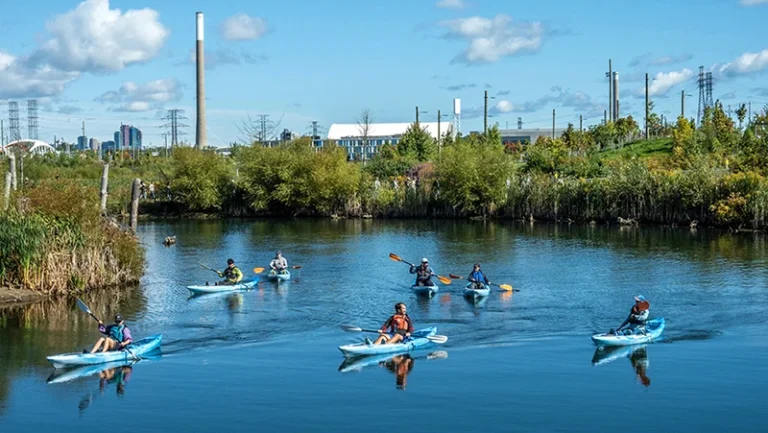
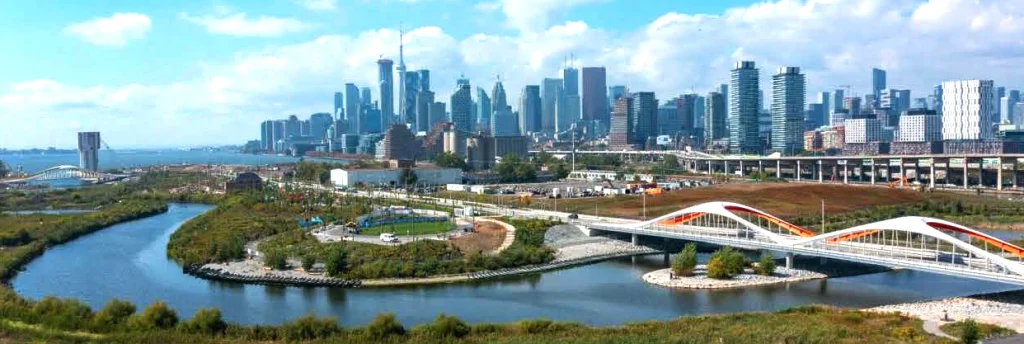
If you’ve paddled through Biidaasige Park, you’ve been on a stretch of river that didn’t exist a few years ago. Where you can now launch a kayak or stop to look at public art, there once stood fuel tanks, a scrap-metal yard and a T&T supermarket. To make this stretch of waterfront safer from floods, Toronto dug the Don River a new way to Lake Ontario.
Ingelevics and fellow photographer Ryan Walker spent six years photographing the transformation, much of it hidden from view behind a construction fence. In November, Ingelevics took a Visi audience behind that fence, from the last days of the old Cherry Street bridge to the first trees planted along the new river.
Biidaasige (pronounced roughly “bee-daw-si-geh”) means “sunlight shining toward us” in Anishinaabemowin. The park is part of one of North America’s largest public infrastructure projects.
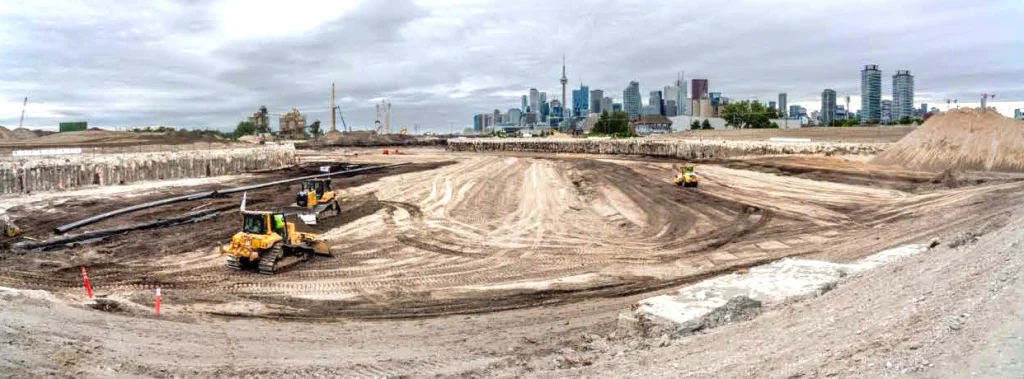
Why the Don Needed a New Way to the Lake
The Don River runs through Toronto and empties into Lake Ontario. Its lower stretch was straightened in the late 19th century. Decades later, crews reinforced the banks to make way for the Don Valley Parkway.
Long before he photographed the waterfront, Ingelevics had explored his Latvian roots through his work. He curated an exhibition of Latvian photography from the glasnost era and made art about his family’s history and the camps that housed Latvian refugees in postwar Germany.
On its way to the lake, the river made a right-angle turn into the Keating Channel. In heavy rain, water couldn’t drain quickly enough and could spill over the banks.
Ingelevics told the Visi audience that a storm on the scale of Hurricane Hazel, which hit Toronto in 1954, could have flooded an estimated 300-400 acres downtown under the old layout.
“It’s a climate change adaptation project as much as anything,” Ingelevics says. The new channel gives the river another route to the lake, and wetlands give floodwater room to spread.
From his Father’s Envelopes to the Waterfront
Long before he photographed the waterfront, Ingelevics had explored his Latvian roots through his work. He curated an exhibition of Latvian photography from the glasnost era and made art about his family’s history and the camps that housed Latvian refugees in postwar Germany.
One family story brought him back to Toronto’s industrial waterfront. His father worked for Smith Transport on Commissioners Street, and Ingelevics sometimes worked summer night shifts there himself.
His father had saved the envelopes from his work correspondence. Ingelevics turned 90 letters addressed to his father into a video about what happened when people tried to spell a Latvian surname they didn’t know.
One envelope said “Inglewick,” another “Inglegwick.” His favourite had the spelling exactly right, followed by a question mark.
Ingelevics says that link to the site helped him land the commission. When Waterfront Toronto, the agency overseeing the renewal of the city’s waterfront, put out a call in 2019, he and Walker applied together and got the job.
Four Exhibitions Behind the Construction Fence
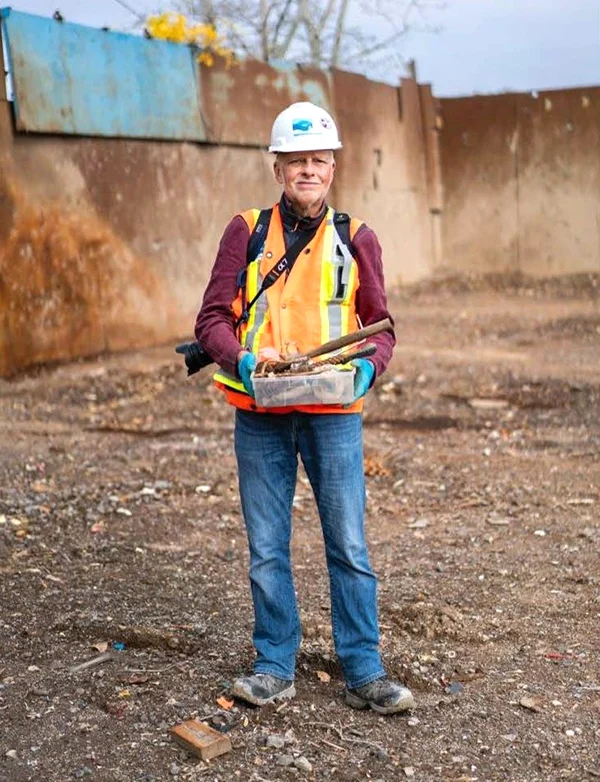
The photographers saw their job as being “the eyes and ears of people in Toronto,” Ingelevics says. The two put up large display boards near the construction site so passersby could see what was happening behind the fence. From thousands of images, they chose just 11 for each exhibition.
Framework (2020) captured views that would soon disappear, including the one from the operator’s window on the old Cherry Street bridge. A week after the photograph was taken, the bridge got stuck in the raised position. It was lowered and never went up again.
Mobile Landscape (2021) showed how crews moved and treated contaminated soil. In How to Build a River (2022), the new channel took shape. Crews anchored logs to the riverbed with stones to create habitat for fish. By Green Work (2023), people were planting trees by hand where heavy machinery had once worked.
The two photographers’ book, How to Build a River, came out in September 2026. Find the book here.
Join Visi for on First Thursdays
Come for Chef Ingo’s lunch and stay for live music at the Toronto Latvian Centre. Visi’s First Thursday programs are in English, and everyone is welcome.
Thursday, Dec. 3 | Jazz by Request with Ori Dagan and Mark Eisenman
Hear jazz classics in Ori Dagan’s rich bass-baritone, with Mark Eisenman setting the swing at the piano. Send a favourite jazz tune to info@visieveryone.org by Nov. 19. If requests pour in, we’ll draw a few from a hat. Yours might make the set!
Thursday, Jan. 7 | Andrew Downing in Concert: Tales of a Year in Latvia
You may have heard JUNO-winning double bassist Andrew Downing on a Toronto stage. At Visi, he’ll share music and stories from the year he spent living in Latvia.
Both Thursdays: Lunch at 11:50 a.m. and concert at 1 p.m. Visi members $25, guests $30. Register for lunch by Dec. 1 for the December concert and Jan. 5 for the January concert. Contact Maruta Freimuta at rsvp@visieveryone.org or 416-233-9552.
Join us at the Toronto Latvian Centre or tune in from anywhere in the world.
Find out more about Visi here.
Mara Gulens, Communications and Programming Lead, Visi
Photos by Vid Ingelevics/Ryan Walker