Hidden behind a wall, past a tram stop and a gas station, stands Tallinn’s oldest surviving monument—a medieval crucifix that has witnessed many eras of violence and upheaval.

Are there monuments in your city that seem to hide in plain sight—so quietly tucked away that even locals don’t know they exist?
When I arrived in Tallinn as a migrant, I began walking the city with eyes open to the unnoticed. One day in the summer of 2023, I found something that even an acquaintance of mine who was born and raised in the city had never seen. So I decided to show it to her, to surprise her.
We stepped off the tram at Tallinn-Väike, and, leaving the gas station behind, walked through wet grass along the remnants of a crumbling brick wall, its surface covered in layers of graffiti. The rain had just ended. We entered a small inner courtyard. And then she saw it. Lowering her dripping umbrella, she gasped: “Jesus in a garden!”
And there he was. Not a statue, but a carved medieval crucifix, weathered and exposed to the open sky. We were standing before a centuries-old stone cross, its surface bearing the figure of the crucified Christ, in the shade of garden shrubs, quiet and unexpected.
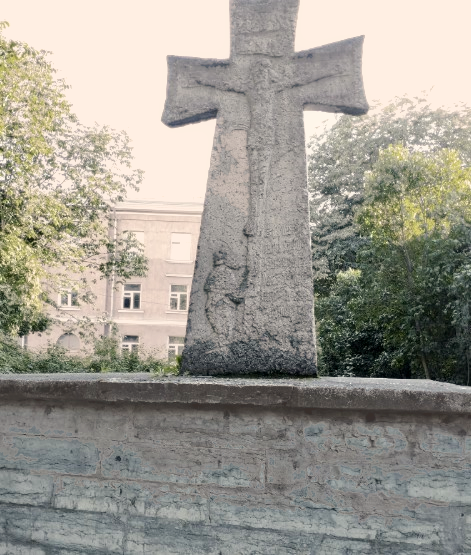
We circled the cross. On the other side, we saw a patch of Gothic lettering carved directly into the stone, almost completely eroded by time. A modern plaque beneath the cross preserves the original dedication, written in Low German. It reads:
“On September 11, 1560, Mr. Blasius Hochgreve was mercilessly slain by the Russians. May God be gracious to him and grant him forgiveness on the Last Day”.
This crucifix is believed to be the oldest surviving monument in Tallinn, and yet few people seem to know it exists.
In September 1560, during the first phase of the Livonian War, Russian forces under Ivan IV clashed with Tallinn’s defenders near the city’s gates. Local militia—including nobles, merchants, craftsmen, members of the Blackheads’ Brotherhood, and even serfs—managed to repel the advancing army, preventing a full-scale siege.
Among the approximately sixty Tallinn residents killed in the fighting was Blasius Hochgreve, a wealthy merchant and prominent figure in the city. His story beyond that remains unclear.
The clash occurred near what came to be called Jerusalem Hill, a small elevation now lost in the cityscape, but once a battlefield that etched itself into Tallinn’s history. Among the approximately sixty Tallinn residents killed in the fighting was Blasius Hochgreve, a wealthy merchant and prominent figure in the city. His story beyond that remains unclear.
According to some accounts shared in online forums, three crosses were originally erected in memory of those who fell in the 1560 battle. One was dedicated to Blasius Hochgreve, another to Lüdtke von Oytinen, both city councillors, and the third cross to ten members of the Blackheads’ Brotherhood. The latter two monuments were later moved to the Tallinn City Museum and are now displayed in the Dominican Monastery.
Only the cross of Blasius Hochgreve remains in its original location. Still, weathered, and alone. The small square where it stands is nestled in a quiet corner, between the busy streets of Tondi and Pärnu maantee. It’s tucked between the tram stop Tallinn-Väike and the Tondi tram terminus.
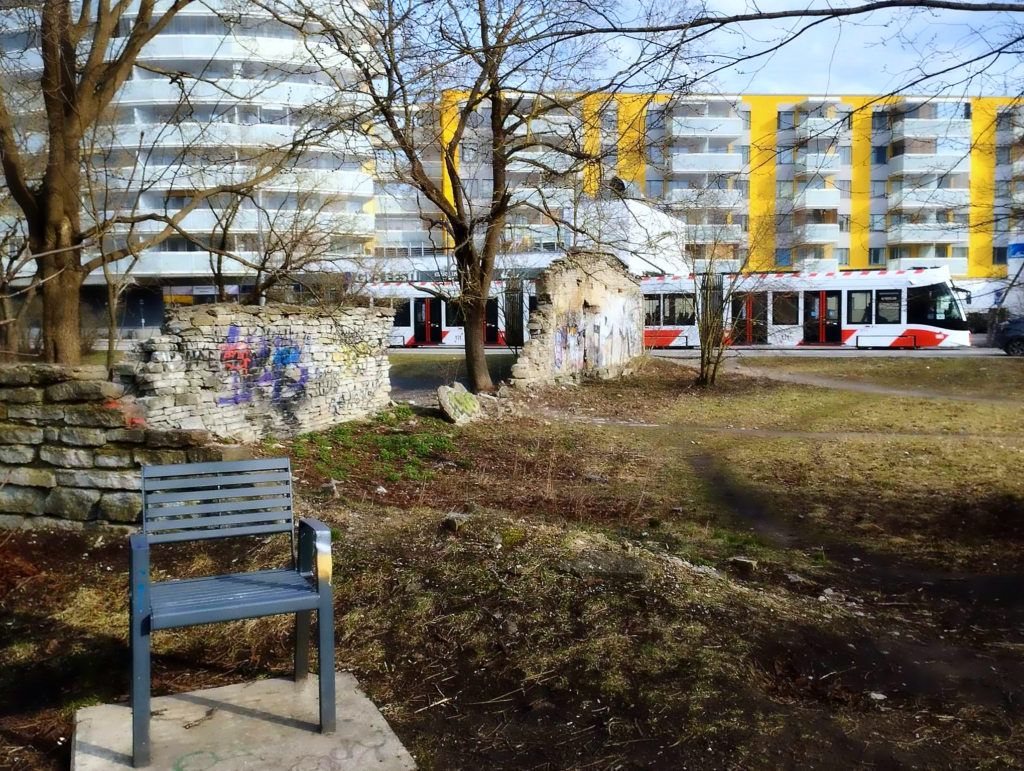
The cross stands in Kitseküla, a subdistrict of Tallinn named after the old Goat Village, where herders once grazed livestock and, later, townspeople built summer estates to escape the city’s noise. The monument stands a good mile from the heart of Tallinn, well beyond the Old Town’s reach, enclosed by a crumbling wall on one side and an aging building from the Soviet era on the other.
The ruined wall gives way to a fence, while another brick wall—intact, tall, and windowless—stands at an angle, with ivy slowly climbing its surface. Against the backdrop of this wall, the cross takes on the feel of a scene from a graveyard.
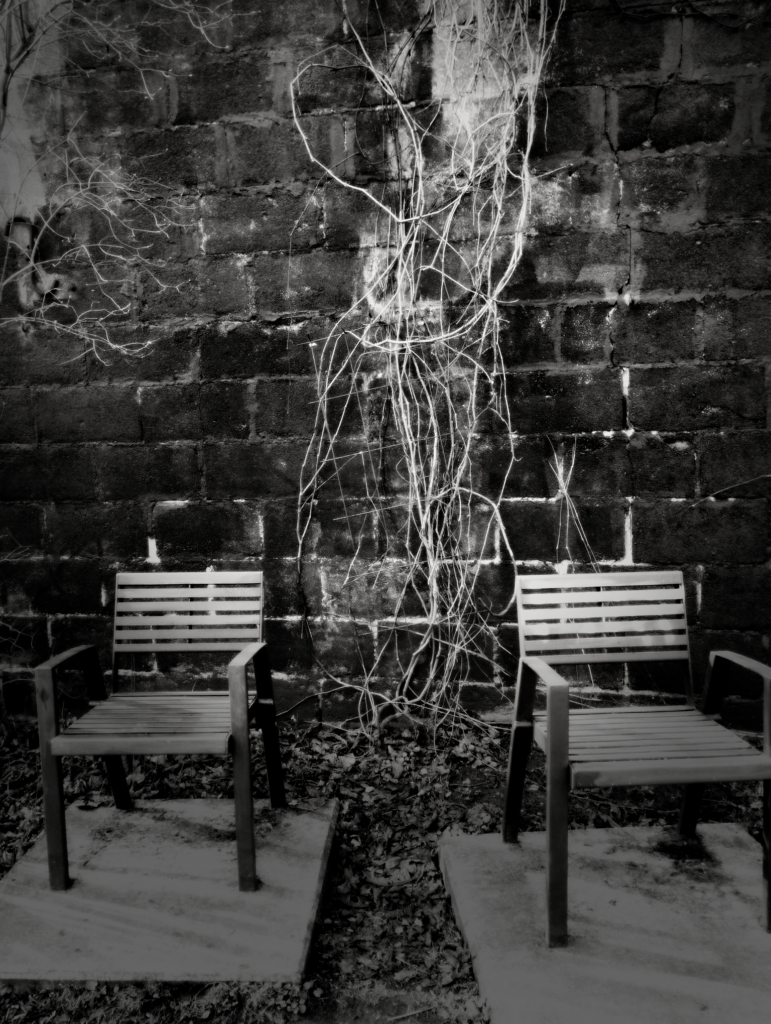
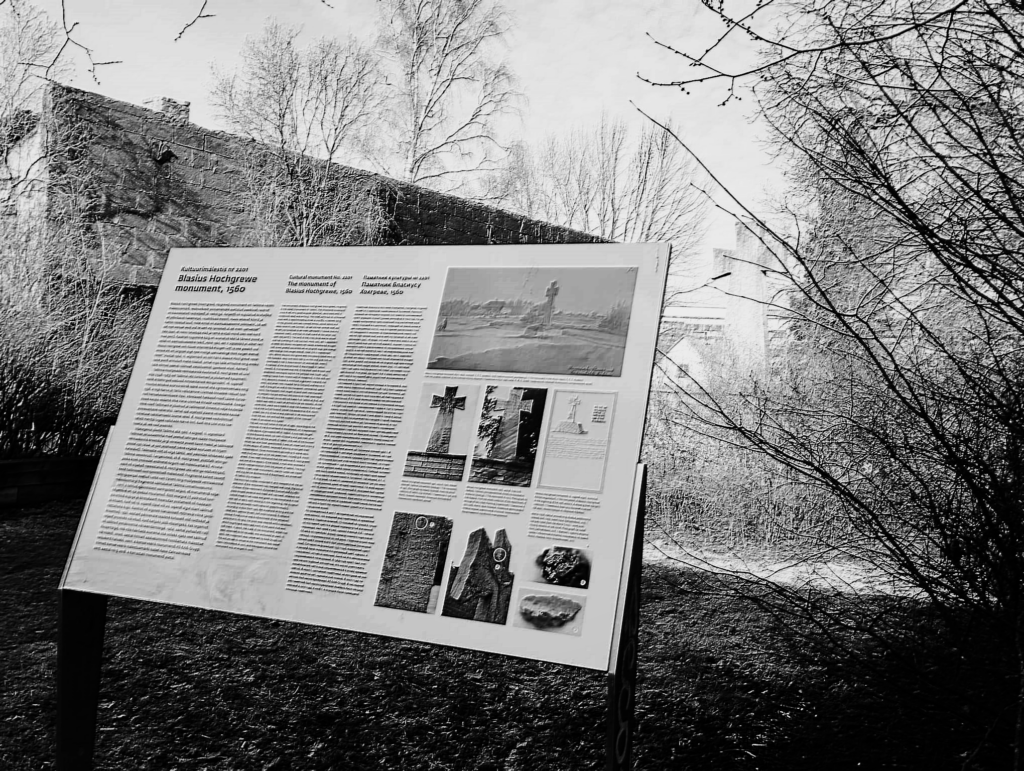
Small metal benches nearby may have been placed to invite visitors to rest, reflect, or perhaps raise a glass of whiskey in memory of Blasius Hochgreve. Though judging by the courtyard’s atmosphere and the proximity of the surrounding buildings such drinks may well be raised for other reasons, too. A plaque offering historical context stands nearby, but since this isn’t a tourist spot, few stop to read it.
According to a 2018 article in Delfi’s tourism section, the Blasius Hochgreve monument was fully restored in 2017, and a small green square was created around it the following spring. The goal, according to Kesklinn district officials, was to preserve the historic setting and enhance it with benches, snowberry bushes, and climbing plants. At the time, it was hoped that this quiet space would invite reflection and help residents recognize the site’s historical importance. When I first visited the square in August 2023, the space still matched that early vision: a neat, contemplative corner of the city.
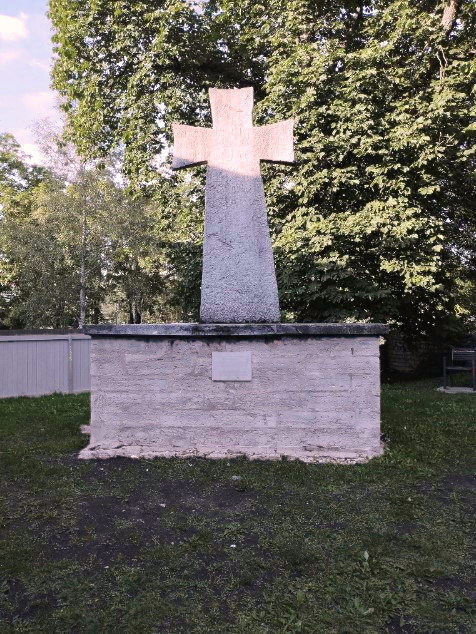
Behind it, a pale wooden fence, not yet claimed by graffiti.
Photo: Jerry Mercury
Today, the square still stands, once a tidy patch of ground with its cross and benches. But it now feels increasingly like an island adrift in neglect.
The fence beside it is layered in graffiti, and the crumbling brick wall nearby no longer protects the space in any meaningful way. The tall wall, once adorned with climbing plants, has been painted black: a failed attempt to cover earlier vandalism. The paint now partially coats the stems of the plants, which may hinder their growth and future foliage. Meanwhile, new tags are already appearing across the darkened surface.
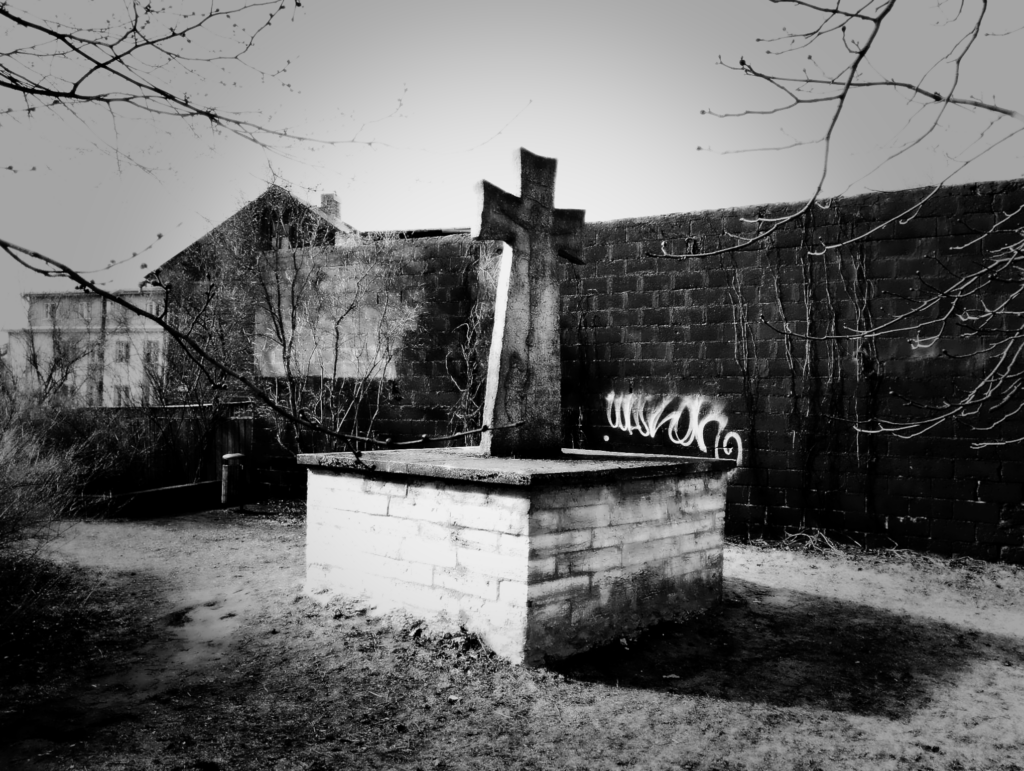
Photo: Jerry Mercury
Discarded bricks from the ruined wall lie scattered near the base of the cross. Broken glass glints near the benches, and other litter collects in the bushes. The benches are grubby, a reminder that people gather here casually, without much care. The place no longer feels peaceful; it feels uneasy, like a space left to whoever claims it after dark.
Behind the square, a parking lot stretches toward a gas station and a convenience store. The noise and ordinary mess of the city is pressing close, but the cross stands, still. The roughness of the surroundings only deepens the sense that the monument remains vulnerable, overlooked, and quietly enduring.
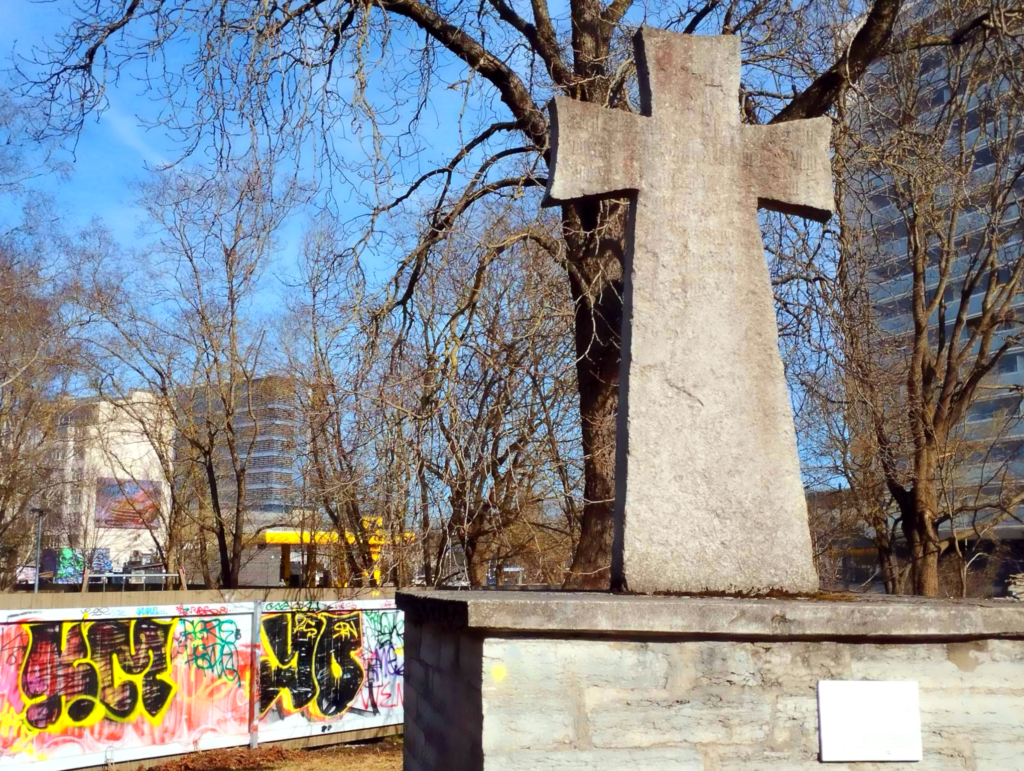
Perhaps the cross waits, for recognition, for reverence. Perhaps it waits for change: for the wall to be rebuilt strong enough to shield, with a small gate woven with climbing plants, offering quiet entry. Perhaps the parking area nearby could be reduced or removed, and a community garden take its place, a space where memory grows alongside rosemary and thyme. Not a place for loud gatherings and vandalism, but a corner of the city meant for reflection, for remembering what was, and noticing what still remains…
Or perhaps it waits for nothing at all. It simply stands. Not waiting, not asking, just being.
And that is why it stays with you: because it stands. Still, unprotected, unambitious, and without asking to be remembered. A monument not to glory, but to endurance.
A crucifix like this would feel expected in a Gothic cathedral, or in the heart of the Old Town, surrounded by medieval façades and tourists with cameras. But here, half-hidden in a courtyard between a gas station and a railway line, it strikes differently. It speaks not only of the distant past, but of the present: of cities built on forgotten grief, of religious forms that outlast the faith they once represented, and of how violence and the urge to victimize others continue to shape our world.
The cross in this courtyard no longer belongs to any religion. It has become something else: a remnant, a metaphor, a question. The surrounding area evokes not only an old, forgotten cemetery, but also Golgotha and Gethsemane, and at the same time, a post-Soviet shadowed nook where drunks gather and boys spray graffiti on the walls. The monument is both sacred and forsaken, both timeless and terribly local. And perhaps that is its power: the cross is not hidden behind glass or guarded by velvet ropes, but exposed to weather, to time, to indifference. And that is why it stays with you: because it stands. Still, unprotected, unambitious, and without asking to be remembered. A monument not to glory, but to endurance.
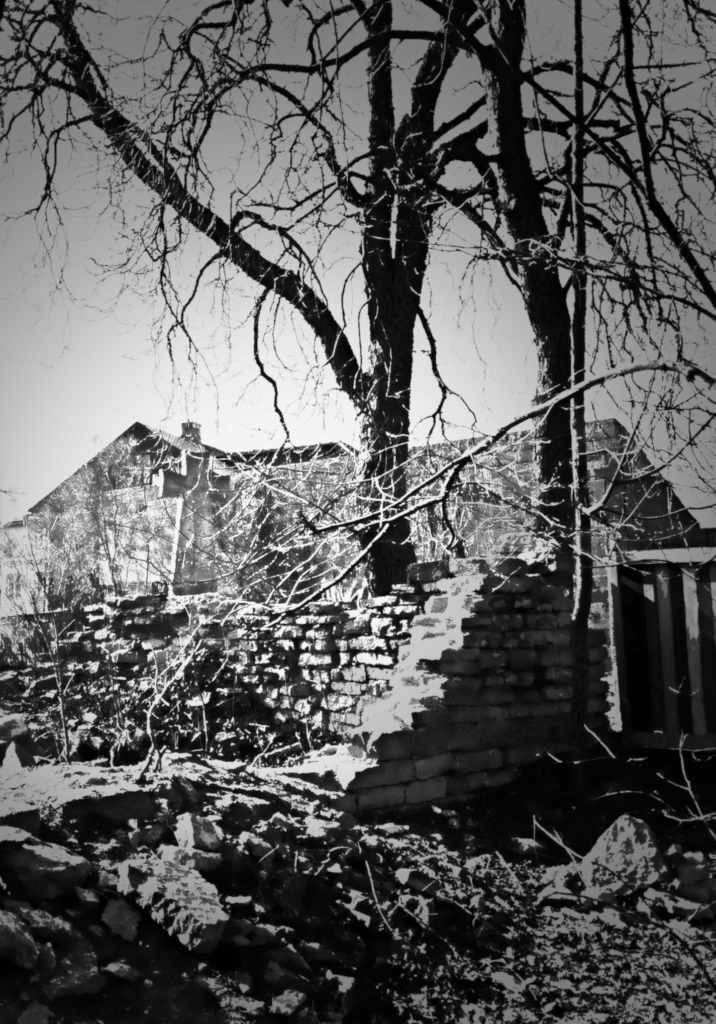
Estonia has seen invasions before from the east and from the west, long before the Soviet occupation and long before the shadow that hangs over the region today.
This cross, carved five centuries ago, still stands. It remembers. In the noise of trams, traffic, and casual daily life, this ancient crucifix still asks: what are we doing with the legacy of violence?
Jerry Mercury, Tallinn, 2025