Does a week ever pass by and leave you wondering what happened? You can’t remember what you ate for dinner the day before. The days blend into each other. Contrast that with the first ten years of your life, when everything was shockingly fresh and distinct. That’s also the sensation of travelling to Mexico.
And specifically, to Mexico City, the capital. One of the most populous cities in the western hemisphere. Every day here expands the intrinsic value of time with every new thing you register.
Mexico City—La Ciudad de México, or CDMX—has four pillars that I’d argue make it so memorable and which provide insight for culture in the 21st century. This is obviously an oversimplification, but please consider it a first impression.
History
Many cities value the close bond to their history. Romans have their ancestors’ buildings everywhere around them. The pyramids of Giza are viewable from downtown Cairo. Estonia’s parliament is located within Tallinn’s Old Town, demonstrating the link between modern life and democracy and Estonia’s origins.
It’s worth noting, though, the unique ways in which the past actively participates with the present in CDMX. History shows itself in urban design, aromas, tastes, as well as language.
For one thing, the nation’s name is directly connected to the name Mexica, which is what the original people of Tenōchtitlan (present-day Mexico City) called themselves. As opposed to “Aztec,” heard more but created after the fact. It’s a bit reminiscent of how Estonians obtained their name via Tacitus’ description of the Aestii people, in contrast to local demonyms like “põhjamaalased” (“northern people”) and “maarahvas” (“people of the land”).
To this day, grasshoppers are called chapulines in Mexico, while in Spain they are saltamontes. Other words of Nahuatl origin include chocolate, aguacate (avocado), and mezcal.
Speaking of language, Nahuatl, the language of the Mexica Empire, is often found in Mexican Spanish. The name of CDMX’s largest park, Bosque de Chapultepec, refers to “the Hill of the Grasshopper.” To this day, grasshoppers are called chapulines in Mexico, while in Spain they are saltamontes. Other words of Nahuatl origin include chocolate, aguacate (avocado), and mezcal.
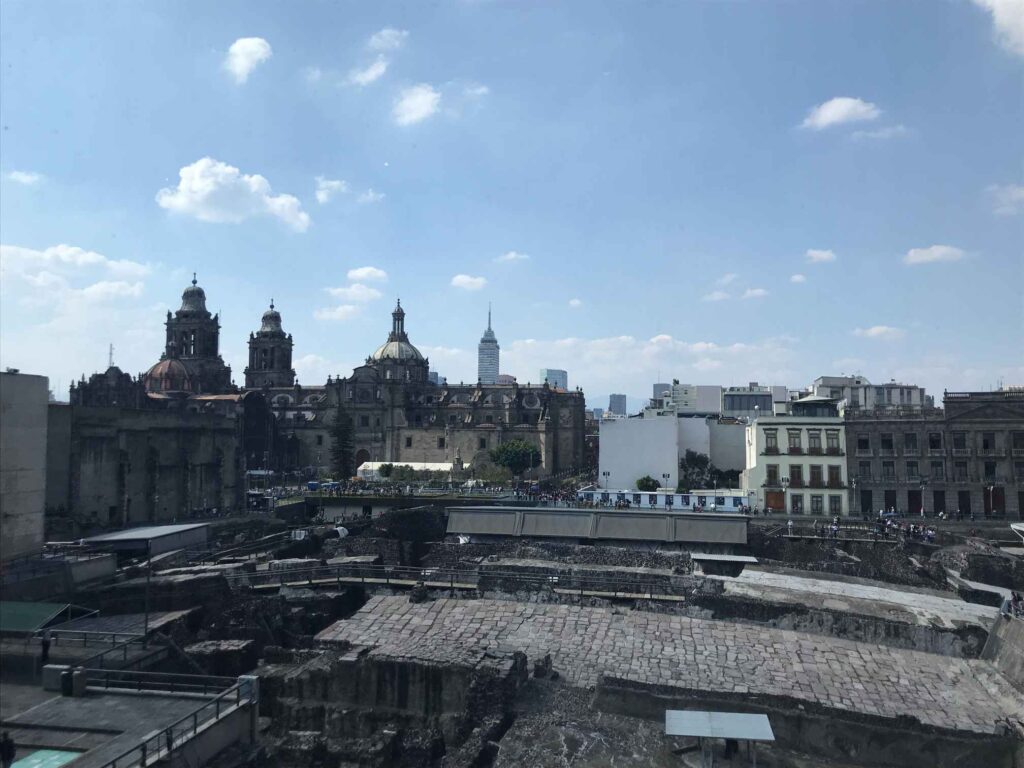
In the dense city square of Zócalo, markers of pre-Hispanic Mexico stand side-by-side with the era of colonization and the present day. Here, Mexico City Metropolitan Cathedral was built on top of the sacred grounds of the ancient Templo Mayor, the primary temple of Tenōchtitlan. The Spanish used the stones of the Templo Mayor to build the cathedral: a symbol of conquering the Mexica Empire, but also symbolic of the Mexica culture continuing to be a vital component of the local identity.
Exploring the cathedral inside on a Sunday, a choir and dozens of parishioners sang during mass. Outside, locals led ancient cleansing rituals in the square, burning copal resin as per tradition. On the other side of Zócalo, sub bass frequencies from a concert soundcheck swept back towards the ruins of the temple.
Food
In Canada and the U.S., Mexican cuisine may feel familiar, but there’s a lot that’s harder to find outside of Mexico, and what we do find tends to be prepared differently.
Tacos, for instance. In the taco epicentre that is CDMX, one often sees six components at work, whether eating on the street or in a restaurant: a corn tortilla, meat, chopped white onion, cilantro, a salsa, and a squeeze of fresh lime on top. Some meat types include pastor (pork shoulder cooked on a spit called a trompo, served with sliced pineapple), tripa (tripe), lengua (slow-cooked beef tongue), suadero (cow belly and leg), carnitas (another variation of pork), and chorizo. The tacos are smaller and usually more affordable.

Corn itself was first grown in Mexico thousands of years ago, and then there are many other dishes derived from corn. For example, chilaquiles, a breakfast dish with fried tortillas, cream, eggs, salsa, and onions; flautas (rolled tightly, filled with meat/potatoes, and fried); tortilla soup; tostadas (fried flat). At one point, a man on the canals of Xochimilco punted over and served elote, corn on the cob covered in a creamy sauce, chili powder, cotija cheese, and lime. There’s also pozole (a restorative soup containing hominy and meat) and a whole spectrum of traditional mole sauces.
Fotogalerii
Urban Action
CDMX is a busy place. On certain days, like New Year’s Day, you’ll see no traffic. At which point you can quietly enjoy places like the ancient city and pyramids of Teotihuacán. On other days, getting around can be more challenging. But pause and you’ll notice the movement of crowded private buses, bread vendors ringing bells, street-level advertising pitches, organilleros in tan uniforms cranking songs on organs, and rapid-fire taco stands. Even after a 6.5 magnitude earthquake swayed buildings on the morning of January 2nd, it didn’t take long for everything to spring back into action.

Folk Art and Culture
And let’s not forget the colour, form, and texture that is brought to Mexico by its craft traditions. By the second day there, one is intoxicated by the beautiful work of artisans, many of whom sell their work in markets like Mercado de Artesanías de La Ciudadela. Tapestries, crockery, sculptures, belts, bags, embroidered shirts, and mariachi instruments. Especially intriguing among all of this are alebrijes, the colourful, detailed sculptures of mythical animals first created by artist Pedro Linares after he saw them in a fever dream.

The thing is, this was not hundreds of years ago, but in the 1930s. It’s modern folk culture. In subsequent decades it became a celebrated object of Mexican art and found a connection to existing wood-carving traditions and the beliefs about spiritual guardians of the Zapotec people in Oaxaca.
Seeing the pulse of history in Mexico, but also how culture is continually transformed by contemporary practitioners today, tells us that folk culture can and will continue in relevance, even in a faraway, tech-heavy future.