Makers and consumers of art, whether that’s a five million dollar David Hockey or a five dollar fridge magnet, account for all of us. So we can’t skirt around this topic.
The issue with this anxiety is that it assumes the labour of the limb is more vital than the labour of a designer. If value is derived solely from the difficulty of the execution, then a machine is just a more efficient brush. But if value resides in the intent, like the decision to place a specific figure in a specific place, then a hand has always been a secondary instrument. Estonian-American painter Mark Kostabi understood this long before the first complex, large language model was trained. He shaped his career around art consumers’ unease with “unhandled” artwork.

Kostabi’s trajectory began in the displacement of his Estonian post-war refugee parents, Kaljo and Rita. As detailed in a Ajakiri Kunst profile, fleeing Soviet occupation, moving through DP camps in Germany, and settling in California with few resources required tenacity. Growing up in Whittier, the young Kostabi was an outsider by both heritage and temperament, likely impacted by the low self esteem that’s seared into immigrants. But the love and creativity of his parents, both musicians, gave him the tools to succeed. When he arrived in New York in 1982, he began to conquer the very idea of the Artist, with a capital A.
The ’80s and ’90s provided the perfect environment for his own brand of provocation. In an era defined by the enfant terrible personas of his peers Jean-Michel Basquiat and Keith Haring, Kostabi became a stick of dynamite in the art market. He founded Kostabi World, a studio where assistants executed the paintings while he focused on the branding and ideas. He is famously candid about this, often to the point of self-sabotage in the eyes of traditionalists. The Art Story notes his role as a postmodernist who embraced appropriation and mass production, while Judd Tully’s 1991 Washington Post article “Painting by the Numbers...” captured the friction he caused by treating art as a transparent commodity. He mocked the art-buying market by showing how the proverbial sausage was made and making a commentary on what it takes to be a “star.” Stepping further back from the picture, as an Artsy editorial points out, Kostabi was dismantling a romantic myth about being an artist. And it attracted hatred. But it also attracted the interest of artists, art lovers, and collectors, including Andy Warhol (Kostabi’s hero), Arnold Schwarzenegger, Debbie Harry, and Bill Gates.
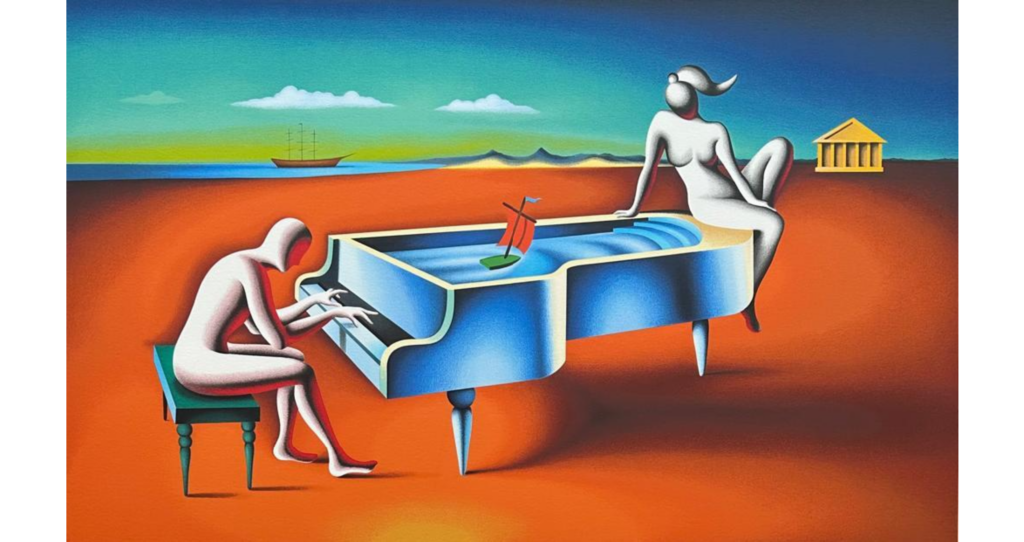
"Despite the lack of faces, their partying, playing, commuting, intimacy, and so on are joyful. If a little bit eerie... their pale souls are enriched by the saturation, shadow, bend, and structure of their surroundings, which are thrilling."
Forgetting about the conversation adjacent to the art, there is a distinct mystery in Kostabi’s paintings. His figures are faceless, tubular, grey. The artist describes these figures as “simplified faceless protagonists in narrative contexts that are universally relatable.” In a way, despite the lack of faces, their partying, playing, commuting, intimacy, and so on are joyful. If a little bit eerie. They’re not weighed down by the baggage of individuality. But then, their pale souls are enriched by the saturation, shadow, bend, and structure of their surroundings, which are thrilling.