Tammsaare read in seven languages and translated into Estonian from three. He was influenced by Shakespeare, Goethe, Homer, Cervantes and – dare we say – Western Civilization? As a writer, his themes were rooted in Estonian life and folklore. His perspective, however, was from that of a 20th century Renaissance man.
Jaan Kross, also a polyglot, was the great novelist of the grey period. Kross thrived with his extraordinary dexterity in getting his work past the Censor, in effect; producing fine prose at a time when writers were expected to be cheer-leaders for the Communist Party.
Soviet Censors examined manuscripts, line by line, looking for the tiniest of “mistakes” – such as a reference to Estonia, as opposed to, Soviet Estonia. Kross presented them with historical novels – about a tyrant's oppression of an innocuous dissident, for example, correctly calculating that the Censor wouldn't see the parallel to Soviet life. This worked only because the hard-headed loyalist fit for the Censor's job was blind to injustices in Soviet life. Kross' writing was an elegant, bold trapeze act, high above a Siberian labour camp.
Much of the literature of the grey period was intense, as writers used wit and ambiguity to foil the Censor. Paradoxically, the Censor was mid-wife to some vital literature, as writers would not expose themselves to danger without passion for a truth.
From the green period, the hungover are the dazed and confused who believed what they were fed by the Soviet education system. They learned how to keyboard, rather than how to write. No examples from this genre are included in the Dedalus compendium; although that might be a mistake because few in the anglosphere can imagine just how stultifying such writing can be. One small sample would have shown it all; just as in one small sip, is the flavour of all seven seas.
In a society where the Communist Party was supposed to be infallible and omniscient, logic and epistemology were subversive subjects. The collapse of Soviet restraints on free expression, released a cacophony of competing ideas, both good and bad, among a populace educated to accept ideas rather than appraise them. Some fell victim to hoaxes, ranging from cult religions to get-rich-quick pyramid-schemes.
The community of writers was touched as well. The cheer-leaders for the Party were suddenly unemployed. Dissident writers, were equally at loose ends, as they no longer had the Censor to spar with. In the resulting disorientation, some writers proved to be suckers for imported fashions. Predominant among them – postmodernism, an extreme form of relativism abnegating truth and standards, telling us that what we take to be true merely reflects our cultural background.
Upon inspection, it's pretentious vapouring based on a contradiction – there is no truth, apart from the postmodernist's truth – that there is no truth. Estonian writers haven't swallowed this with a single gulp, perhaps, because it's too close to the Marxist postulate that, what we take to be true is shaped by our material conditions. That too is based on a contradiction, as it doesn't apply to Marxists.
A lesson in Marxism, hard across the back, is a memorable experience and, for that, the prospects for Estonian fiction are bright. The hangovers are wearing off and the green we see is new growth.
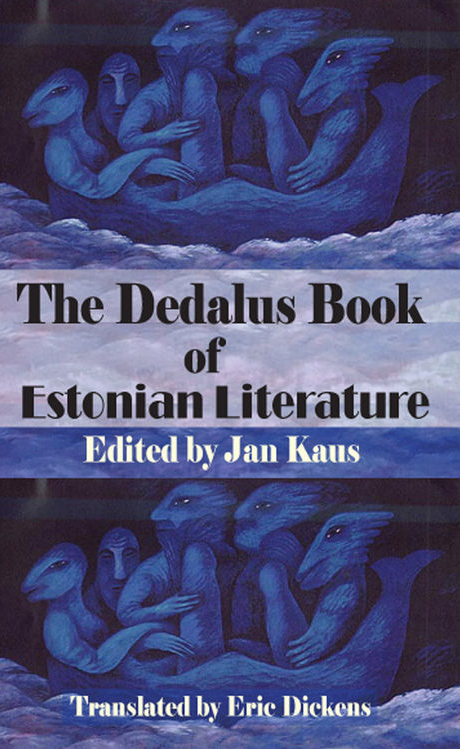
Sixteen writers are represented in this compendium. That is not many, yet it's a judicious selection, effectively representing a hundred years of fiction.
From personal experience, I can testify to the devilish difficulty of translating fiction and, for this, I'm compelled to bow reverently before Eric Dickens. He's a prodigious translator and of the highest quality.
Estonians, mostly out-of-sight and out-of-mind, should be grateful to Eric Dickens for introducing Estonian writers to the wider world and proving that, they too have a place at the table.
Andres Gutman