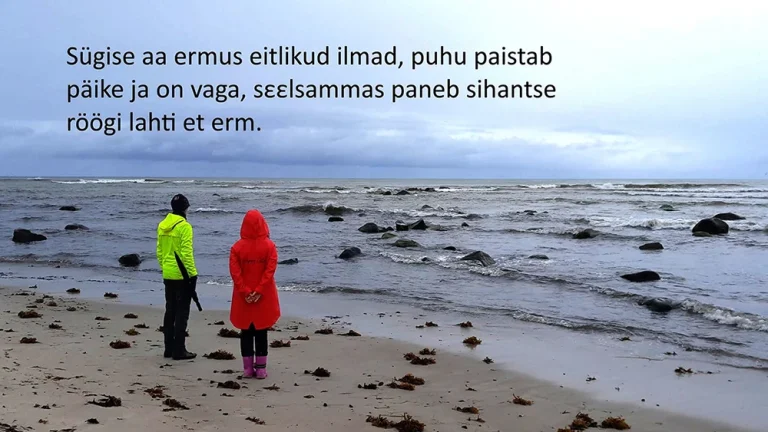
Küllaltki is a tricky word in Estonian. It shows quantity, but in an ambivalent way. It can be barely enough and it can be more than enough. How’s that? Let’s take the word and analyse it in grammatical portions.
It is often useful to start unraveling the meaning of an ambiguous word from its end instead of its beginning. At the end of “küllaltki” we have the suffix (i.e. end part) -ki. These two letters are attached to the end of a word to add emphasis and to indicate the importance of this particular word in the sentence structure as a whole. According to the most authoritative handbook of Estonian grammar (available on the University of Tartu’s Dspace), -ki is the most often used one among these suffixes that can attach themselves to different types of words. For example, in addition to “küllaltki,” which is an adverb demonstrating a certain quality, we can attach -ki to verbs (“läkski” = one actually went), to nouns (“raamatki” = even the book), to numbers (“ükski” = just one), to pronouns (“nemadki” = even these people), to words indicating spatial relations (“juureski” = was or was not even near) and so on.
Täismahus artikkel on loetav Eesti Elu tellijatele
Igal nädalal toome me sinuni kõige olulisemad kogukonna uudised ja eksklusiivsed lood uutelt kolumnistidelt. Räägime eestlastele südamelähedastest teemadest, kogukonna tegijatest ja sündmustest. Loodame sinu toele, et meie kogukonna leht jätkuks pikkadeks aastateks.
Hind alates $2.30 nädalas.