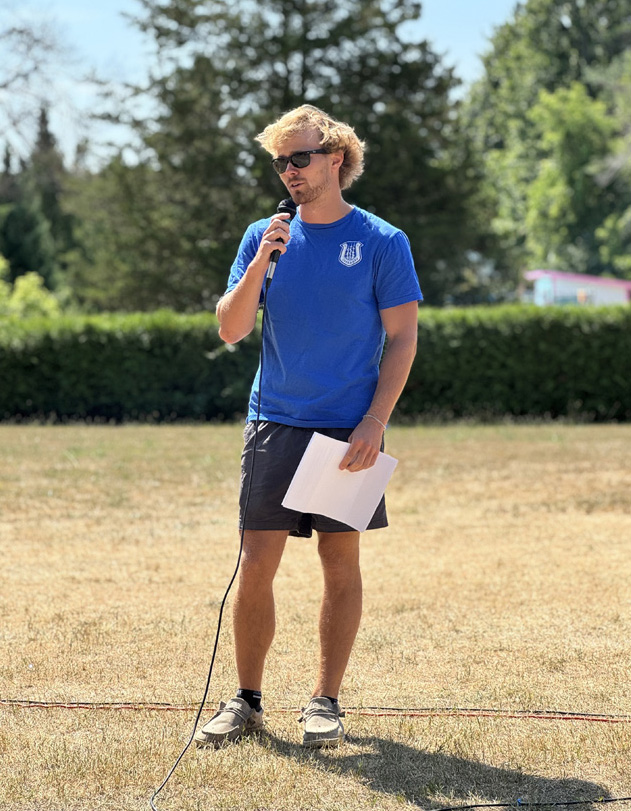
This year, longtime Jõekääru summer camp attendee Lief Kolga is the laagri juhataja (camp director). Lief has been responsible for overseeing and planning the camp’s day-to-day activities, ensuring everything runs smoothly and that this year’s campers are having a summer to remember. Read Eesti Elu’s interview with him below to learn about his experience so far.
How long have you been going to Jõekääru? What are your earliest memories of coming here?
Lief: I started going to Jõekääru when I was two or three until I was sixteen. Unfortunately, during the following year that I hoped to be a kasvataja (counsellor), COVID happened, so it wasn’t until this summer that I was able to work—now I’m a juhataja (leader)! I’d say my earliest memories are from being in väiksed (juniors) playing in konnatiik (Frog Creek) with my friends.
“Jõekääru loves its traditions, including ones that I’ve witnessed growing up as a kasvandik. That’s a very special thing—I’ve grown up doing some things that a whole new generation of kids today are still doing.”
(Lief Kolga)
How has Jõekääru changed since you were a kasvandik (counsellor)? How has it stayed the same?
Lief: I think things change naturally over time things as people come and go (for example, nahatöö [leatherwork] with Härra Veenpere and kudumine [weaving] with Härra Salusoo), but there are some things about Jõekääru that will always keep their charm. For one, Jõekääru loves its traditions, including ones that I’ve witnessed growing up as a kasvandik. That’s a very special thing—I’ve grown up doing some things that a whole new generation of kids today are still doing.
What’s your favourite Jõekääru tradition, then and now?
Lief: That’s tough because there are so many and I love all of them. I’ll start with my favourite one from the past. When I was a kasvandik my favourite things to do were the raids on the girls when they were at saun (the sauna). I also love tantsuõhtud (dance parties). Now as juhataja, I really enjoy doing the eesti keele märgid (Estonian language badge) because you can see how much it means for the campers to get the märk.
What’s been the most rewarding part so far?
Lief: Being able to speak eesti keel and be around eestlus (Estonianness) every day. That’s something that’s been hard having been away at university. The other thing is being able to help schedule and plan things. Seeing that I can help make Jõekääru fun for the new generations of kids means a lot to me.
“I remember the little moments: playing cards during puhketund (rest break), inside jokes with my friends. I hope they remember experiences like those, because they go a long way.”
(Lief Kolga)
What do you hope the kasvandikud will remember about this summer in the future?
Lief: Thinking back to when I was a kasvandik, I remember the little moments: playing cards during puhketund (rest break), inside jokes with my friends. I hope they remember experiences like those, because they go a long way.
Why do you think camps like Jõekääru are important for cultural connection today?
Lief: Whenever you talk to someone in the Toronto-Estonian community, it's likely they have some kind of story of coming to camps like Jõekääru, or have family that did. I think Jõekääru is one of the most important parts of our community. Coming to Jõekääru for several weeks lets you form deep relationships with other Estonians and eestlus that last for a long time.
Responses have been edited for clarity and length.
This article was written by Natalie Jenkins as part of the Local Journalism Initiative.