Subscribe Menu

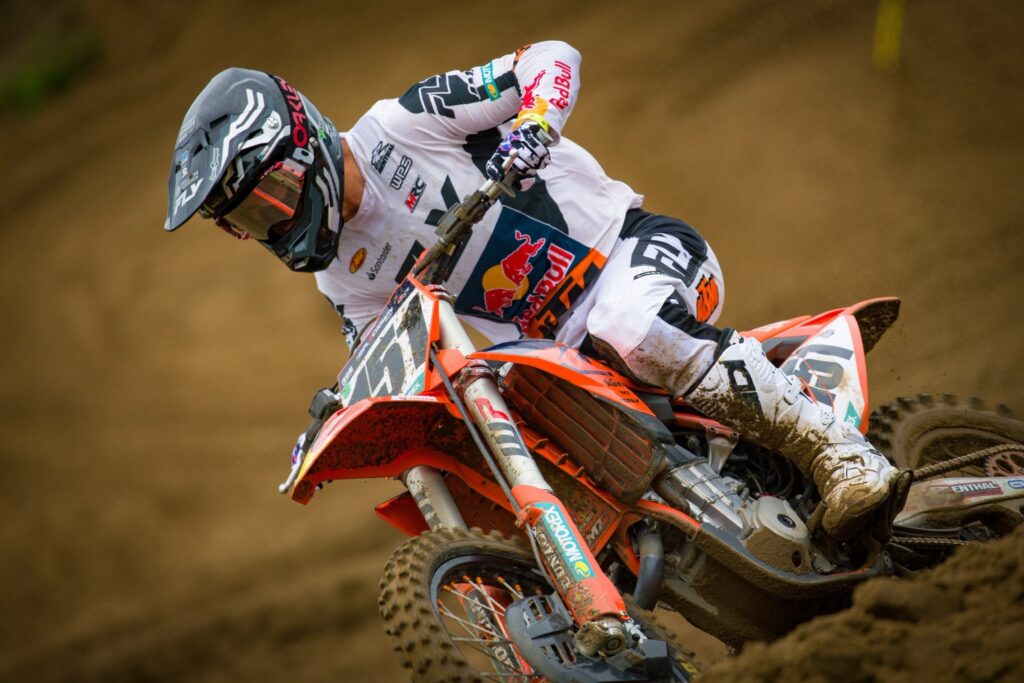
Harri Kullas takes on the Triple Crown Series across Canada

interview by Vincent Teetsov

When Estonian-Finnish motocross veteran Harri Kullas signed with the KTM Canada Red Bull Race Team for the 2026 season, he brought a wealth of international experience to North America. Born in Tallinn and raised in Finland, the thirty-four-year-old racer has spent over a decade competing at the highest levels of the sport, including seven full seasons in the MXGP World Championship as well as national series in Great Britain, Spain, the Netherlands, Brazil, and the United States.

Competing in the premier 450 Pro class of Canada’s Triple Crown Series, Kullas has spent the summer battling across eight demanding rounds spanning Western Canada, Québec, and the Maritimes. Sitting near the top of the championship standings, Kullas spoke about his transition to Canadian racing, the physical reality of the sport, his roots, and his push toward the season finale.

source: press.ktm.com

VT: From what I understand, you've been racing all over Canada this summer for the Triple Crown Series. Whereabouts are you right now, and how does it feel nearing the end?

HK: We are based in Bromont, Québec. We have lived here for the three summer months, training, riding, running, and cycling locally. It’s an active community and a great place to stay. The first month felt a bit slower as we settled in and learned the area, but once the racing started, July moved very fast. We had five race weekends packed together. It is nice to have a condensed championship, finish strong, and then return home to focus on family and friends in Europe. At the same time, it is a bit sad to see the summer end because we’ve enjoyed Canada so much. Hopefully, we can return next year.

“In a recent thirty-seven-minute moto, I had another rider right on my rear wheel the entire time, trying to pass. You have to stay precise, pick smart lines, protect your position, and keep pushing without making a single mistake.”

(Harri Kullas)

VT: For sports fans who might be watching motocross for the first time, how would you describe the physical and mental demand of racing a 450cc bike at this level?

HK: The initial hurdle is physical. Modern 450cc bikes are exceptionally powerful, and as suspension technology improves, the pace keeps rising. You are managing massive jumps and terrain that changes every single lap. A track might start firm, but ruts and deep bumps form continuously. You have to adapt your lines continuously while pushing your body to its limit.

Mentally, you have to remain completely composed under pressure. In a recent thirty-seven-minute moto, I had another rider right on my rear wheel the entire time, trying to pass. You have to stay precise, pick smart lines, protect your position, and keep pushing without making a single mistake. Between bike setup, weather conditions, starting gate preparation, and physical endurance, the mental load is constant.

VT: You’ve raced across Europe in the MXGP and all over the world. What makes the tracks and racing culture in North America (and specifically the Canadian Triple Crown Series) unique compared to the European circuits?

HK: After seven years in MXGP and seasons in the UK, Spain, Holland, Brazil, and America, I have seen a broad range of circuits. Canadian tracks generally feature longer lap times with plenty of elevation jumps and technical humps. They build in chicanes and slower technical sections rather than long, high-speed straights, which suits my riding style well.

The tracks here are also somewhat less rocky than European courses. Because European events often run across two days with larger rider entries, the circuits there get much more churned up and rough. Canadian tracks are slightly cleaner, but they present their own rhythm.

VT: And not only that, Canadian tracks vary wildly, from deep sand like Gopher Dunes to high-speed elevation changes like Walton Raceway. How do you adapt your bike setup and riding style to such contrasting surfaces from week to week?

HK: Adapting to varied dirt is standard in motocross. While Gopher Dunes is known as Canada’s sand track, it is actually quite manageable compared to the deep, heavy sand tracks in Belgium or the Netherlands.

With experience, transitioning between surfaces becomes straightforward. As a veteran rider, I know how the bike needs to feel on hardpack versus soft sand before I even arrive at the venue. Younger riders often rely on trial and error during weekend practice, but experience allows me to adjust my riding technique and machine settings smoothly from track to track.

source: press.ktm.com

VT: Looking at the 2026 Triple Crown Series format—spanning multiple stages across Alberta, Manitoba, Québec, Ontario, and New Brunswick—how do you manage the travel, logistics, and physical recovery over such a massive geographical area?

HK: Long-distance travel is second nature to me after racing in the United States and Europe. Having a strong factory team behind me like KTM Canada makes a big difference. They transport the motorcycles, spare parts, and equipment to every round, so I can travel light.

I travel alongside my wife and baby, which keeps life grounded. Midweek recovery focuses on physical training, proper nutrition, hydration, and sleep. Eight rounds across Canada is a manageable schedule. With solid team support and smooth flights, the transition into this championship has been straightforward.

source: press.ktm.com

VT: Motocross involves instant split-second decisions at the starting gate and through the first turn. What goes through your head during those final seconds before the gate drops?

HK: Everything moves quickly, but preparation makes execution automatic. In those final seconds, you fall back on thousands of hours of practice. Body position, throttle control, and clutch feel have to be second nature.

Before getting on the gate, I analyze the starting grate, test the traction, and visualize the start. I mentally rehearse different scenarios: what to do if I get the holeshot, how to enter turn one cleanly if I am inside traffic, and where to make moves on the opening laps. Once you are behind the gate, the thinking is done, and you simply apply your routine.

“When I was young, my family sacrificed a lot to travel so I could race against the strongest possible competition… I kept my grades high so my teachers would allow me to miss days for international events. That gave me a persistent work ethic that stays with me today.”

(Harri Kullas)

VT: You have Estonian and Finnish roots, both nations with rich motorsport traditions. How has your background shaped your work ethic and approach to racing on the international stage?

HK: I was born in Tallinn and grew up in Finland, spending my early years going to school there while racing primarily under an Estonian license. Finland had a strong motocross tradition from the 1970s and 80s, and I learned a lot from coaches and mentors in both countries about the discipline required to reach the World Championship level.

My dad was also a racer and taught me early on that results only come through hard work. When I was young, my family sacrificed a lot to travel so I could race against the strongest possible competition. Balancing school and racing required discipline. I kept my grades high so my teachers would allow me to miss days for international events. That gave me a persistent work ethic that stays with me today.

VT: For fans used to traditional stadium sports, the physical environment of motocross—rutted tracks, weather changes, roost—is constantly shifting. How much of a race is executing a planned strategy versus purely reacting to the terrain?

HK: Motocross is constantly fluid. You can’t stick to a single plan because the track deteriorates every lap. You have to feel what the motorcycle, the tires, the suspension, and the engine are doing beneath you.

You enter a race with a general strategy based on how you feel on that specific dirt, but during the moto, it’s about instinct and reaction. You are constantly responding to roost, changing lines, shifting weather, and the riders around you. Confidence comes when the bike behaves predictably, allowing you to react instantly to whatever the track throws at you.

VT: Mechanical setup plays a role in your performance. What are one or two specific bike adjustments you and your team focus on most to gain a fraction of a second on track?

HK: Suspension balance is the most critical element we adjust every single weekend. Finding the exact balance between front and rear suspension determines how the bike handles bumps, turns, and acceleration. Sometimes, adjusting a clicker by just one single click makes the difference.

A minor mechanical change sometimes provides as much of a mental boost as a physical one. Knowing you made a precise adjustment gives you the confidence to charge harder. Beyond suspension, tire selection is our other main variable, matching specific tread patterns to hardpack or sandy conditions. Once the chassis balance is set, I can stop worrying about the machine and focus on my riding.

source: press.ktm.com

VT: The Canadian season builds toward the finale at Walton Raceway, an iconic venue with deep history. What is it like racing in front of that crowd, and how does the atmosphere influence your performance on championship day?

HK: This will be my first time racing at Walton Raceway. I know it’s a famous hardpack circuit with history, but I prefer to approach it like any other major race.

Going into the final round, the championship points are tight and everything remains on the line. My focus is strong starts, riding two solid motos, solid wins, and maximizing our points. I came into a brand-new championship, adapted to new tracks, and I was able to fight for a championship and we can be happy about that.

Attending and watching the Triple Crown finale:

The 2026 Canadian Triple Crown Series reaches its finale on Sunday, August 16th, 2026, at Walton Raceway in Walton, Ontario.

Spectator tickets for Pro Race Day on August 16th are available directly through Walton Raceway or the official series website. Gates open at 8:00 AM local time, with practice and qualifying starting at 9:00 AM, followed by afternoon 450 Pro, 250 Pro, and WMX motos.

Fans across Canada can watch the action live on Fox Sports. Moreover, all motos are streamed live worldwide through the Ryde TV app and online at rydetv.com.

For full event schedules, standings, and ticket information, visit triplecrownseries.ca.

This interview was edited and condensed.

Read more