Icy Strait Point, Juneau, and Ketchikan are all in the protected Tongass National Forest. On average, this rainforest receives rain two out of every three days, but we were lucky, as it didn’t rain much on our excursion days.
Mike reminded us that the Russians sold something that did not even belong to them. His mother vehemently denied all Orthodox associations as the Indigenous church is the land and their religion is nature.
Along with the beautiful scenery, we had hopes of seeing lots of wildlife, which is the predominant attraction of Alaska. In our first port, Icy Strait Point, we joined a small excursion to look for brown bears and other wildlife. The van was driven by Mike, an Indigenous Tlingit of the Raven moiety. After a short while, I realized the area was hardly any different from the cottage country roads north of Toronto, which is remarkable when you consider how much further north Alaska is. Our reward for spending four hours in a van, eyes constantly strained for sightings of bears in the bushes, was to finally see one mama bear with a two-year-old cub on the road ahead of us. Both disappeared into the woods within fifteen seconds. Thanks to Mike’s storytelling, the excursion was worth our time and dollars. Mike told us much about his people’s history and culture. The Tlingit were all baptized into the Russian Orthodox faith, as they had been under Russian rule before Alaska was sold to the Americans. Mike reminded us that the Russians sold something that did not even belong to them. His mother vehemently denied all Orthodox associations as the Indigenous church is the land and their religion is nature. Much of what Mike had to say resonated with me.
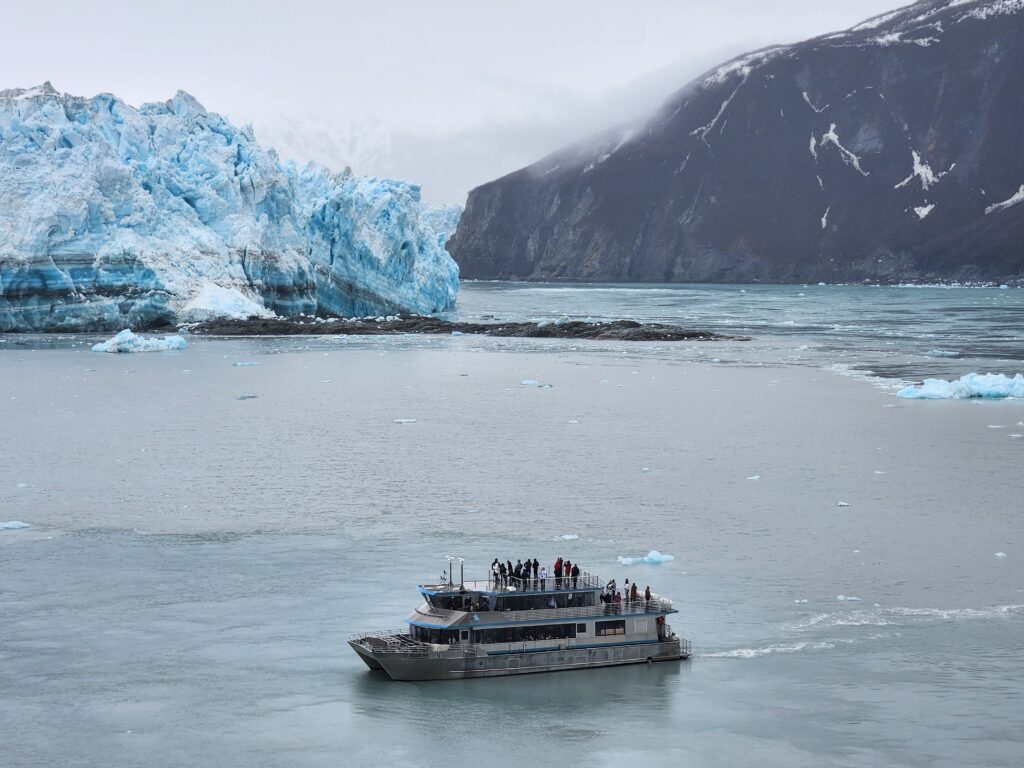
Next stop was the Hubbard Glacier in Disenchantment Bay. I can’t help but think of Shackleton, Franklin, and other early explorers who had nerves of steel to take on the risks of sailing into uncharted icy waters. Our ship got to within a kilometre of the glacier face, but the perspective makes it feel more like 200 metres. The face is 137 metres tall, twice our ship’s full height above the waterline. The glacier is truly a beautiful and impressive spectacle, but in a haunting and threatening way.


The stop in Juneau was for whale watching. A short bus ride to the excursion dock took us past a marsh along the highway. Our bus driver pointed out about a dozen bald eagles off in the distance. The raptors were a good one hundred metres away and the bus was travelling at 80 kph, so it was impossible to take any pictures. This was the extent of seeing the “countless” number of bald eagles we were led to believe we would see.
The weather on the water was cooperative and so were the whales. We witnessed about six different humpbacks surface and a couple individuals honoured our vigilant observation with their tail “flukes”—a flick, where the tail comes fully out of the water and points ninety degrees to the sky.
The tour guides provided a lot of interesting facts about whales. As with the glacier, perspective on the water is distorted and the whales seemed much smaller than they really are. In terms of photo opportunities, this was strike three and I was out of the game. Bears, eagles, and whales are much too distant, too few in number, or obstructed by window glass or other tourists to even attempt to take a picture. Even a tripod with a telescopic lens won’t help when you are in a moving van or a rocking boat.
Ketchikan was our last stop. We had booked a canoe ride on a small lake with a nature hike along the lake’s trail. The canoe was for twelve people, modelled after a traditional local Indigenous canoe. We were surprised that this tour was not led by an Indigenous guide, someone who could teach us more about their local culture and traditions.

Our guides were similar to the tour guides from the whale watching trip—young seasonal workers from the mainland US. They did their best to inform us about various flora and fauna, but much of what they told us was repetitive, with information already obtained from presentations on the ship or from the other excursions.
My friend had some wise words to share when I mentioned my frustration with the lack of wildlife… when a fellow diver complained to the dive leader about not seeing various sea creatures. The dive leader responded sharply, “This is not a zoo.”
I confess that although it was interesting to visit these locations, I was a little bit disappointed. I had hoped for more engagement with the local Indigenous communities. My friend had some wise words to share when I mentioned my frustration with the lack of wildlife. He had been on a scuba diving excursion in the Caribbean, when a fellow diver complained to the dive leader about not seeing various sea creatures. The dive leader responded sharply, “This is not a zoo.”
The few cruises we’ve been to have featured permanent attractions. Whether it is Barcelona’s Sagrada Familia or the volcanoes of Tenerife, you can be sure to get beautiful photos to share. Alas, I haven’t a single picture of an Alaskan animal. In retrospect, I realize this just makes sense. However, like a gambler in the ship’s casino, we all have high hopes: “Wouldn’t it be great to get soaking wet from a humpback whale’s surprise dive just three metres from our boat? Maybe I’ll get an amazing picture of a bald eagle scooping salmon out of the river mouth!” Or “I am going to have the best story ever of a close encounter with a wild and dangerous Alaskan bear!” Nevertheless, the Alaskan panhandle truly is a beautiful and unique habitat to visit—just with an adjustment in expectations.