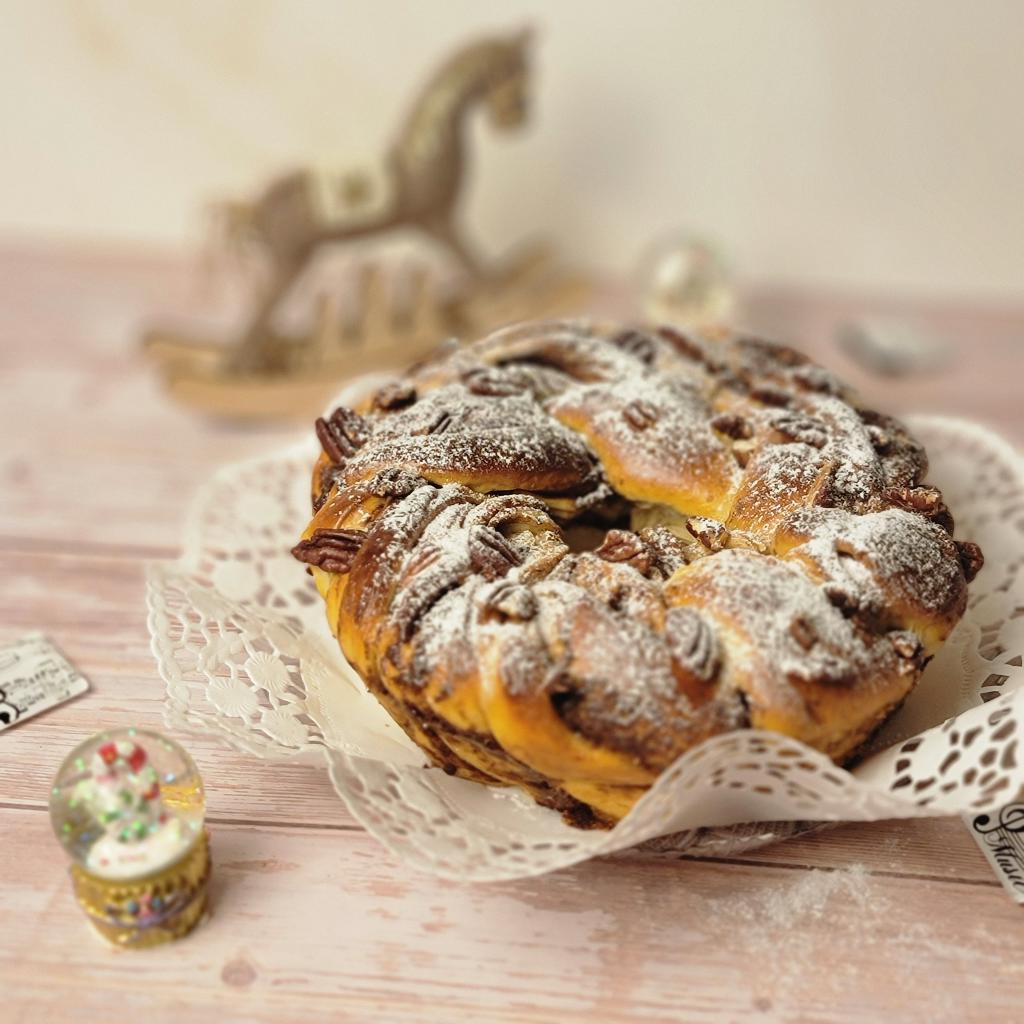
The appearance of double consonants (kr-) at the beginning of the word immediately reveals to us that this must be a loan word. No Finno-Ugric word starts with two consonants. It is always just one, followed by a vowel or two. It’s not difficult to find out either where the word has been borrowed from: all the fancy things used to come to us from Baltic Germans.
The web page of the Estonian Language Institute hosts a separate dictionary of German loan words in Estonian and provides us more answers. The first appearance of the word kringel in written Estonian dates back to 1660, used by pastor Heinrich Göseken, in his book Manuductio ad linguam Oesthonicam (Handbook for the Estonian Language, digitally available through the Eesti Kirjandusmuuseum). It’s described as a sweet, twisted bun. The word can be encountered in the oldest Estonian written sources. Swedes and Latvians know the word, too. It has been borrowed and used in all of these languages and dialects from Lower Middle German quite a while ago.
The most authoritative German dictionary, Duden, identifies kringel as a sweet festive baked good for only the secondary meaning of the word. The first meaning of the word in German is “imperfect round shape.” Not exactly a “ring” (“circle” in Estonian), but a ring-like little thing. I think it describes the shape of a kringel pretty well.
We usually estimate the time of appearance of words in languages by the century it appeared, but here we get not only a pretty precise date, but also the name of the particular individual who brought the word into existence in the first place.
The best English translation for “kringel” that I’ve encountered so far is “event bread,” a translation that I noticed in a social media post by Elin Marley, my colleague from Toronto Eesti Kool. She readily provided an explanation: “This term was devised by Eerik Randsalu a couple of decades ago when we were celebrating the anniversary of the Estonian Republic with our student friends from Guelph and Waterloo Universities, among whom there were some non-Estonian-speakers. We had to explain them what this stuff was, and that’s how it took root in our family’s vocabulary.”
Brilliant! We usually estimate the time of appearance of words in languages by the century it appeared, but here we get not only a pretty precise date, but also the name of the particular individual who brought the word into existence in the first place.
It should be noted, there are several individuals in the history of the Estonian language who are known to have invented new words for our language. The most notable one among them is certainly Johannes Aavik who actively made efforts to modernise Estonian during the first half of the 20th century. Words, such as relv (gun), mõrv (murder), but also ulm (reverie), sulnis (absolutely pleasing), or verbs such as väisama (to pay a visit) or kiinduma (to grow affectionate) all are his brainchildren. There is a small museum dedicated to his work in Kuressaare, his hometown, which I recommend visiting when you happen to be on that side of the ocean.
And while it’s true that “event bread” is a term for kringel in English, not Estonian, it is nevertheless an important achievement in explaining things dear to an Estonian’s (who is living abroad) heart to one’s non-Estonian neighbours.
In the unlikely event that you feel like going for just one slice, rather than the whole loaf, did you know that there’s at least one cafe in Estonia where it’s possible to buy kringel by the slice? It’s located in Rapla.