If this new language derives its words from different sources — for example, if you learned English or a Romance language first and then approach Estonian, which is not an Indo-European language — then you have no frame of reference to learn certain new words.
Some language teachers and learners would advise memorization, blasting through piles and piles of flashcards, to sear the vocabulary and verb conjugations into your brain. This is valid. Repetition works. Perhaps, though, there is a more nuanced way to understand each word, to make it memorable and meaningful.
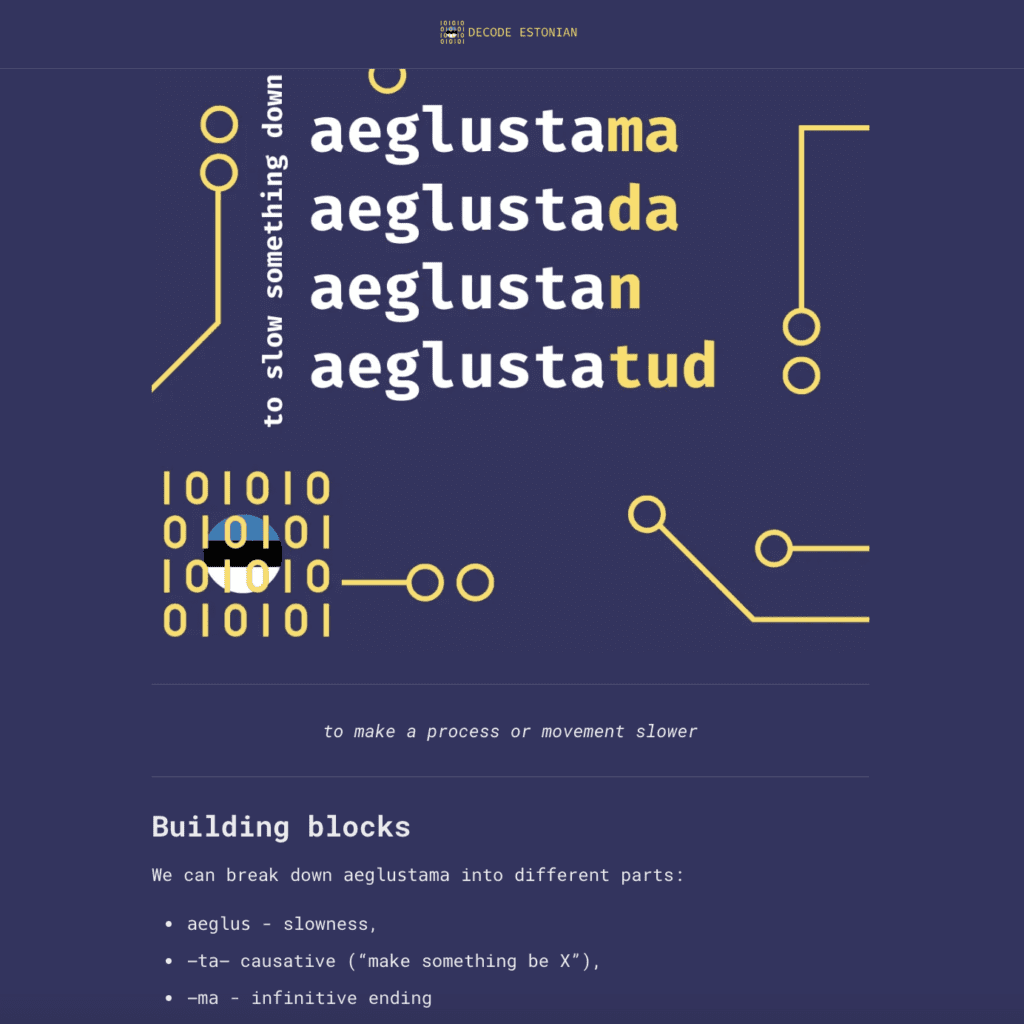
Decode Estonian is one such approach, offering a more analytical perspective on the Estonian language. Started by Dario Hamidi in early 2023, Decode Estonian has published a deconstruction of an Estonian verb, adjective, or noun every few days for the past year. For example, the verb “aeglustama” (to slow something down). This post begins with an image showing the core of the verb “aeglusta” and four options for suffixes added at the end of this core: aeglustama, aeglustada, aeglustan, and aeglustatud.
Below these words, he provides examples of the word in a sentence, telling us what each word means and what grammatical form they are in.
Hamidi then breaks it down further, pointing out that “aeglus” refers to “slowness.” The “ta” segment of the word “aeglusta” is called a causative, indicating “[to] make something be X”, to make something slow in this case. Then “ma” is the infinitive form of the verb. Whether it's olema (“to be”) or magama (“to sleep”), ending with “ma” makes it the most basic form of a verb. Below these words, he provides examples of the word in a sentence, telling us what each word means and what grammatical form they are in.
It's especially helpful when Decode Estonian gives us the exact literal translation of a sentence, because that explains how Estonian speakers approach sentence structure naturally. In the post about the noun “õis” (blossom), we read the sentence “Tartu Ülikooli botaanikaaias on palju kevadisi õisi.” This is literally translated as “Tartu University in botanical garden has many spring blossoms.” Below it is a more realistic English translation: “In the botanical gardens of the University of Tartu, there are many spring blossoms.” But look at the difference. Insightful, right?
Some days, Decode Estonian dives into grammar, like the internal debate that plagues everyone learning to speak Estonian — when should you use “ma” or “da” at the end of a verb? From Hamidi’s perspective, the “da” ending should “be your default choice for when you need to express ‘to do', ‘to drink', etc in Estonian.” Why? Hamidi posits, “The ma-form is actually… referring to ‘the act of X'… This meaning is [not strong] enough for the ma-form to stand on its own or govern a sentence.”
It’s shrewd and efficient. Not surprising considering Decode Estonian’s creator is an engineering manager at Bolt, with a background in software development.
It feels different looking at language learning this way, weighing up the usefulness of a word ending. It’s shrewd and efficient. Not surprising considering Decode Estonian’s creator is an engineering manager at Bolt, with a background in software development.
After reading a couple of posts on the site, you will max-out your limit of free articles and be prompted to subscribe for eight Canadian Dollars per month (or annually, which ends up costing $6.25 CAD per month) in order to receive grammar breakdowns. Free subscribers receive emails with smaller lessons.
If you’re looking for something even more digestible, the Decode Estonian Instagram page, created together with Käti Kase, shares helpful infographics for each of these words and occasional grammar lessons. If you’re scrolling Instagram anyway, it’s worth it to see these words appear on your feed every once in a while, to have the language be part of your day-to-day.
Hamidi also runs in-person, full-day workshops in Tallinn, with a few sessions for small groups of six students each month. The approach is no-nonsense. First, the basic components of language are introduced, then the “structure and rules of Estonian,” followed by practical exercises. This includes some translation, to apply what was learned. Then, the intention is that you will have picked up enough basics in one session that you’re prepared to put in the work to learn the rest of the language.
Learning from someone who didn’t grow up with the Estonian language is bound to offer some helpful insights on the language.
Having grown up in Germany, Hamidi’s first language wasn’t Estonian. But after having studied Latin for many years in school, and going on to study Russian, Hungarian, Greek, and Mandarin Chinese, he decided to learn Estonian and eventually moved there as well. Learning from someone who didn’t grow up with the Estonian language is bound to offer some helpful insights on the language.
It’s refreshing how, from the get-go, Decode Estonian is critical of two common beliefs about Estonian: 1) that it’s “hard” and 2) because it doesn’t have as many speakers as some other languages, there’s no point learning it. The latter is, of course, foolish and skewed. One should learn a language to communicate with people and cultures you want to connect with, regardless of population size. But Hamidi also has a point, that each language’s difficulty level depends on what you know already, particularly about the structure of a language.
With a site like Decode Estonian, you gradually reduce the guess work and start to reveal the logic of the Estonian language.