The other day it was by finding out about the passing of Tom Lehrer in late July. For many of us, there is no need to explain who Lehrer was, and his role in the bohemian underground of the 1950s and the 1960s. A musical satirist who was darkly humorous, Lehrer (the name in German means teacher or rabbi, suitable here as Tom Lehrer was ethnically Jewish but his family blended in by practicing aspects of Christianity, such as celebrating Christmas. Lehrer quipped that his Jewish roots had “more to do with the delicatessen than the synagogue”) was a child prodigy on the piano. However, after a brief burst of classical training, he preferred Broadway show tunes, a great grounding for his songs about political themes, delivered with acerbic, often black humour.
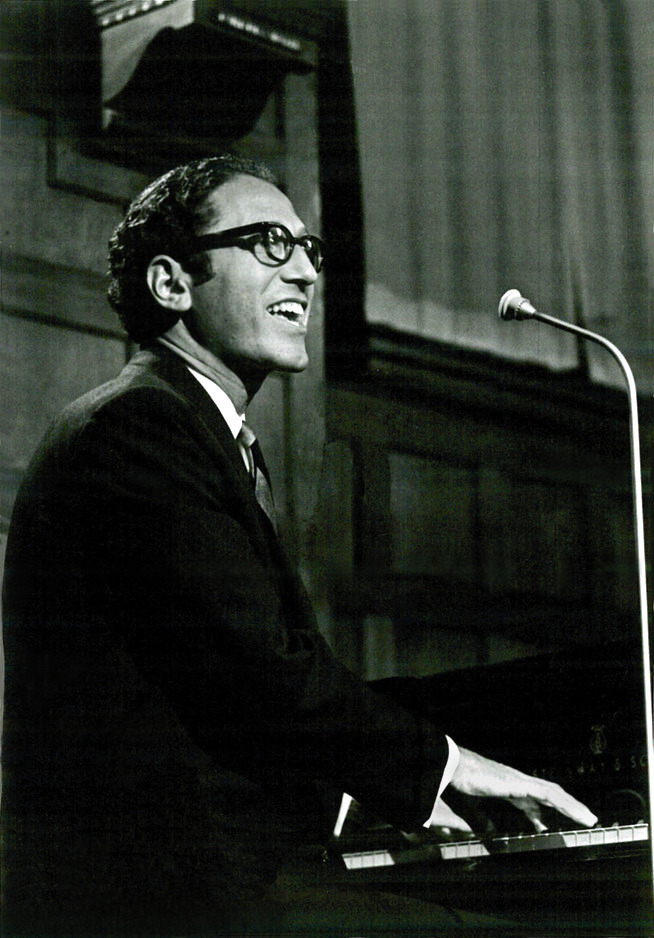
Lehrer lived to the ripe old age of ninety-seven. Which was a surprise to these ears, having thought, considering when his years in the public eye took place, that he was no longer with us. The splinter was aware of his being a mathematician of note. Graduating from Harvard at the age of eighteen numbers, rather than tickling the ivories, were what made Lehrer’s musical career short-lived. Mathematics was his bread and butter, music his chosen form of youthful expression.
Lehrer’s few records were classics. A young and lean one recalls laughing along to the lyrics of “Poisoning Pigeons in the Park,” a cut that Allen played on his classical music program to mark Lehrer’s contribution to satire. Allen also chose to play “Vatican Rag”, mocking the Catholic Church’s decision with the Second Vatican Council (1962-65) to update their practices in an increasingly secularized world, full of protest and upheaval. Sacrilegious lyrics to a ragtime adaptation of a Catholic hymn did not endear Lehrer to many Catholics, who missed the point. The satirist saw the changes proposed as “making the church more commercial.”
Reading the numerous obits online, one comment struck home. Lehrer, when asked why he stopped performing and writing in the 1960s answered that it was the Vietnam War that did it. “Everybody got earnest. My purpose was to make people laugh and not applaud.” Another famous reason he gave much later was that “political satire became obsolete when Henry Kissinger was awarded the Nobel Peace Prize.” For those not familiar with Lehrer’s work, here’s a strong encouragement to read about him and listen to his songs. They’re emblematic of a generation.
As were the satiric songs of Olaf Kopvillem (1926-1997). Villu, as his friends affectionately knew him, took the refugee experience, having to come to terms with a new homeland in Canada, and satirized it better than anyone then or since. He was a master of the veste, or feuilleton in print (writing in Vaba Eestlane), and as a musician pianist and singer, Kopvillem was known for his kupleed (from the French couplet for rhyming satirical songs). Some can be found and heard on YouTube, but unfortunately not all. A personal favourite is Pastoraal, which does not need translating. A splendid number about a cow that refuses to leave the pasture no matter the efforts of the herder. Leaving the cow to ruminate (literally) in the evening and the bovine thoughts that lead to a temporary escape from the humdrum. Much like the desire of many Estonians forced abroad.
A classic Olaf Kopvillem song is his take on the children’s standard “Sauna taga tiigi ääres,” with the intro being Kopvillem’s take on what Miku and Manni were up to in North American exile, sung to the original melody. He then breaks into the famous Kurt Weill “Mack the Knife” melody, and lo and behold, the Estonian words that we all learned at Jõekääru, Seedrioru, or Long Island suvekodud fit that tune just fine.
As we suffer through the dog days of summer, one is well advised to listen to Lehrer and Kopvillem. It’s guaranteed to banish the doldrums. Both proved masterfully that there is a vast difference between doggerel and satire for amusement sake. For those who understand how pointing out our flawed existence is a form of therapy. That music is the medium that best cheers the heart; clever, pointed, and often barbed lyrics that make one able to laugh at the world are truly a treasure rarely found.