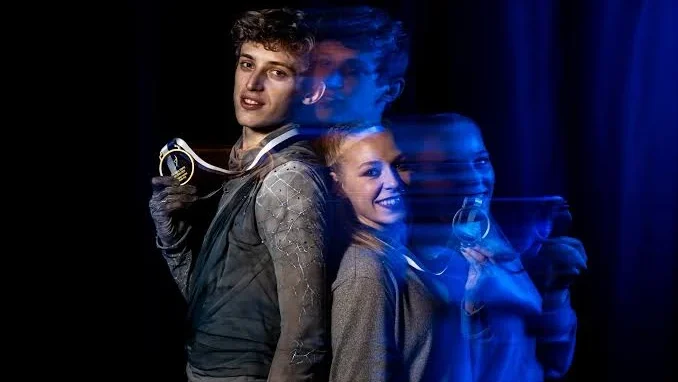
Selevko reached his first Grand Prix Tour medal and placed third in the men’s singles, becoming the third ever Estonian to reach the podium in the competition, while Petrõkina finished in second place in the women’s singles, her second-ever Grand Tour medal and her first since 2023.
To say that the Grand Prix Tour is a big deal is an understatement. The tour, which takes place across six host countries: France, Canada, China, the United States, Finland, and Japan, is figure skaters’ key to the ISU Grand Prix of Figure Skating Final, a competition that is widely regarded as one of the sport’s most prestigious.
The Grand Prix tour works as such: each skater must be invited to compete, skaters cannot compete at more than two Grand Prix Tour stops per season, and the top six in each category qualify for the Final.
Niina Petrõkina pointed out how consistency is key to success in the Grand Prix tour: “Every win is important. It’s harder because to make the Grand Prix Final, you have to skate well twice in a row. For the European Championships, you prepare, you skate once, you win once, and you’re done.” she said.
Qualification for the final is based on a points system through which winners get 15 points, second place gets 13, third gets 11, and so on.
This stop, in Helsinki, Finland, named Finlandia, was the fifth stop of the season and the final stop for the two Estonians. Going into Finlandia, Selevko and Petrõnika had 11 and 13 points, respectively, meaning that qualification for the Grand Prix Final would require excellent displays from the pair.
Thankfully, the two Estonians possessed something that few of their competitors had: a second home advantage. Competing in Helsinki, just a two-hour ferry ride from Tallinn, where both skaters are based, is the closest tour stop to home. Moreover, Mihhail Selevko also attends the South-Eastern Finland University of Applied Sciences in Kouvola, Finland, meaning it is a second home for him. Meanwhile, Niina Petrõkina was seen practicing at the Helsinki Ice Hall, where Finlandia was taking place, leading up to the competition.
“This is my second consecutive birthday at the Finlandia Trophy,” said Selevko. “Last year, I broke my skate during morning practice before the short program, so I’m glad today was a little easier!”
Finland’s proximity to Estonia also allowed for quick and easy access to the competition for Estonian fans, who showed up with flags to cheer on the two skaters. Mihhail Selevko’s first competition day happened to fall on his 24th birthday, and an impressive short program allowed him to climb to the top of the leaderboards, which was better than any present he could have asked for. Selevko was happy with his strong birthday performance, noting, “This is my second consecutive birthday at the Finlandia Trophy,” said Selevko. “Last year, I broke my skate during morning practice before the short program, so I’m glad today was a little easier!”
His second-day performance was even more impressive. He achieved a new personal best in the free skate and finished with a total score of 254.99, over fourteen points more than second place, Andreas Nordebäck. Selevko became the first-ever Estonian to win a gold medal at the ISU Grand Prix Tour and could not have been happier. “I still can’t quite believe I’ve actually done it. It feels incredible!” Selevko said, “It honestly feels unbelievable!”
Up next was Niina Petrõkina. The 22-year-old finished second in the short program and performed admirably in the free skate, achieving a score of 214.06, which is high enough to help her to second place, only behind Japanese skater Moa Shimada.
After exceptional performances, the two Estonians have made history by becoming the first skaters from their country to ever qualify for the Grand Prix Final. Both finished with a strong 26 points after the two competitions, a mark good enough to qualify them before the sixth Grand Prix tour stop takes place.
Petrõkina was incredibly happy that both she and Selevko qualified for the final. “I knew that if I skated well, it was possible. But the fact that Misha came in first—that was his only chance to make it to the final. I don’t know when I last cried after a competition. I didn’t want to go there alone,” she said after qualifying.
Petrõkina and Selevko will compete in the Grand Prix Final in Chongqing, China, between December 10th and 13th. The two have already made history by qualifying; now they have the opportunity to bring home Estonia’s first-ever Grand Prix Final medals and, if they both skate their best, they will bring back Estonia’s first-ever gold medals.
This article was written by Marc-André Perron as part of the Local Journalism Initiative.