Many years on, the centre’s historical origins provide a highly appropriate backdrop for the work of Estonian artist Kristina Õllek, whose practice analyses the ecological and chemical complexities of the Baltic Sea.
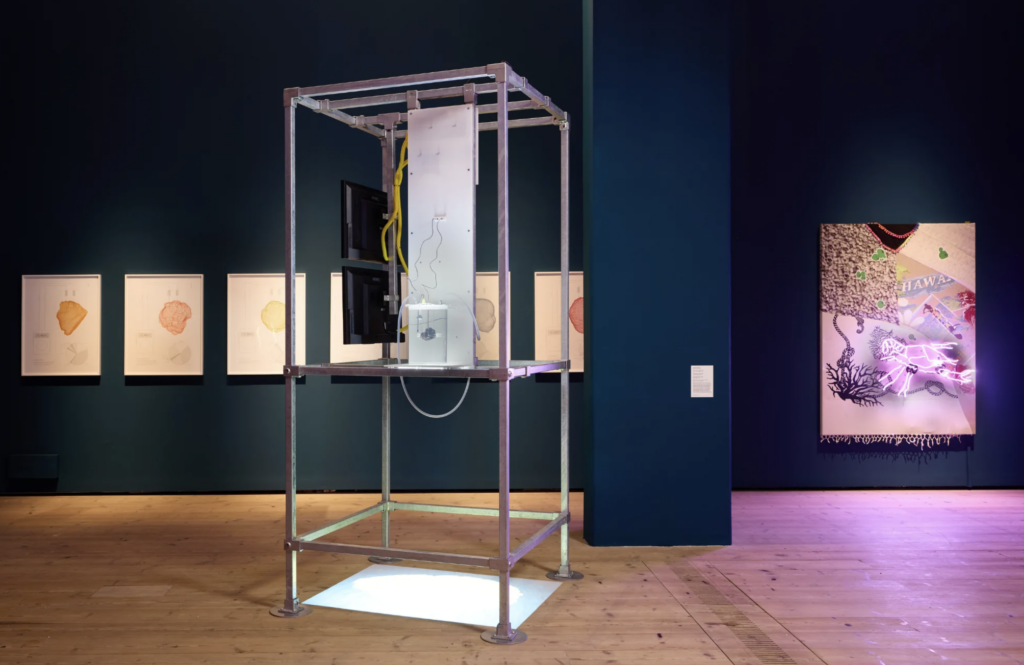
In her exhibition For All At Last Return, Õllek explores the shifting state of marine environments. As described on the Baltic Centre for Contemporary Art website, the exhibition functions as a deep dive into the interconnectedness of human activity and oceanic health. Õllek’s residency at the institution, part of the Baltic|States program, allowed her to expand upon her ongoing research into the Baltic Sea’s “dead zones,” hypoxic areas where oxygen levels are too low to support most marine life. These ecological concerns are integrated into the materiality of her installations. Kogo Gallery, which represents the artist in Tartu, characterizes Õllek’s work as an exploration of the relationship between nature, technology, and human intervention. She often takes a multidisciplinary approach, combining photography, video, and site-specific installations that use biological and synthetic materials. In an interview with Lithuanian National Radio and Television (LRT), Õllek explained her interest in thinking with the sea, viewing the water as a complex chemical entity more than passive background matter. This perspective is evident in her use of sea salt, cyanobacteria, and various minerals that physically alter the texture of her photographic prints and sculptures over time.