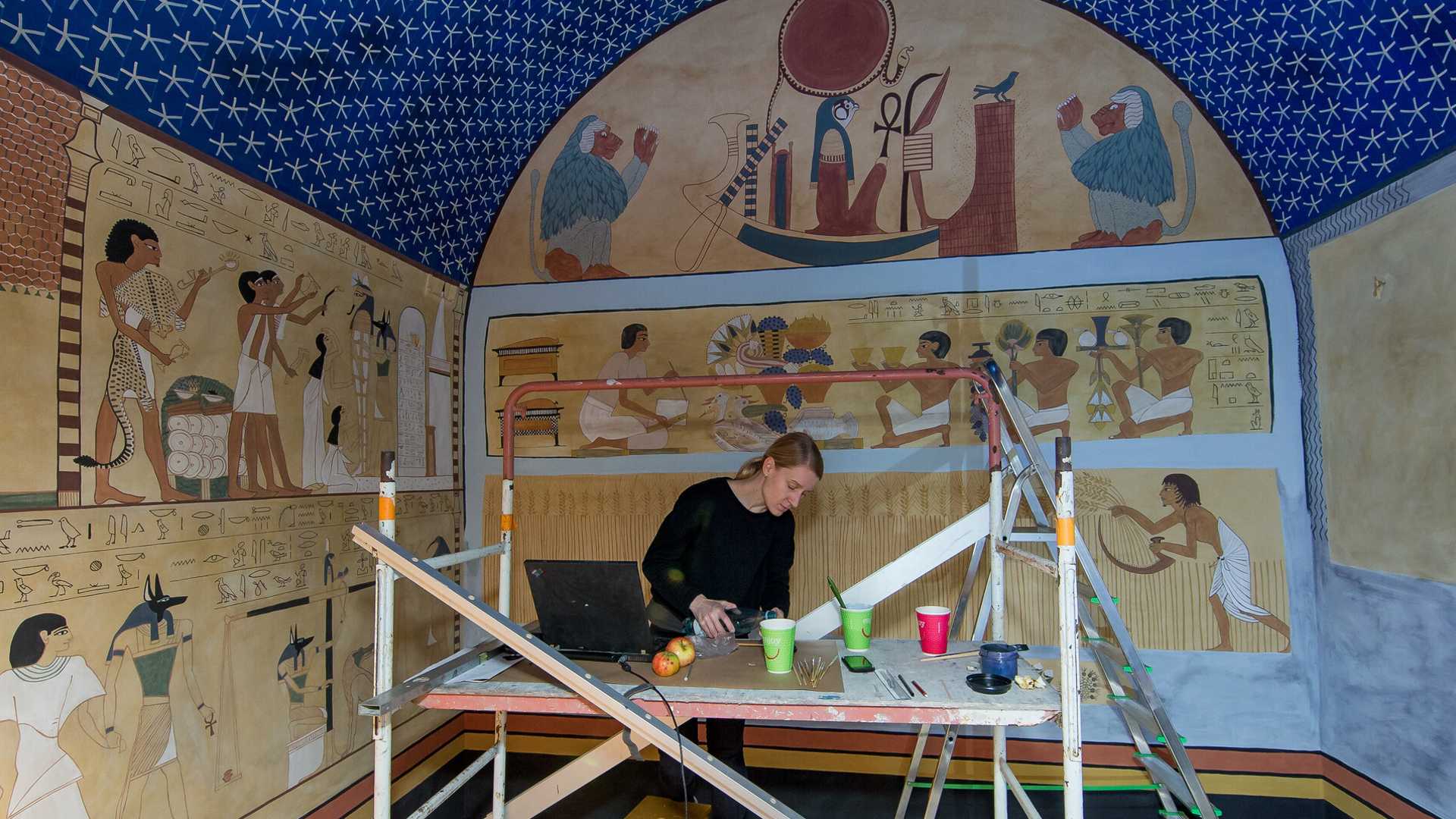
For Estonia, it took longer for such an exhibit to arrive. The country's “first major exhibition of ancient Egyptian art”, Egypt of Glory: Art from the Nile Valley, opened at Kumu Art Museum in October 2020, ending in March 2021.
Curated by Paolo Marini from the Museo Egizio (Egyptian Museum) in Torino, Italy and Dr. Jaanika Anderson, Acting Director of the University of Tartu Museum, it was a reminder of the pivotal force that the ancient Egyptians were as an early society. For their beliefs, their art, their engineering, their productivity. Astonishment over the scale at which ancient Egypt grew as a civilization has only grown, in academia and pop culture alike.
Amidst the sparsely-illuminated, tomb-like rooms of the exhibit, Kumu laid out many of the fundamentals of what is known about ancient Egypt, namely, its deeply spiritual way of life and powerful royalty. In addition, the wooden sculptures, bas-reliefs, figurines, scarabs, earrings, amulets, and necklaces on display reiterated the significance of decoration and design for this civilization.
A great deal of this knowledge would be missing if archaeologists hadn't excavated and studied these kinds of artifacts. One such archaeologist was Baltic German scholar Otto Friedrich von Richter, who documented his time in Egypt through sketches and handwritten notes. Dr. Anderson deems him part of a wave of individuals of his time who travelled around to discover and study ancient civilizations.
Of course, this study involved removing human remains and possessions belonging to the deceased from their resting places in Egypt, which is where we begin to see the controversy that archaeology elicits. In the early 1800s, von Richter is thought to have purchased over 120 ancient items from locals, proceeding to send them to Sweden and onto his home in Estonia, Väimela Manor. Among these purchases were the sarkofaag (sarcophagus) of a pharaoh's scribe and the mummified remains of two children.
According to a 2020 research paper published in the scientific journal PLOS ONE—which involved academics based in Estonia, Egypt, Lithuania, and England—von Richter “carried out scientific expeditions to Egypt, Asia Minor, Greece, and Lower Nubia” between 1814 and his sudden death in 1816. He was only in his mid twenties when this happened, and had just recently completed his education at Heidelberg University and the University of Vienna.
In 1819, all that he sent to Estonia was donated by his father to the University of Tartu, before most of it was moved to Russia in 1915. What remained were the mummies of the two children, plus a dog and an ibis.
The research paper notes that “Based on changes made to the policy of the museum collections, the mummies were moved to the university’s anatomical theatre in 1862.” Here, they were “measured, autopsied, and the bodies were briefly described.” This description mentions images of the Sons of Horus and the Eye of Horus, believed to protect those who had died, among the linen wrappings applied to the bodies. Analyses of the wrappings also revealed prayers written in Hieratic (ancient Egyptian cursive) that date the larger of the two human mummies to the Ptolemaic period, between 332 BCE and 30 BCE, or later.
Meanwhile, other attempts to analyze the remains over the years were destructive. A tooth, pieces of hair, and packaged organs were removed. Damage was inflicted to a lip and to toes. An autopsy from the early 1900s resulted in the removal of the right hand and forearm of the older of the two human mummies. It's clear that this work was not done with respect.
The mummies were moved to the University of Tartu's Art Museum in 1980, and since then, researchers have endeavoured to be more careful. Contemporary research teams have taken smaller and less destructive samples, 34 in total, from the mummies. Analysis has ranged from chemical and textile analyses to DNA investigation. This has clarified details about the lives of the deceased, the mummification process, and even clues as to where the deceased were from. Their origin has been identified as either Memphis, Luxor, or the Faiyum Basin area, where many child mummies have been found.
Still, it raises a difficult question: how much time must elapse before it is ethical for human remains to be exhumed, studied, and shown to the public?
Prominent Egyptologist Dr. Zahi Hawass has spoken in favour of excavating mummies and artifacts and showing them in museums. In 2021, he insisted that “archaeologists work to immortalize these people, as they restore their coffins, graves and mummies, because the presence of these coffins inside the wells exposes them to decomposition and fragmentation…”
At the same time, Dr. Hawass has argued for the repatriation of a number of significant artifacts from museums abroad back to Egypt. There is plenty of space to store artifacts just like the ones taken by Otto Friedrich von Richter. For instance, the Grand Egyptian Museum in Giza, Egypt. Already, significant artifacts have been moved here from the old Museum of Egyptian Antiquities in Cairo. In April 2021, the BBC reported on the Pharaoh's Golden Parade, in which 18 kings and four queens were transported in climate-controlled, “nitrogen-filled boxes to help protect them against external conditions.” Demonstrations of cultural pride like this make you wonder how we would respond to these questions if the remains or artifacts in question were Estonian.
Dr. Anderson makes an excellent point about grappling with the ethics of the mummies held in Tartu, though. She writes, “The Mummy Chamber of the University of Tartu Art Museum aims to teach people how to look at the body with respect and with positive intentions – to see, behind each body, a life, and their various customs, traditions and beliefs… The problem is not that Egyptian mummies are on public display. The problem is that some members of the public can bring the wrong mindset to the encounter with them…”
Ancient human remains and artifacts being transported far away from their places of origin creates a turbulent debate over heritage, ownership, and the consequences of the past. In the end, though, viewing these fragments of the past, in and of itself, is an act that requires us to reassess our relationship with death.