Try to let the word sound out with that trembling letter R: Kurr–rat! Kurat küll! Kuradi kurat! After you have uttered these words a couple of times from the bottom of your heart, you might feel better. I suggest you try when you’re upset. It’s pretty safe to do it in predominantly English-speaking settings, as no one will be offended.
Actually, no one would feel offended when hearing someone swear with the word kurat in Estonian-language settings either, because it is clear that you are not angry at someone in particular, but rather at a situation in general. Perhaps it would even make sense to teach the word to your immediate neighbours, just like our ancestors have done earlier: Baltic Germans borrowed the word from Estonian verbatim; coastal Swedes rendered it as “korat”, Latvians—“kurrata”, and Finns—“kuratti”. All have the same meaning as in Estonian.
Kurat has several sources and origins. First, it is related to the word “kuri” (“angry”). Logical, right? When you are kuri, you’d say “kurat!” to let everyone around know of your situation. In our closest related Baltic-Finnic languages, kuri also means poor, starved, or underprivileged. A parallel name for kurat that has been recorded in Estonian is “kõhnrett” (literally “an angry bundle of bones”). It is quite true that when one is hungry, one gets angry (note, those words sound similar even in English, not just Estonian!). So, kurat is someone who is kuri, and most likely because of poor nutrition.
In Indigenous cultures, one must always be alert to such cosmic tricks and pranks. No idyllic, laissez-faire attitude is possible. I think it’s time we learned from this outlook on life…
There is another etymological thread that connects kurat to the word “kura” that is used in Southern Estonia to this day, which means “left-hand side.” As most people are right-handed, then everything that has to be done with the left hand tends to be less perfect, if not outright messy. Thus, kura is something that is not “right,” that is crooked and prone to go wrong from the very outset. Kurat is located on the left.
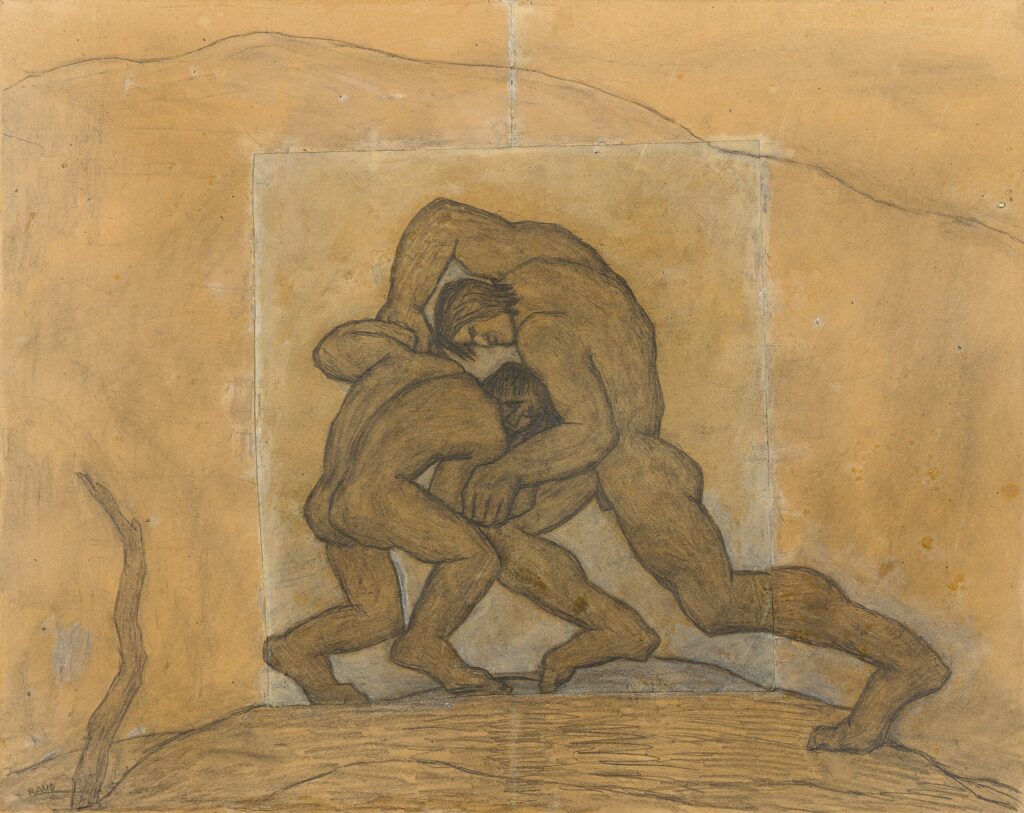
Estonian poet and literary scholar Hasso Krull recently defended a PhD thesis discussing the trickster figure in Estonian mythology. He argues that the Estonian kurat is actually the same old trickster that we encounter in the beliefs and stories of Indigenous peoples. “The trickster figure is so universal that readers will recognise them, no matter how strange or alien the details,” he claims in a recent interview with Kristjan Haljak, accessible at estonianliterature.ee. The trickster is a figure that tends to appear and mess things up, mostly just to see how people would react. If one is resourceful enough, the trickster’s deeds can be neutralised—but it certainly takes some mental and physical effort. In Indigenous cultures, one must always be alert to such cosmic tricks and pranks. No idyllic, laissez-faire attitude is possible. I think it’s time we learned from this outlook on life, and we’re lucky to have our own Estonian mythology to help us here.
Legendary Estonian punk band Propeller has a song titled “Üks sõna,” (“One Word”) written by Urmas Alender (melody) and Juhan Saar (lyrics). Saar is best known for his children’s bedtime song “Mina ei taha veel magama jääda” (“I’m Not Sleepy Yet”), but he has written other things, too. “Üks sõna” is about the word kurat, and it characterises its sound and effect as follows:
“Sel sõnal on kodune kõla / tal saba ja sarved ja pää / ütled ‘kurat’ ja sirguvad õlad / ja tuju on korraga hää.” Translation: “That word has a familiar sound / it has tail and two horns and a head / your back straightens up as you say it out loud / and suddenly makes you feel good.”
As such, the Estonian kurat is not that diabolical or demonic creature that we encounter in Indo-European mythology. It is a principle of something (potentially) going wrong. And this is what happens to all of us from time to time. Then you just utter “kurat!” a couple of times and life goes on. You’re all set and ready to go correct your mistakes. Or someone else’s, for that matter.