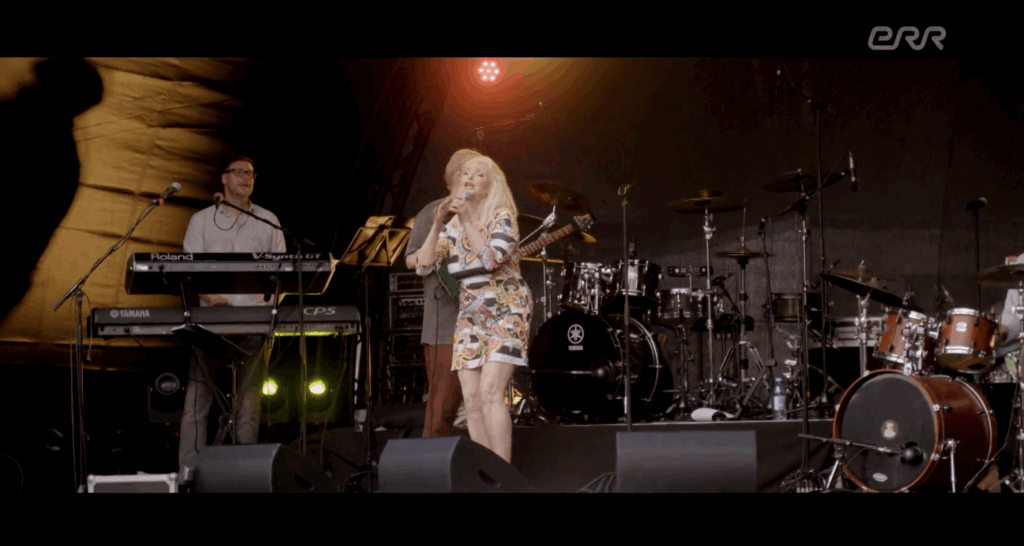
One day last spring I happened to mention the documentary titled Südame kutse (The Call of the Heart) about a beloved Estonian pop singer, Marju Länik, in our beginners’ Estonian class. It was a slightly emotional moment, as one of the students is a great fan of the singer.
Also, I think it really is a good documentary, one worth watching, as it tells the story of a strong Estonian woman doing what she likes best.
So, in order to steer our discussion back on track to the grammar that we were actually supposed to tackle, I asked, “Now, guys, in which case is südame and what is its nominative form?” An astonishing silence followed.
As I later found out, it was actually too difficult of a question, because historically, the word has been flexed in at least two different ways, and nowadays a third version is circulating, too. This, again, is because „süda” is one of the oldest-ever words in Estonian. It’s a Uralic root that has its counterparts in distantly-related languages such as Kamas, Selkup, or Enets (ever heard of the existence of these languages before?) that were spoken in the far northeastern tundras of Siberia already several thousand years ago. Beyond meaning “heart” as it does nowadays, the word has referred to anything that is located in the middle. The echo of this usage can be seen in expressions like „südalinn” (the very centre of a city) or „õunasüda” (apple core).
So I have already revealed above that the nominative form of „südame” is „süda.” The paradigm that one of the students then proposed follows the model of „ema” (“mother”), also a very old and indigenous Estonian word. This one stays the same in all the three first cases, as shown by the usual questions we ask to distinguish noun cases. Who? Ema. Whose? Ema. Concerning whom? Ema. Alas, that is not the case with „süda”! The matters of the heart never are that easy.
Do you know the word „söakas,” denoting someone who has the courage to speak up and act? That’s where it comes from. It is someone who has a heart inside them.
Being a grammar nerd, one of my favourite books is the Estonian-German dictionary compiled by Ferdinand Johann Wiedemann in 1869. This valuable book has its own take on „süda,” especially its declension, proposing its genitive form as „söä.” If you are an advanced speaker of Estonian and think you have never encountered such a weird word in your life, think again. Do you know the word „söakas,” denoting someone who has the courage to speak up and act? That’s where it comes from. It is someone who has a heart inside them.
In addition to the dialect-based form of „söä,” Wiedemann also provides the genitive form „südame” which is used in our current written language. Thus, the genitive form, when something belongs to a heart, is „südame.” What about the partitive form, then (where we ask, “concerning what”)? The answer is „südant.”
Why does it have to be so difficult? We have „süda,” a plain-looking word that first gets the ending of -me seemingly out of the blue when flexed, and then this miraculously changes into -nt!
Things clear up a bit when one thinks of the same word as used by our northern neighbours, the Finns. There, heart is “sydän.” Do you now see where that -n comes from to the partitive case? It just takes back its rightful place that it had been denied in the nominative and replaced by -m in genitive by Estonian-speakers.
Matters of heart, I can not emphasize enough, are never easy.