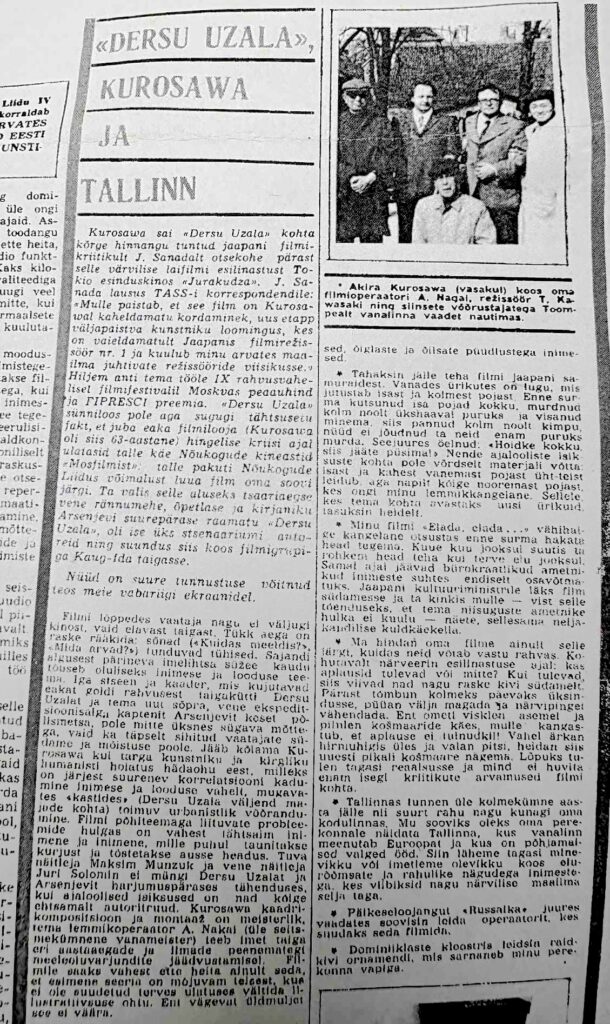
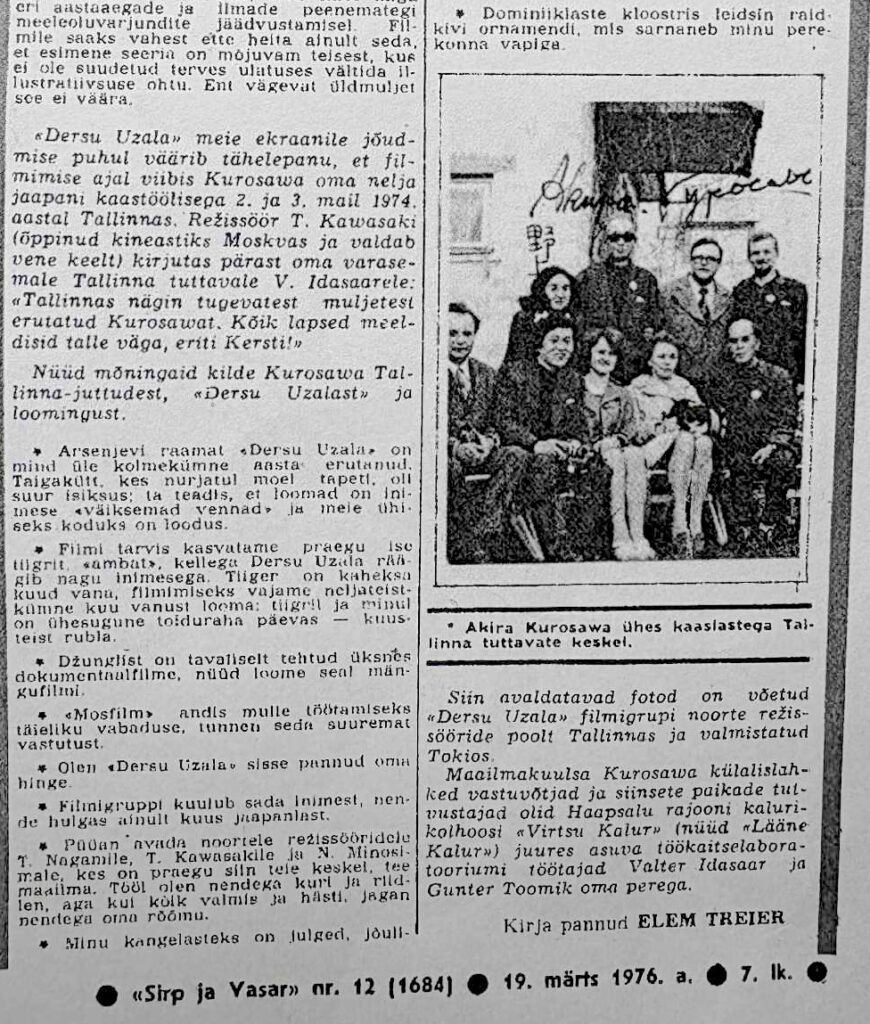
Very likely, even the most devoted cinephiles don’t realize that Akira Kurosawa, the director of Seven Samurai, Rashōmon, and Dreams, once walked the streets of Tallinn’s Old Town. But it’s true. With the help of writer and translator Tauno Vahter’s meticulous research, today the time machine is going to take us to 1974, by way of Vahter’s 2020 article in Eesti Ekspress and Elem Treier's March 1976 article, “Kurosawa ja Tallinn,” in Sirp ja Vasar newspaper.
It’s something that seemingly completely escaped all other documentation. Today, a famous film director’s movements are well documented, between film festivals, press junkets, the incursions of paparazzi, or their own social media profiles. Five decades ago, though, one could go under the radar. Especially in Russia or Soviet-occupied Estonia. There’s no trace of Estonia in script supervisor Teruyo Nogami’s memoir Waiting on the Weather. In ‘77, Kurosawa mentioned how he met “[Andrei] Tarkovsky for the first time when I attended my welcome luncheon at the Mosfilm during my first visit to Soviet Russia.” The 2015 book Akira Kurosawa's “Labyrinth of the Sea of Trees” – Complete Recording of the Film “Dersu Uzala” 1971-1976 does not appear to mention Estonia either.
As Tauno Vahter tells the story (founded on the memories of the Idasaar, Toomik, and Treier families), in the summer of 1966, Aleksander-Valentin Idasaar, an electrician at an industrial plant in Tallinn called “Ühendus,” encountered two unlikely tourists in Vanalinn (the Old Town): Tamotsu and Michiko Kawasaki. Their friendship, sparked through chance conversation, continued for years, despite the distance and isolation of the occupation. The Kawasakis had lived extraordinary lives, working in radio and cinema, travelling clandestinely through Beijing, Moscow, and beyond. This was the link to Estonia for Kurosawa’s crew.
By the early 1970s, Kurosawa was at a crossroads. His Hollywood connections had collapsed, a notable blow being his getting fired from working on Tora! Tora! Tora!. He had a bitter falling-out with actor Toshirō Mifune (the star of Seven Samurai). Not only that, he had health problems and attempted suicide.
On the morning of May 2nd, 1974, Kurosawa and his team arrived by train in Tallinn, from Moscow… They were met warmly, and the Estonians who took up the task of hosting the Japanese crew put in a great deal of effort to show their respect.
Thus, when given a shot at making a film with Mosfilm, a Soviet studio, he took it up. After a bit of prodding, he was allowed to re-adapt the 1923 memoir Dersu Uzala, about Russian explorer Vladimir Arsenyev and his friendship in Siberia with a Nanai hunter named Dersu. Kurosawa’s creative freedom was guaranteed, a contrast to the intense control of studios like 20th Century Fox. Before filming began, Kawasaki suggested a visit to Estonia for some R&R. On the morning of May 2nd, 1974, Kurosawa and his team arrived by train in Tallinn, from Moscow: Teruyo Nogami, cinematographer Asakazu Nakai, producer Yōichi Matsue, and assistant director Norio Minoshima. They were met warmly, and the Estonians who took up the task of hosting the Japanese crew put in a great deal of effort to show their respect. Idasaar and Kunter Toomik toured the crew around in Moskvich cars and arranged meals in homes in Nõmme and Keila.
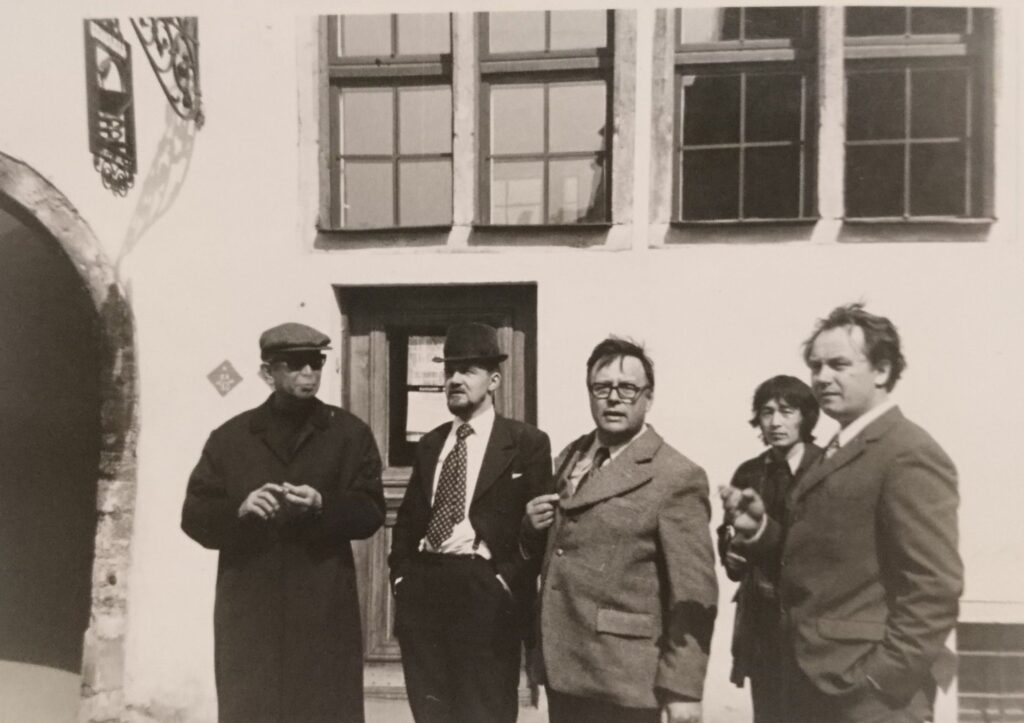
The visitors were struck by the pale, enduring light of Tallinn’s evenings in May, a phenomenon they had likely never encountered in Japan. They wandered the cobbled streets, paused at St. Catherine’s Dominican Monastery, where Kurosawa marvelled at a carved stone resembling his family crest, and sipped coffee and beer at local cafés. And of course, overnight, the visitors stayed at Hotel Viru, known for its intense KGB surveillance. Playwright Elem Treier, director of the Eduard Vilde House Museum, accompanied the group, noting Kurosawa’s curiosity about European art. Evenings at the Idasaar home in Keila were full of accordion music, folk songs, and tasty homemade treats. Kurosawa, rather reserved in demeanour and hidden behind his trademark sunglasses, made a young Kersti a bit afraid, but smiled at her and gave an inflatable cat toy to quell the noticeable unease.
The team had to adapt frequently, wrestling with outdated Russian film equipment and bureaucratic restrictions. In these conditions, the crew sent a letter saying how fondly they remembered Estonia…
After the weekend, the crew departed Tallinn for Moscow. Then travelled all the way to the town of Arsenyev, via Omsk and Khabarovsk. Contrastingly, what followed was an onslaught of Siberian extremes. Snowstorms. Mosquitoes and ticks. Logistical and diplomatic nightmares. A wild tiger named Anchom, intended for a key sequence, defied all directions, necessitating elaborate staging and patience. The team had to adapt frequently, wrestling with outdated Russian film equipment and bureaucratic restrictions. In these conditions, the crew sent a letter saying how fondly they remembered Estonia… Nonetheless, Kurosawa’s film captured human fragility and the beautiful terror of the wilderness, showing Dersu’s friendship with Arsenyev in a memorable way. Released in 1975, Dersu Uzala drew 20.4 million viewers during its theatrical release and, in 1976, won the Oscar for Best Foreign Language Film.
For a relatively short stay, there are more anecdotes and details from the trip to Estonia than could fit these printed pages. But it makes one wonder if that was just the fuel needed to take this devastating, epic film to the finish line.
[Editor's note: Previously, this article indicated that Kurosawa and his crew were in Tallinn until the end of May. In fact, they spent just three days in Tallinn. We regret the error. In addition, communication with our readership revealed Elem Treier's newspaper piece (visible below) published two years after the visit.]