Subscribe Menu

Wartime Lessons from the Life of Arne Roosman in “Twas a Sunny Day”

I was fascinated to learn that Arne Roosman—the recently departed artist from Bancroft, Ontario—had a book written about his life and art. I was already familiar with Arne’s work and through mutual friends, I had met him once a few years back, but only had a chance to speak with him very briefly.

When I saw the VEMU announcement for the book launch of Nate Smelle’s Twas a Sunny Day, I was pleased to join the event and to hear the author and Arne’s daughter, Rebecca, speak about Arne Roosman and his eventful life.
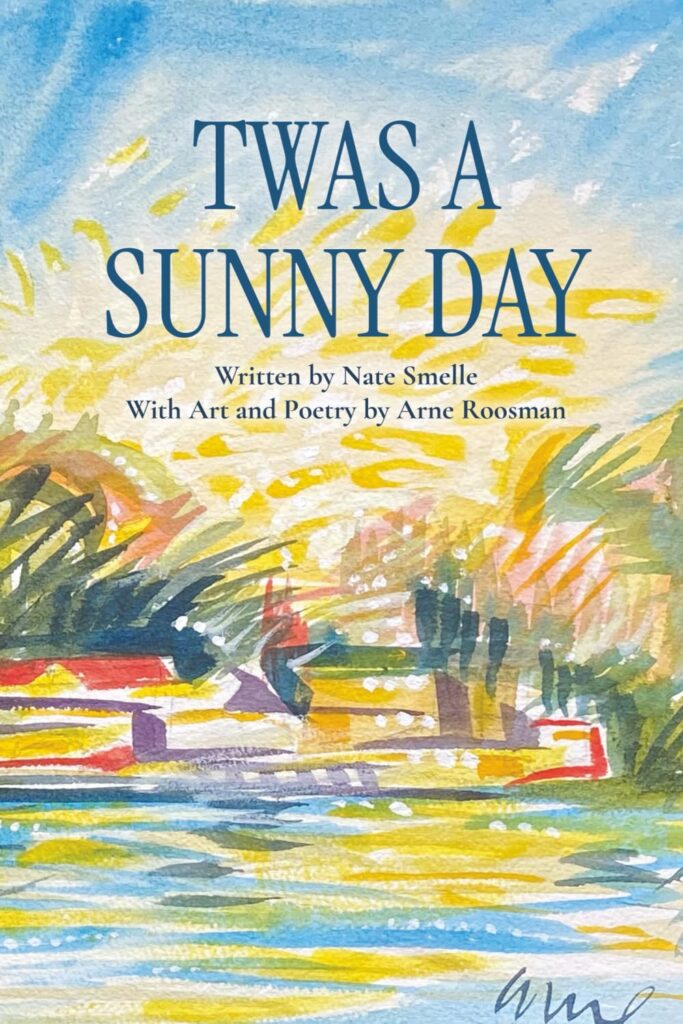
The cover of "Twas a Sunny Day"
The cover of “Twas a Sunny Day”

This book is an interesting read with some old family photographs and plenty of his more recent sketches. Arne and his family’s journey to freedom during the war was quite different from many other Estonians. Since Arne’s grandmother had German ancestry, they were able to escape from the Soviets to Germany earlier on. However, this was fraught with danger, as they needed to pretend to be allied with Germany at some border crossings, but also allied with Russia at other border crossings. Arne recounts how his parents travelled with photographs that included people whose faces were scratched out. This was so they could say to either the Russian or the German border control officers, “these were acquaintances, but now are bad people, so we took them out.”
As Nate Smelle recounts the story of the Roosman family’s escape from Estonia, Arne implies that their family also had some Jewish ancestry. His grandmother emphasized that this was never to be mentioned to anyone, as it could end up becoming a matter of life or death.

Unlike most of our parents and grandparents’ stories, which are about the terror of the Russian occupation, much of Arne’s story is about the danger of fascism. Much of Nate’s interviews took place during the last years of Trump’s first presidency. The reader can’t help but be disturbed by all the turmoil and outrageous announcements of that time. Nate, as the editor of The Bancroft Times newspaper, received threats from far-right extremists and conspiracy theorists, who did not believe COVID-19 was a serious risk and that the vaccine would actually harm people. Thus, the conversation between Arne and Nate focuses primarily on fascism and often their shared concern over the direction of the US government.

Another interesting sidebar the author weaves into the narrative is about life in Canada and Bancroft during the war. Mr. Smelle has added photographs of advertisements placed by The Wartime Prices & Trade Board. These newsprint ads describe in detail the rules and restrictions for public consumption of gasoline, sugar, coffee, tea, butter, and a wide range of other food products and household supplies. In 1940, Canada’s Federal Munitions Ministry (under the leadership of C.D. Howe), banned all sales of new tires, in order to help keep the war machine rolling ahead.

Arne could not make those boys understand that he had never been against the Americans… The author conveys Arne’s feelings of always being a foreigner in Germany.

The description of displaced persons camp children’s lives is captured in more detail than I have heard before. Arne and his brothers had been called “un-German” during the Nazi years, as they were not German. With the American victory, these boys were now considered in an even more lowly manner, as traitors, since they had welcomed the American soldiers. Arne could not make those boys understand that he had never been against the Americans. His family was simply escaping from the Russians and trying to stay out of all wars, as war raged all around them. The author conveys Arne’s feelings of always being a foreigner in Germany.

The most painful moment for Arne is a very traumatic incident he witnessed as a fifteen-year-old during the deportation of Russian refugees back to the Soviets. We often forget that Germany had captured many Russians to use as slave labour, while the German men and boys were fighting in the war. Most of these Russians did not wish to return to the Soviet Union, as a labour camp in Siberia or immediate execution could be waiting for them.

Nate says the most important lesson he learned from Arne is the value of spending time with those you love and respect. “Our exchange and our friendship have taught me the great value of truly paying attention to what matters most… how much there is to learn when we focus our time and energy on getting to know one another on a deeper than surface level.” A very appropriate lesson, in light of all the discussion about addiction to social media.

The fact that this relatively lesser-known individual—from our Estonian community, who lived in the remote cottage area of Bancroft—had a book written about his life story by a Canadian journalist is almost astonishing. And it is equally amazing to see how Estonia gets attention from these unexpected, far-flung corners. It reminds me of Estonia’s foreign minister Margus Tsahkna’s 2026 Independence Day message: “Hopefully you will keep Estonia in your thoughts, your hearts and your songs… And here I am talking about the great, borderless Estonia that can be found around the world in the hearts of Estonians and friends of Estonia.”

Read more