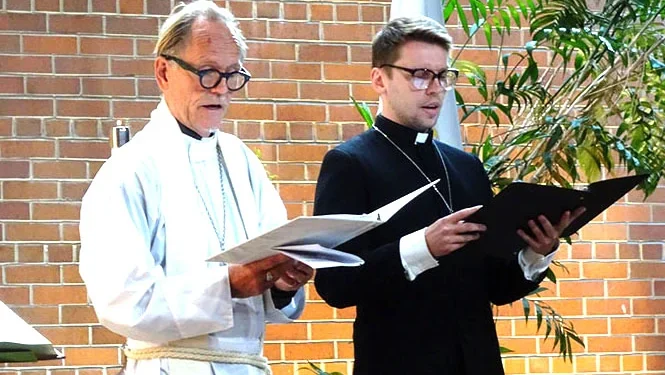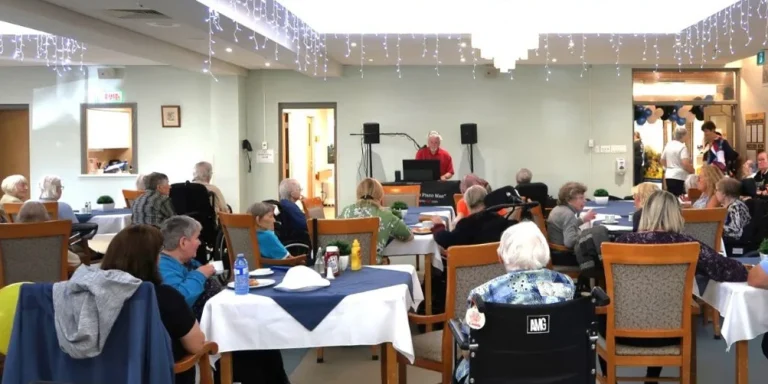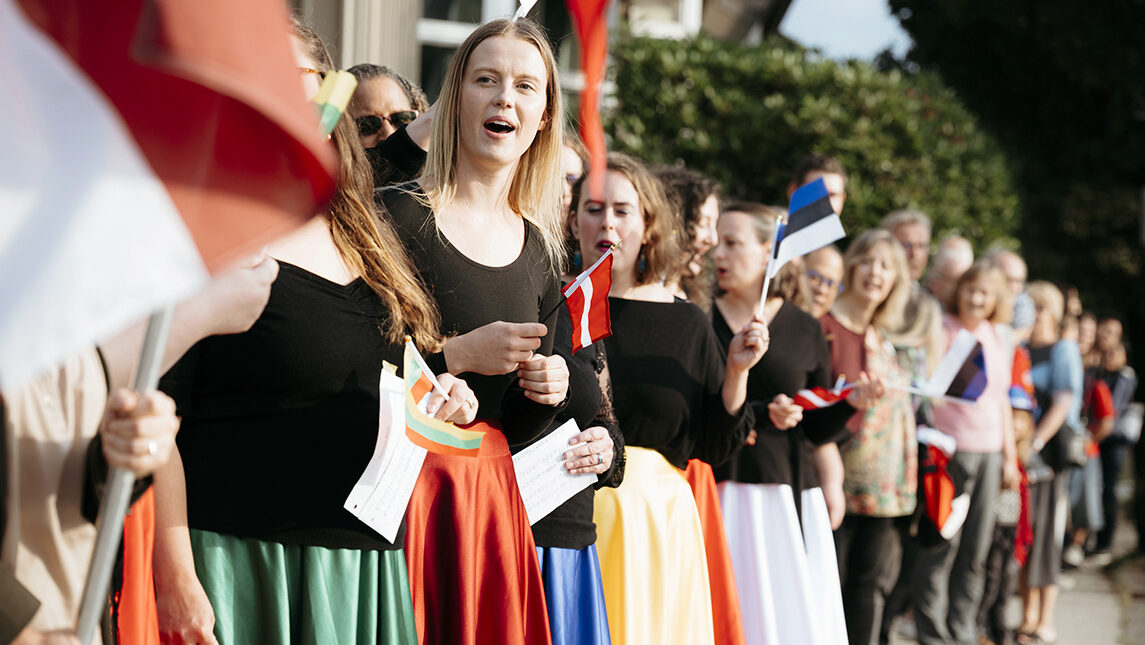
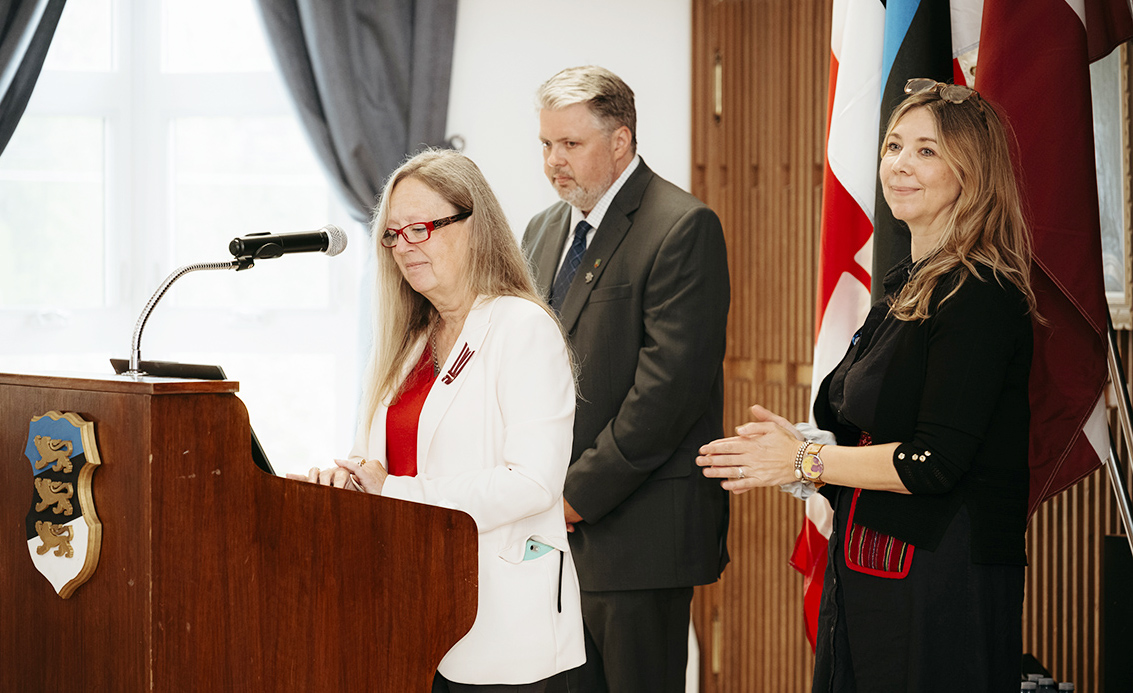
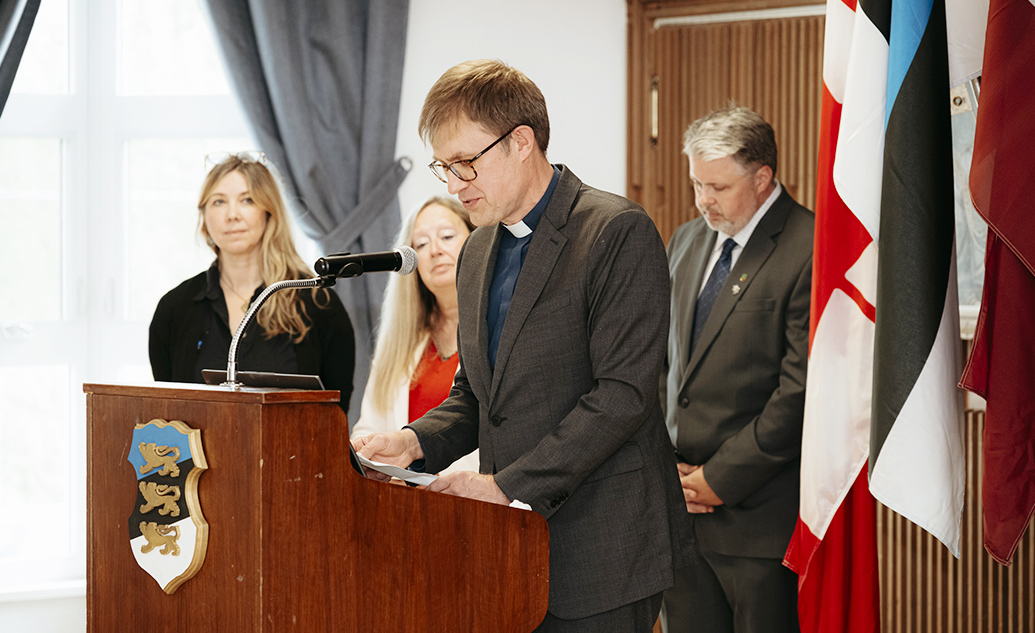
Held at Meie Kodu in Vancouver, the commemoration brought together leaders and representatives of the Baltic communities. The event opened with a welcome by Ingrid Soide, President of the Vancouver Estonian Society, along with Latvian community leader Rita Blosmanis, and Vidas Viktus, President of the Lithuanian Community of B.C. Pastor Andres Rebane delivered opening words and prayer.
Greetings from Margus Rava, Estonian Ambassador to Canada, Latvian Ambassador to Canada Kaspars Ozoliņš, and Darius Skusevičius Lithuanian Ambassador to Canada, were presented. Each Ambassador’s messages highlighted the historic importance of the powerful demonstration of solidarity, the fight for the independence of the Baltic peoples, and the gratitude to the Vancouver Baltic communities for their continued support for Ukrainians, in their current struggle for sovereignty.
Deputy Mayor of Vancouver, Sarah Kirby-Yung, was also in attendance. She spoke to the strength and resilience of the Baltic nations and their determination in the pursuit of freedom and democracy, exemplified by the non-violent display of the Baltic Chain. Kirby-Yung presented the leaders of the Baltic communities with a proclamation declaring August 23rd, 2024, as the “35th Anniversary of the Baltic Way” in the City of Vancouver.

Photo gallery
Photos: Sova Photography

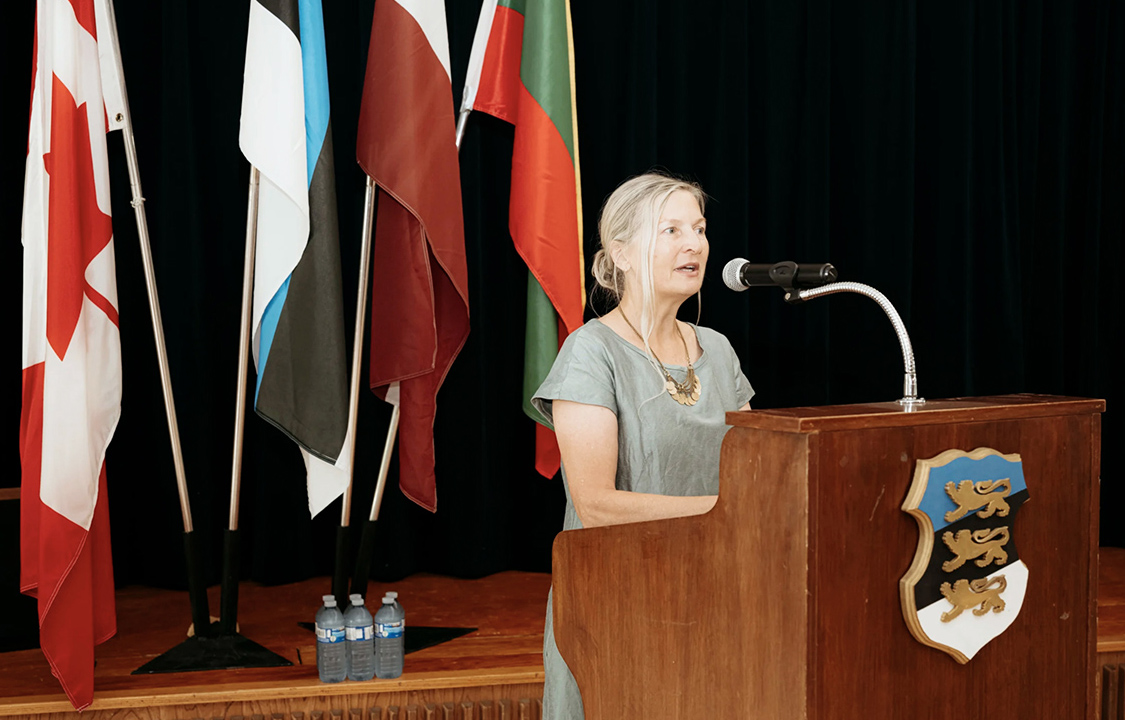
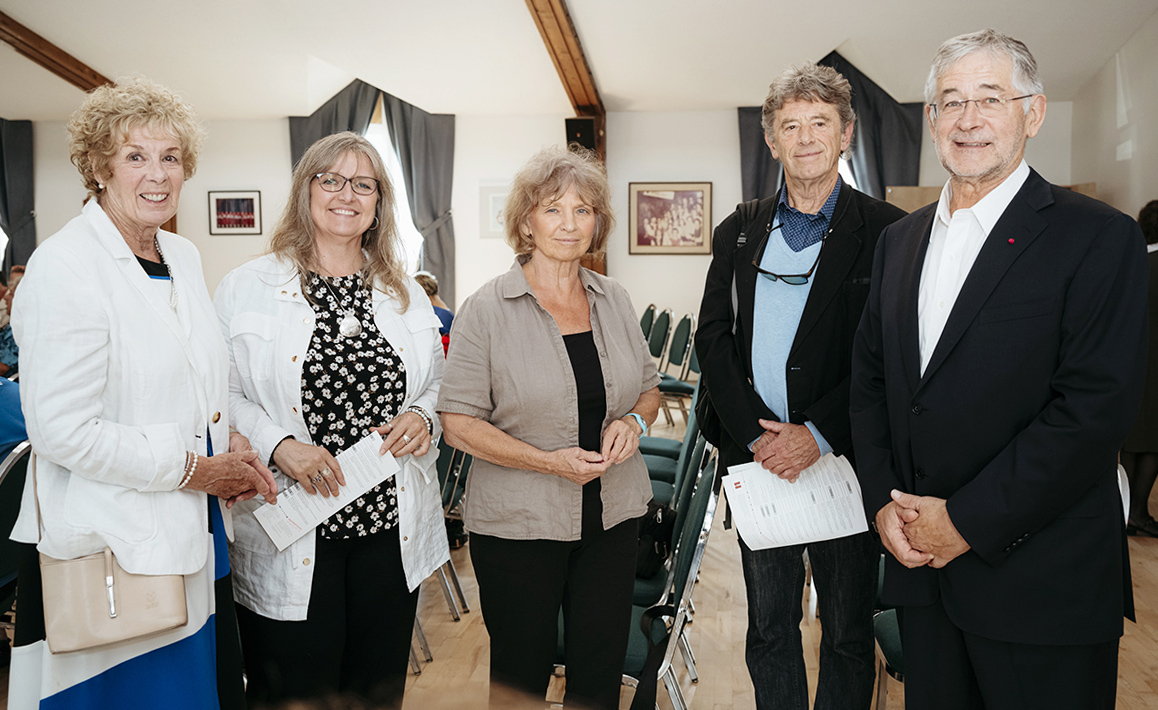
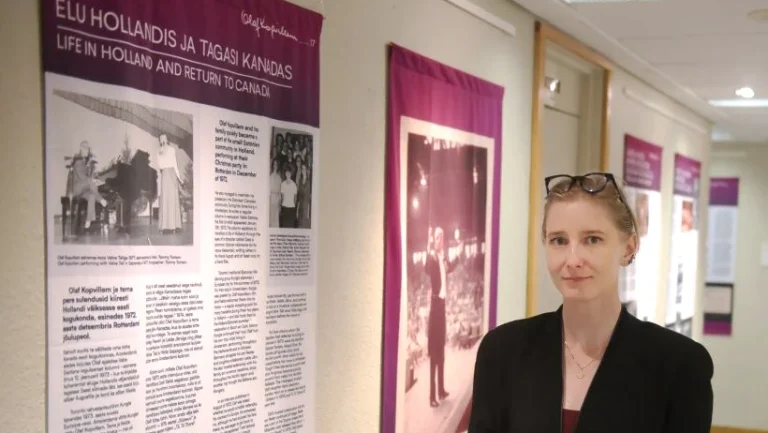
Special guest speaker Ellen Valter from KESKUS International Estonian Arts Centre in Toronto, who was in Vancouver for a film project on the 80th anniversary of the Great Escape, emphasized the powerful solidarity that emerges when Baltic communities work together (continue below to read her speech at the end of the article). She highlighted the various ways in which the Baltic diasporas in Toronto have collaborated to support one another, the merger of the Latvian and Estonian Birch Credit Union as an example, and the importance of working together given our small communities.
Representative Orest Romanish, from the Ukrainian Canadian Congress spoke to the significance of Black Ribbon Day and expressed deep gratitude for the support of the Baltic communities to the Ukrainian community, in light of the current political turmoil and war affecting their families. Each Baltic community leader was presented with a Certificate of Appreciation for their support to the Ukrainian Canadian community.
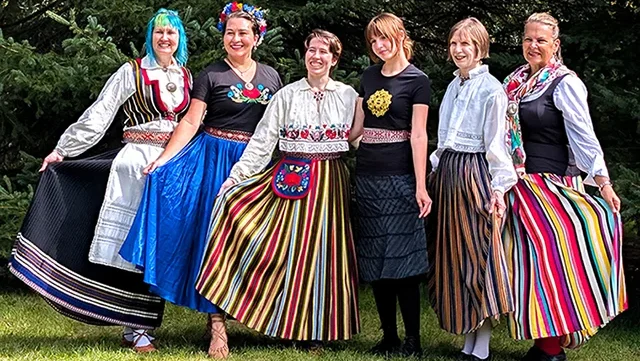
The highlight of the event was a musical performance by the Magi Ensemble, a professional vocal group from Seattle specializing in Baltic music. Directed by Dr. Heather MacLaughlin Garbes, Assistant Professor at the University of Washington and founder of the UW Baltic Choral Library, the ensemble performed a repertoire of folk and national songs in Estonian, Latvian, and Lithuanian. The concert concluded with the famous “Ärgake, Baltimaad” (“The Baltics are Waking Up”) where everyone was invited to join and sing along.
The atmosphere was filled with Baltic tunes, candlelight, and a sense of community unity, leaving everyone in high spirits.
After the concert, attendees gathered outside the church hall. In single file, following large Baltic flags, they stepped out facing Oak Street and joined hands, re-enacting the Baltic Chain in a vibrant display of Baltic unity and colors as traffic drove by.
The evening ended with a lively barbecue featuring grilled šašlõkk, a special marinated recipe of Lithuanian Community leader Vidas Viktus, accompanied by rye bread and homemade Baltic salads. The atmosphere was filled with Baltic tunes, candlelight, and a sense of community unity, leaving everyone in high spirits.
The Baltic communities of Vancouver extend their deepest thanks to all of the attendees, guest speakers, organizational representatives, sponsors, and especially the volunteers who helped to make the event a success – all extra proceeds for the fundraising event, will be donated to the Ukrainian Canadian Congress, Humanitarian Aid Fund.
Representative in attendance: Former Honorary Consul of Vancouver Harry Jaako, and representatives from the Canadian Polish Congress, Ukrainian Canadian Congress, Maple Hope Foundation, Chinese Youth Association, and Vancouver Society in Support of Democratic Movement.
Thank-you to the organizational support of: Estonian Church Foundation, Estonian Central Council in Canada, Latvian National Federation in Canada, KESKUS International Estonian Centre, Vancouver Estonian Society, the local Latvian community, Lithuanian Community of British Columbia, City of Vancouver, Province of British Columbia.
Below, read Ellen Valter's speech (August 24th at Meie Kodu, in Vancouver) on the occasion of the 35th anniversary of the Baltic Chain, organized by the Estonian Society of Vancouver and similar Latvian and Lithuanian organizations
“Dear Deputy Mayor, Diplomatic corps representatives, organizers, ladies, and gentlemen,
Today marks a momentous occasion, when thirty-five years ago, on a hot summer’s day, rather unlike Vancouver, and half a world away on a Wednesday, August 23, 1989, more than two million Estonian, Latvian and Lithuanian men, women and children joined hands all at the same time. They formed a human chain uniting 3 capital cities, Tallinn, Riga, and Vilnius, in a powerful demonstration of solidarity in our shared desire for freedom.
This most peaceful act was fifty years to the day of signing of the Treaty of Non-Aggression between Germany and the USSR – called the Molotov-Ribbentrop pact. But the Baltic Way was about more than protesting against something. It was a symbol of powers more enduring than that of protest.
The Baltic Way was for.
Balti Kett was for our three countries’ pledge of mutual support.
Baltijas ceļš was for unity and courage.
Baltijos kelias was for our freedom and hope.
Planners calculated that the human chain would require 200 thousand people in each of the three countries. Yet more than two million arrived to the designated route and without the aid of cellphones or meetup apps, but through radio broadcast to help with logistics on the day-of, and at the appointed time, joined hands and stood.
Now, the body may be a poor conductor of electricity but it does still do so. The electric charge that coursed from hand through hand to hand through the 675km long line of joined human hands would have been measurable, palpable even. The human chain became a symbol of unity and solidarity that was impossible to overlook. Indeed, two years later, the Soviet Union was no more.
Our three nations share geography and common threads through our histories. None are more stark than Soviet brutality and the illegal occupation of our countries by the USSR. And while that chapter is now closed, the effects of having the same neighbour to the east continue unabated. Our spidey sense is constantly on alert. Our sympathy and staunch support of Ukraine comes from the voice of experience.
Canada offered our parents and grandparents a secure haven. Now a few generations later, we no longer associate ourselves with being Displaced Persons.
We have done very well in Canada.
As diaspora communities we are moving forward.
We give back.
I can speak to the Estonian experience and where the majority of post-war Estonians ended up in Toronto. I like to think that an example of giving back is the KESKUS project with which I’m involved. It is an almost $50million Estonian cultural centre currently in construction in the heart of Toronto. KESKUS International Estonian Centre is designed by 4-time Governor-General Award-winning architect Alar Kongats, from Hamilton, Ontario and of Estonian heritage. It is the first urban purpose-built Estonian centre in the diaspora in over 60 years. The public courtyard of KESKUS, which means “centre” in Estonian, is shaped like the borders of Estonia. When viewed through Google Maps, zooming into the cultural and academia district of Toronto by the end of next year, the map of Estonia will appear in the built environment, smack in the heart of Toronto, North America’s 4th largest city.
It is an ambitious project, one that continues to need everyone’s support to complete this architectural jewel. It puts the small country of Estonia onto the map on this continent quite literally so that from this flagship, strength, support, activity, shared resources can be drawn by Estonia communities in North America, and by the Southwestern Ontario Latvian and Lithuanian communities, and, frankly, everyone struggling with a rye bread and herring addiction.
It will be a reference point, a natural gathering place, one that reflects who we are today.
Another Ontario example – after the post WW-II wave of further migration to North America, those who settled in the Toronto area promptly set up five credit unions – Latvian, Estonian and three Lithuanian. Fast forward through accelerated dispersion of next generations into Canadian society and evolution of the credit union sector and 65 years later, the case for mergers was clear. I again speak from personal experience as the resulting credit union’s board chair, that in order for our communities to continue to be supported, the natural partner for Latvians was to join with the Estonians. Shared values and shared gene pool had everything to do with it. Now called Northern Birch Credit Union, Estonian and Latvian merged into a $200 million financial institution that supports both communities and has drawn them closer together. We have greater resilience by uniting and know that we will better adapt to what lies beyond the curve.
Just like the Baltic Way was not just about looking back at our shared past, it was about looking forward, about envisioning a future where our nations could again thrive as free and independent states. It was about the power of cooperation, about what we can achieve when we stand together. The success of the Baltic Way was not just in its scale or its symbolism, but in the way it demonstrated that when we join forces, we are more resilient, confident, adaptable.
Strength lies in unity and today we gather in “Meie Kodu”, “our home” an Estonian meeting place. Every community ebbs, flows, evolves and the Vancouver Lithuanian community is aspirational evidence of renewed engagement and growth through younger generations and those who have more recently arrived from Lithuania, taking up the cause to ensure that our Baltic voices remain strong.
Together, we commemorate the extraordinary show of solidarity 35 years ago, and now supporting Ukraine as it battles back Russian aggression. As we stand united in our own communities on this continent and with our neighbours just as we did 35 years ago overseas, there is nothing we cannot achieve.
Thank you.”