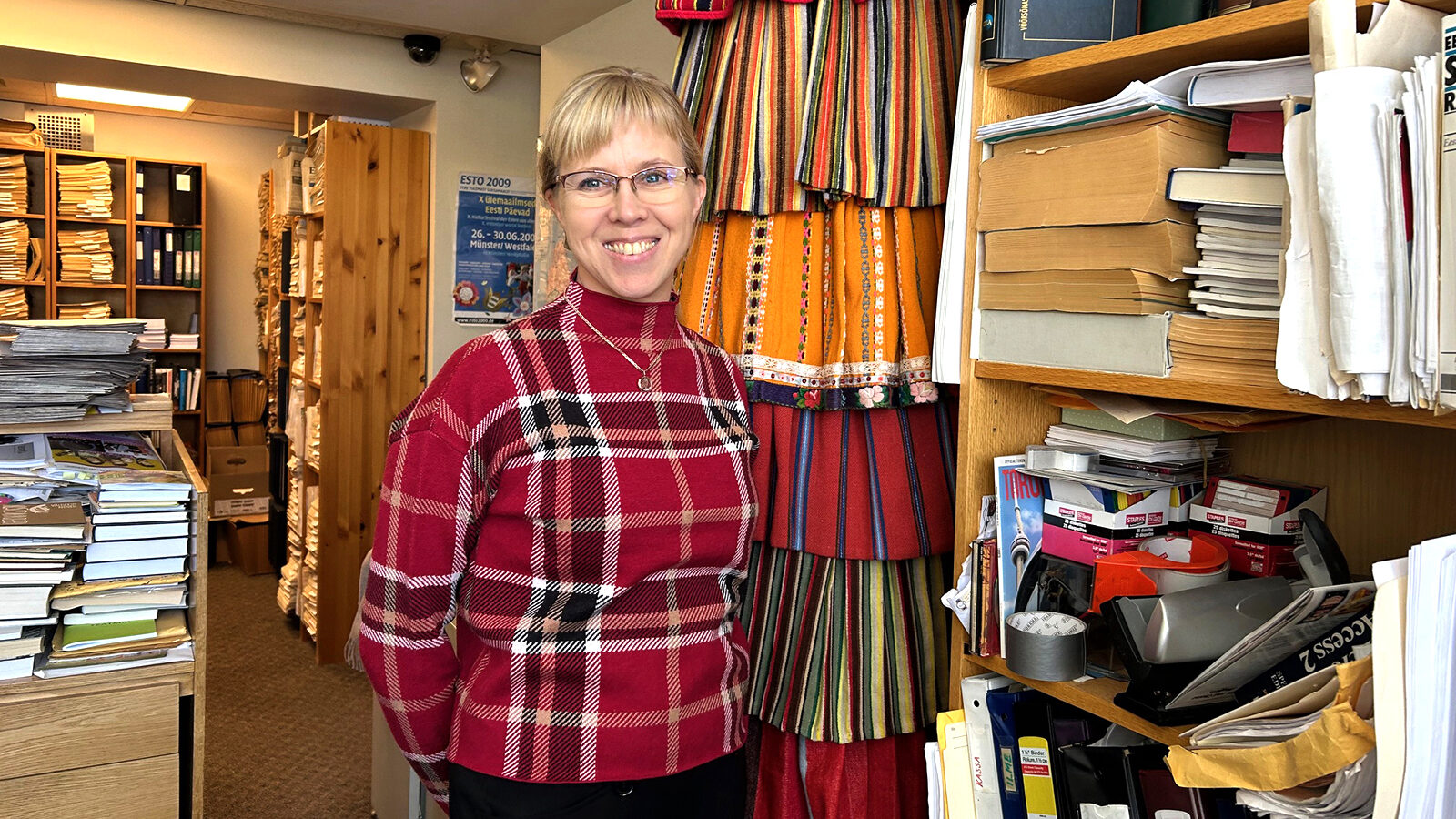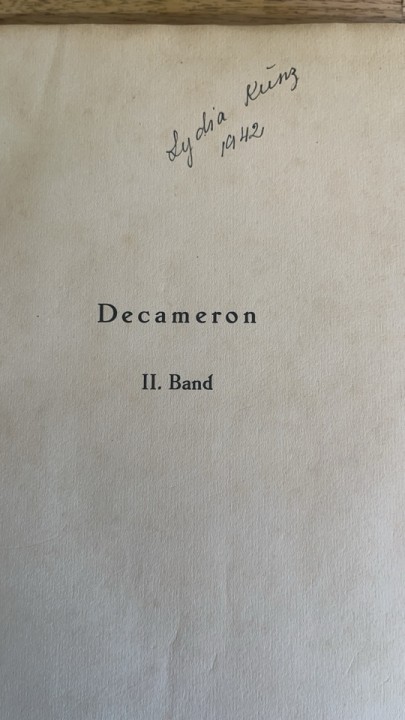
Looking through our collection, the book covers and endpapers captured and kept my attention. In February 2025, I wrote an Estonian-language article about the many ex libris that can be found within our books. Alongside ex libris, I also stumbled upon handwritten personal inscriptions, which included birthday wishes from loved ones, Christmas greetings from friends, and sometimes—simply in place of an ex libris—the name of the (former) owner of the book. I was surprised that amidst the detailed personal messages and designs of ex libris, one of the simple handwritten names intrigued me the most.
I picked out books from the VEMU library such as Ukuaru by Veera Saare, the Estonian pentalogy Tõde ja õigus (Truth and Justice) by A.H. Tammsaare, Kalevipoeg by Friedrich Reinhold Kreutzwald, and Libahunt by August Kitzberg. In one of the editions of Tõde ja õigus, there was simply a handwritten name and year: “Lydia Meel 1938.” Amidst the different ex libris and longer messages, I did not think much of it at first. But then I came across the name again, this time in one of our copies of Libahunt: “Lydia Meel 1935.”
… it didn’t ring a bell for me… I could not find anything about Lydia Meel in the rest of VEMU’s collections either. At this point, it was too late for me; I went down the research rabbit hole.
The VEMU library has been built up through donations; oftentimes when looking through our collection, you will find the stamps of previous libraries. It is also common to spot recognizable names from Estonian diaspora communities. Lydia Meel, however, was not one of those names. As it didn’t ring a bell for me, I asked several members of our Bibliography Club if they recognized it, which they did not. I could not find anything about Lydia Meel in the rest of VEMU’s collections either. At this point, it was too late for me; I went down the research rabbit hole.
Turning to the Estonian National Archives, I searched through their online material to find that someone named Lydia Meel was born on July 9th, 1920, in Tallinn, Estonia, to parents Konstantin and Klaudine-Marie Meel. According to the National Archives’ Media Library, Konstantin was born July 30th, 1896 in Tallinn. He was a senior lieutenant who voluntarily joined the Estonian Navy in November of 1918 and fought in the Estonian War of Independence. Within the Media Library record, it is stated that Konstantin died in 1942 in a Russian prison camp. Alongside her passport photo, Klaudine is listed as having been born in 1894. She worked as a dentist. Keeping in mind Konstantin’s fate, I searched for Klaudine-Marie Meel in the Repressed Persons Records Book 2, Political Arrests in Estonia under Soviet Occupation, published in 1998. A Klavdia Meel born 1894 is listed as having been arrested on June 29th, 1941 for “anti-Soviet agitation.” She died in the Ussollag forced labour camp on January 13th, 1942. Her husband is listed right underneath her as having been arrested on the same day and died in the same camp on February 29th, 1942. Lydia, however, was not listed alongside her parents.
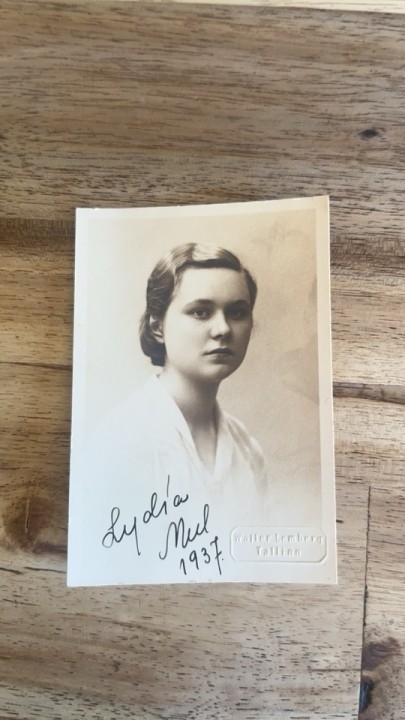
I was able to find some of Lydia’s documents through the University of Tartu archives. Lydia was accepted there as a student in 1938 to the Faculty of Medicine, following in her mother’s footsteps. Other documents in the file included Lydia’s high school diploma (she finished high school on June 3rd, 1938 in Tallinn), as well as a letter noting that Lydia’s father was a recipient of the Estonian Cross of Liberty. Lydia was the daughter of a recipient of the Cross of Liberty and therefore was eligible to study at the university with half of the tuition fee waived. Unfortunately, as with many others, Lydia’s university studies were interrupted by the war.
As previously mentioned, Konstantin and Klaudine Meel were arrested in 1941 in their home on Tatari Street in Tallinn, with Soviet security officers leaving behind chaos. Lydia wrote to the university in October of that year asking that a copy of her high school diploma be sent to her in Tallinn. She once again requested this in January of 1942, as she needed to present it to authorities. At the time, Estonia had already been occupied by Nazi Germany. Lydia attempted to continue her studies in Tartu, but this sadly did not last. In a letter to the university dated November 30th, 1943, Lydia requested a German transcript and documents; the letter listed her place of residence as Negast Bei Stralsund, Pomerania. I was unable to find any other digital sources about Lydia Meel in the Estonian National Archives after this date.
I searched for Lydia in the Estonian Second World War refugees’ database, established by the Estonian Institute of Historical Memory, and was unable to find a record of her. Knowing Lydia’s location was Negast Bei Stralsund in 1943, I also went directly to the Arolsen Archives (the world’s most extensive collection of documents about the victims and survivors of National Socialism), predictably finding nothing. At this point, searching Google with the criteria of “Lydia Meel Klaudine” miraculously brought me to a LinkedIn blog post published on December 30th, 2024, entitled “This is the story of my necklace- which is also the story of a young Estonian woman.” Here I found some of the answers I was looking for.
It is also unclear when they left Estonia, but once they had settled in Germany, Lydia once again changed her name. For the duration of her life in Germany, she was known as Gitta Künz.
The author of the post is a German woman named Susann Kunz. I got in touch with Susann, and she was kind enough to have a conversation with me about the young woman I had been researching. Susann’s husband has an aunt named Bieni, who has shared a great deal of family history with Susann. The Kunz family was originally from East Prussia and had connections to Kaiser Wilhelm, the police, and subsequently the Nazi regime. Otto Franz-Ferdinand Kunz (born in 1903) was a Wehrmacht soldier, who ended up being stationed in Nazi-occupied Estonia, although we do not know exactly when. It is also unclear how Lydia, then a student in her early 20s, met Otto, who was 17 years her senior. At some point however, they married. The timeline was interesting to think about, as the correspondence with the University of Tartu I had been reading through was signed as “Lydia Meel” up until 1943. However, Susann, who is in possession of several of Lydia’s belongings, had one of Lydia’s books that was inscribed in the same handwriting as I had found in the VEMU library—although this time the inscription was “Lydia Künz 1942”. It is also unclear when they left Estonia, but once they had settled in Germany, Lydia once again changed her name. For the duration of her life in Germany, she was known as Gitta Künz.
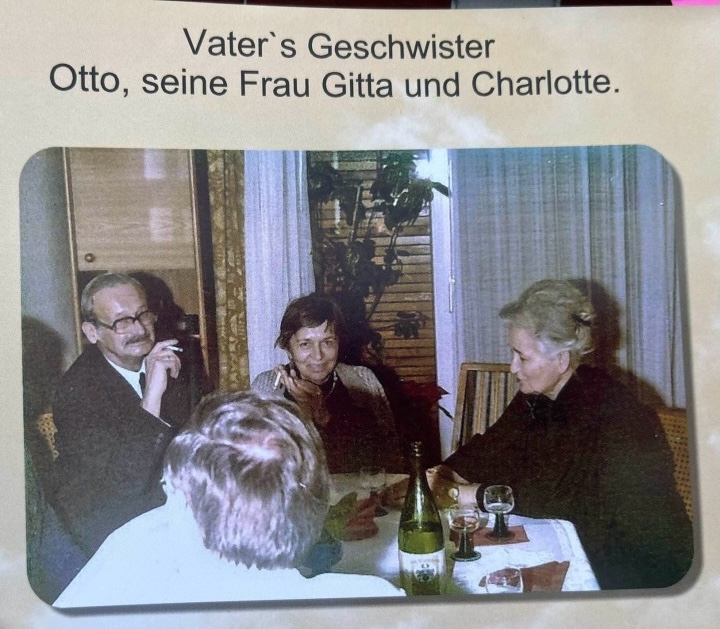
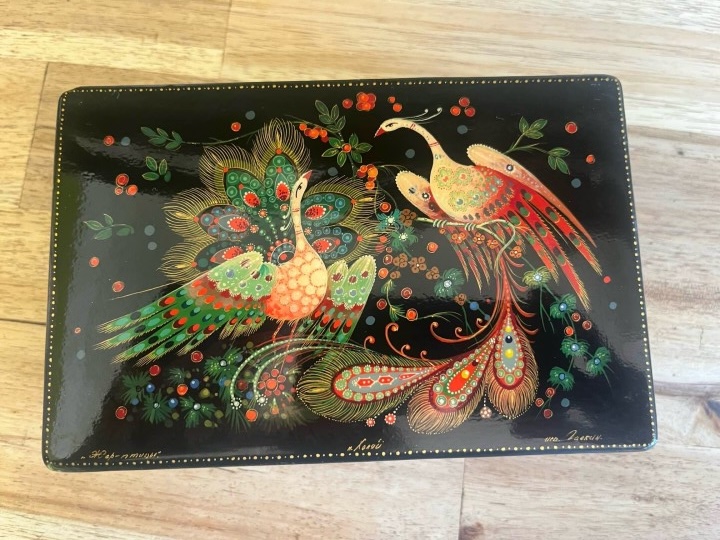
From the information that Susann has gathered from Bieni, Otto and Lydia/Gitta eventually settled in Trier. At one point, Lydia/Gitta worked as a translator at a military base near Trier; Susann guessed it must have been Ramstein Air Base. Lydia/Gitta struggled with mental health issues throughout her life in Germany, which Susann has written about in her post. Unfortunately, following a family conflict, Otto and Lydia/Gitta separated from Bieni and the rest of the Künz family. They were not reunited until Lydia/Gitta’s funeral. Susann estimates that Lydia/Gitta died in the early 1980s, and much earlier than Otto.
Many of the books in VEMU’s collections are memoirs, often sharing stories of the Estonian refugee experience. When we read about the experiences of displaced Estonians after World War II, the focus is often on community, which results in many stories left untold. It seems safe to assume that Lydia/Gitta did not have much, if any, contact with Estonians after going to Germany. Approaching the conclusion of the Year of the Estonian Book on March 14th, I’m glad to have been able to find out about another story. At one point during our conversation about Lydia/Gitta, Susann called Bieni to verify some information. They clearly place great importance on sharing Lydia/Gitta’s life story, which I appreciate. Susann and Bieni told me that Lydia/Gitta and Otto travelled to Canada four or five times; that she was an animal lover; and that she must be buried somewhere in or near Trier. Lydia/Gitta’s experience as seen through online records thus far has certainly been a bit different to others we might know of in our diaspora communities. I have been told, however, that if I find a record of her death and where she is buried, that it may be possible to add her name to the Estonian Second World War refugee’s database, as she too seemingly had no choice but to leave Estonia during the war. I will certainly be looking into this, and in the meantime here in Toronto, we will continue to take care of Lydia’s books that randomly wound up in the VEMU library. Perhaps we might find something else of hers in our collections.