Subscribe Menu

A Red Line Under Our Very Identity

Many Estonians go about their lives with a cultural stumbling block. In the company of other Estonians and those knowledgeable about our culture we can forget about it. But elsewhere, it ranges from a funny quirk to a source of frustration: pronunciation and spelling.

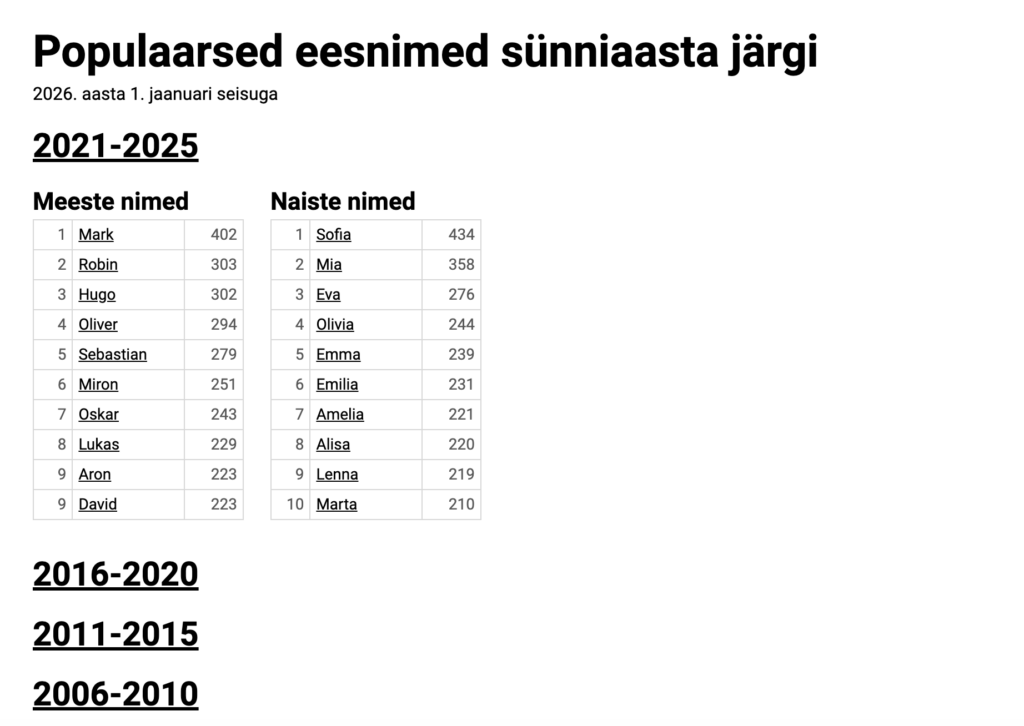
A list of popular, recent Estonian names (source: stat.ee)
A list of popular, recent Estonian names (source: stat.ee)

Consider the small, jagged red line that appears beneath some of our names in a digital document or text message. To a word processor, several Estonian names are “mistakes” that ought to be flagged and corrected. Until you manually right-click and “add to dictionary,” your own name remains a typo in the eyes of your computer. This digital erasure is, in a way, a prompt to conform, suggesting that anything outside the standard lexicon is an error. But our names are not errors.

This feature represents a broader, subtler pressure we face in an Anglo-centric world. That is, the urge to smooth out the phonetic edges of our heritage to make things easier for everyone else.

Pronunciation is often treated as a technicality, but when you dig into it, it’s also a mark of respect. When we attempt to say a name as it was intended, especially of a living being, but also places and things, we acknowledge the history behind the sounds. Even though names carry sentiment and memories, for many families in the Estonian diaspora, choosing a name involves a strategic calculation. We look at a name like Marju or Taavi and see graceful, traditional choices. Then we start to wonder if a teacher will see two vowels and stumble, or if classmates will turn heritage into a punchline.

It would be interesting to know—how does this play out for Estonians in countries with languages other than English, such as France or Argentina? But certainly, growing up in English-speaking countries with any names (first, middle, or last) that don’t follow standard English phonetic rules creates a certain identity dissonance. Being different can feel precarious depending on where you socialize or attend school. I still remember my brother, Jahn Teetsov, being summoned over the school intercom. The administrator read his name as “Ju-hawn Teets-on.” The leap from a “v” to an “n” happens from time to time, especially on name tags for some reason, but it shows how easily a person’s identity can be garbled. In my own case, first grade brought the nickname “Vincent Pizza” from a fellow student. It’s a silly half rhyme and pretty funny when you think about what makes a whole lot of sense to a kid. But the underlying mechanism is the same. We take the unfamiliar and force it into a category we already understand.

For some people, regardless of cultural background, having one’s name or elements of one’s language flipped, even with the best of intentions, can be hurtful. Like the linguistic equivalent of someone saying your nostalgic family foods (külmlaud, or “cold table” buffet selections, being an easy target) are gross.

We already put immense effort into mastering the intricacies of English, with its erratic spelling and silent letters. So why not be verbal ambassadors and extend that same courtesy to other languages?

We learn early on not to rock the boat, often accepting the mispronunciation of our names or the names of our family members because it feels less tiring than constantly correcting our peers.

This linguistic issue extends beyond names to the way we talk about the world. There’s often a fear of sounding stiff or pretentious when using original pronunciations for food or places. No one wants to be the person who stops a dinner conversation to order “broos-ketta” with theatrical flourish. However, there is a middle ground between erasure and linguistic elitism. Perhaps, as an example, a milder “brew-sketta” is a way of tipping our hats to Italy, its language, and its cuisine. Similarly, rolling a letter R slightly or drawing out a long vowel would show an Estonian that the person speaking thinks Estonia is worth getting to know more about.

The irony of writing this in English is not lost on me. But English is a bridge that allows many of us to communicate across our range of cultural backgrounds. We already put immense effort into mastering the intricacies of English, with its erratic spelling and silent letters. So why not be verbal ambassadors and extend that same courtesy to other languages?

Read more