Subscribe Menu

An Estonian Electrician’s Narrow Escape from the World Trade Center

September 11th, 2001. At 08:46 a.m. American Airlines Flight 11 crashed into the North Tower of the World Trade Center. At 09:03 a.m. United Airlines Flight 175 crashed into the WTC’s South Tower. At 09:37 a.m. American Airlines Flight 77 crashed into the Pentagon. At 10:02 a.m. United Airlines Flight 93 crashed into an empty field in Shanksville, Pennsylvania. By 10:28, both WTC towers had fallen. Within an hour and forty-two minutes, the eyes of the world were upon New York City.

The murder of 2,977 innocent people is burned into the memories of so many alive and aware on that day, young and old. For some, the trauma is deep, being personally connected to those who died, or having been in these places personally. For others, it was more distant, watching life and safety shattered on international television.

We are left to wonder how those who narrowly escaped death that day must have felt and continue to feel. Among them was Konstantin Petrov, an Estonian electrician who was working at the Windows on the World restaurant at the top of the WTC’s North Tower the night before the attacks.
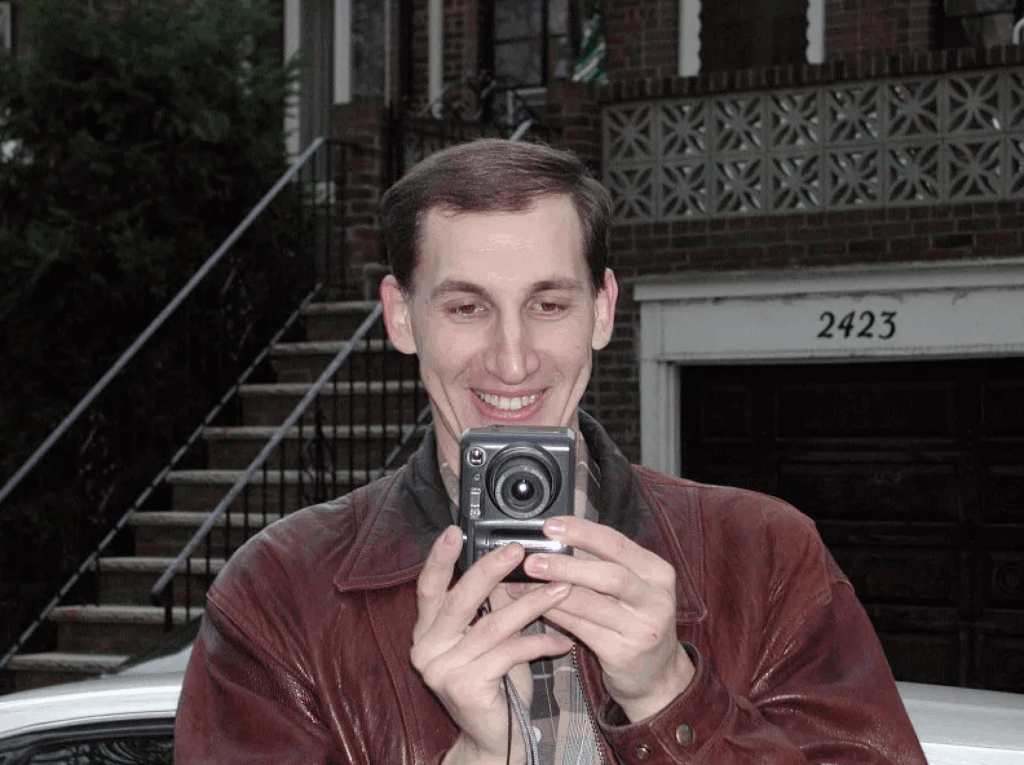
Konstantin Petrov with his Nikon Coolpix 880 camera

Petrov’s path to the United States began in Estonia, where he had once made and sold electronics and offered his services as an electrician. After his friend Dmitri Don convinced him to move to the US in 1998, he secured a student visa and later a green card through marriage, which opened up further opportunities. In New York City, he landed a job as an electrician at the famed Windows on the World restaurant. As Nick Paumgarten writes in his commemorative article in The New Yorker, it was an impressive development among Petrov’s circle of friends. “When he got this job at World Trade Center,” Dmitri recalled, “we were all, like, ‘No way! World Trade Center is, like, so cool.’”
Looking at his workplace in August 2000
Looking at his workplace in August 2000 (source: public.fotki.com/kostic/world_trade_center/windows_on_the_world-4/view_from_restauran-3/)

Petrov loved photography and often carried a digital camera with him, including when he went up and down the floors of the North Tower, giving his friends a glimpse into what was then the tallest building in NYC. As his friend Dmitri had founded an early photo sharing site called Fotki, this is where he shared the photos, many of them taken in the years 2000 and 2001 and posted in the weeks leading up to 9/11. His pictures were varied: sophisticated dining rooms and lobbies, signage, elevators, moving cloud cover and fog, ferries in the surrounding harbour, tourists at the top of south tower, and the stark vertical lines of the tower. Of course, they weren’t intended as portents of future calamity. They were part of a larger personal archive that included street scenes, memories with friends, and snapshots of his daily life.

On September 11th, 2001, Petrov had just finished a night shift at the restaurant. He clocked out and left to get his car in the basement parking garage around 8:30 a.m. Minutes later, Flight 11 struck the very building he had just exited. He was close enough to see debris falling, but carried on home, unaware of what had happened. Conversely, many of his co-workers from the restaurant did not make it out.

… virtually every angle and second of the attacks has been revealed over the years, from filmmaker Jules Naudet’s unexpected footage of the first plane to images of firefighters climbing up the stairs and Ed Kotski’s photos of the damage from inside.

In the aftermath, Petrov’s WTC photographs were hidden in the depths of the internet, despite the added meaning they had taken on. Meanwhile, virtually every angle and second of the attacks has been revealed over the years, from filmmaker Jules Naudet’s unexpected footage of the first plane to images of firefighters climbing up the stairs and Ed Kotski’s photos of the damage from inside. But with the release of Erik Nelson’s 2014 documentary 9/10: The Final Hours, which focused on the day before the attacks, Petrov’s photos became much more prominent. His workplace photos became a primary visual record of a now-vanished place. This documentary is what has led many people to his Fotki profile, the piece in The New Yorker, and to Petrov’s story.

Petrov’s photo archive continued after the attacks, indicating how those in the city tried to carry on. Among his photo sets are images of social gatherings, hikes, and a trip to Niagara Falls, as well as images around the WTC site from October 2001 and February 2002, showing the barricades around rubble and the memorial wall put up for the international victims of the WTC attack. But tragically, less than a year after 9/11, on July 7th, 2002, after leaving a party, Konstantin Petrov crashed his motorcycle on Joe DiMaggio Highway on the west side of Manhattan. He was pronounced dead at the scene, at only twenty-eight years of age.

Even today, thousands of people look through, comment on, and share his photos. Viewers comment on the dread elicited by seeing the buildings, disbelief that the place no longer exists as it was. Viewers reflect on those who lost their lives. They marvel at the scenery’s beauty, the sparse setting of the photographs, the retro decor of the restaurant, or the meals they once shared on the top floor.

What the photographer left us in his passing is a means to process trauma and what may well be the most-documented event in recent history.

The South Tower in August 2000
The South Tower in August 2000 (source: https://public.fotki.com/kostic/world_trade_center/windows_on_the_world-4/view_from_restauran-3/)

Read more