How and why were naiskorporatsioonid (sororities) created in Estonia, and are they active in today’s academic world?
In Tsarist Russia (which included Estonia until 1918), women were admitted to universities as “free observers” (“vabakuulajad” in Estonian) beginning in 1905. Times changed in 1915, when the Tsar decreed that all universities in the Russian Empire (which still included Estonia) could formally accept female students and women could formally graduate from university. For example, from 1915-1917, The University of Tartu had 103 female university students.
Estonia declared independence in 1918 and obtained de jure independence in 1920. In 1918, the University of Tartu began teaching, step-by-step, in Estonian. Previously Russian had been the main teaching language, and prior to 1893, German. But female university students were not accepted by some university professors, male university students, and by some parts of society.
As a recent B.A. thesis stated: It was thought women university students would lower the academic standard of universities, that women acquiring a university education would “endanger the continuity of the Estonian people” (i.e. women would have less children), and endanger the current relationship between men and women. [1]
To support each other, women began to form organisations. The first one was formed in 1911: Eesti Naisüliõpilaste Selts (“ENÜS,” or in English, the “Estonian Women’s Student Society”).
Despite a difficult beginning, by 1935, 65% of female university students belonged to a sorority. In summary, the founding principles of all female korporatsioonid emphasized hard work, a moral lifestyle, and patriotism (“isamaalisus”).
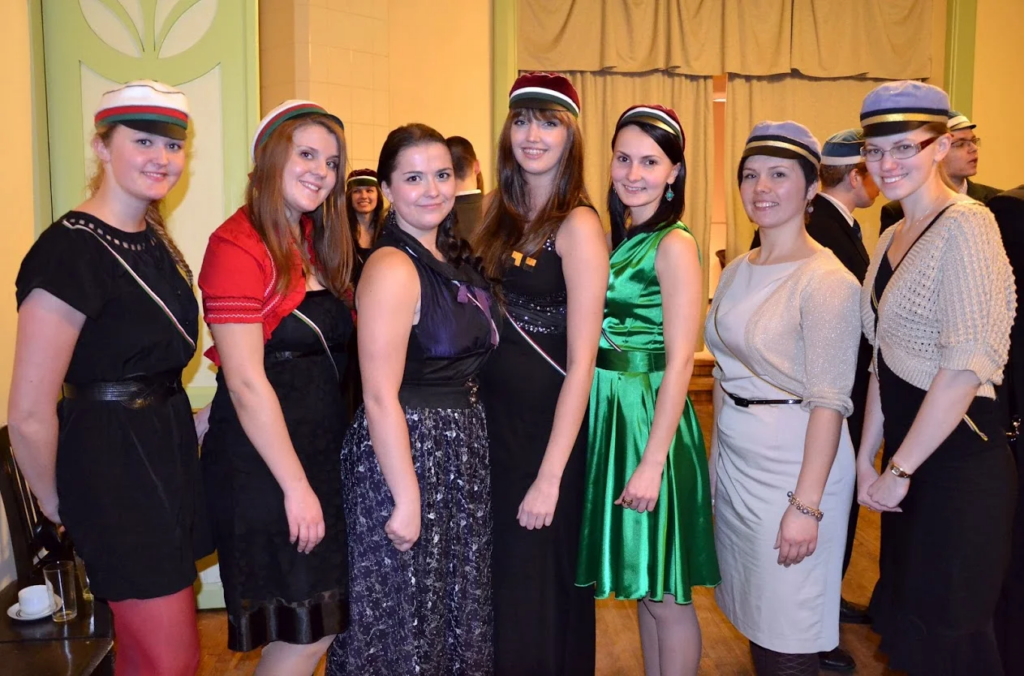
To find like-minded women, female students formed four naiskorporatsioonid (sororities) during the period 1920 to 1940. The first one was Filiae Patriae in 1920, with naiskorporatsioonid Indla, Lembela, and Amicitia being founded in 1924. The goal of these sororities was to “…to raise well- rounded, self-aware and moral academic women”. [2]
Despite a difficult beginning, by 1935, 65% of female university students belonged to a sorority. In summary, the founding principles of all female korporatsioonid emphasized hard work, a moral lifestyle, and patriotism (“isamaalisus”).[3]
For the record, it should be noted that korporatsioonid or seltsid (“societies” in English) with both sexes also exist in Estonia (along the lines of an “osakunta” in Finland, [“nation” in English]), for example Eesti Üliõpilaselts Põhjala.
That being said, Korp! Sororitas Estoniae, a new naiskorporatsioon, was founded in February 2011 and has become quite popular.
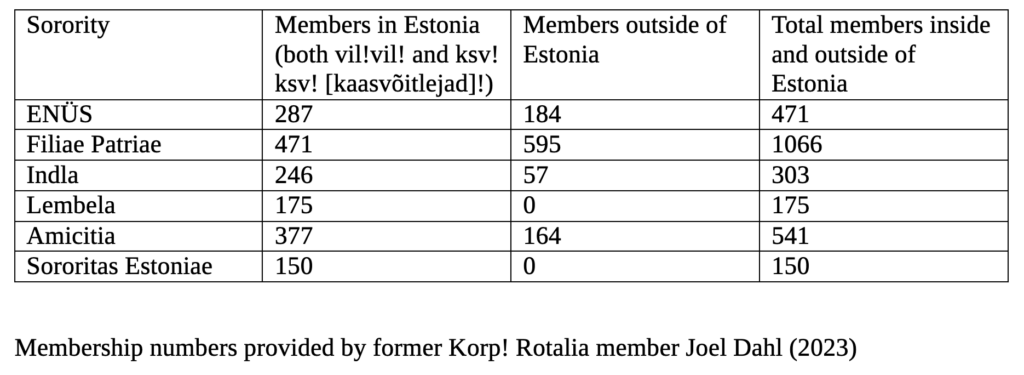
For background, ENÜS, Korporatsioon Filia Patria (although their homepage states that they have an apartment in Tallinn), Korporatsioon Amicitia, and Korporatsioon Indla have permanent branches (“konvendid”) only in Tartu. Korp! Lembela only has a konvent (branch) in Tallinn and Sorotias Estoniae is the only sorority with a konvent in both Tallinn and Tartu.
To give a feeling of relative membership numbers, below is a chart:
When Filiae Patriae and Indla became active again after 1989 (all fraternities and sororities had been closed down during the Soviet occupation), their members from pre-WW II times made significant donations to their respective sororities, which allowed them to purchase konvendid in Tartu. But the bequests came with specific rules related to alcohol. To this day, no alcohol (including beer) can be consumed in the Indla konvent. For Filiae Patriae, although their original sorority house at Struve 4 in Tartu was re-purchased, they can only hold events with alcohol with a prior decision from the leadership of active members.

Katariina Päts, the former President of the University of Tartu Student Union and the former Chairwoman and rebasvanem (who teaches pledges/rebased) of Amicitia stated that the similarities between all sororities are quite strong, as is also the case with fraternities. The difference comes from the groups of friends within each korporatsioon.
Katariina Päts adds, “All Estonian sororities have isamaalisus or patriotism written in their principles, but in Estonia that patriotism is something we almost take for granted—it’s a by-product of speaking Estonian, studying at an Estonian university, and living in an Estonian environment.” Sororities don’t have to consciously “practice” being Estonian. Rather, it’s part of everyday life. Päts thinks sororities’ patriotism shows less through ritual and more through wider impact—by encouraging their members to shape Estonian society and carry forward the values at the heart of our organizations.
“There is ongoing, often sharp, debate among members on many topics… In that sense, the sorority is not just about preserving tradition but about teaching, through everyday practice, how to participate in and shape society.”
(Katariina Päts)
“Although sororities may appear to be tradition-bound institutions, they are in fact deeply democratic,” notes Katariina Päts. “They operate as small models of society—places where members learn to negotiate, find compromises, take responsibility, and lead. There is ongoing, often sharp, debate among members on many topics: how strictly traditions and rules should be followed, how to make membership more inclusive, and how customs should evolve with time. In that sense, the sorority is not just about preserving tradition but about teaching, through everyday practice, how to participate in and shape society.”
In other words, naiskorporatsioonid continue to play an active role in Estonia’s academic world. Tensions within that world will be explored in the author’s next article.
Footnotes
1. Tamar, Jaanika. Her B.A. thesis: “The image in written materials of Estonian female sororities during the years 1920-1940” (in Estonian), pp. 15-16, University of Tartu, 2013.
2. Ibid, p. 21.
3. Ibid, p. 22.