If nautical nonsense be something you wish, and you’ve spent time watching cartoons in North America either just last year or twenty-seven years ago, you’ll probably be able to guess the character I’m speaking of—SpongeBob SquarePants. However, if you’re watching the show in Estonia, his name is Käsna-Kalle Kantpüks. This name is like a linguistic puzzle. In Estonian, käsn means sponge, and püksid are pants. Kalle was chosen as a friendly, alliterative stand-in for Bob to match the hard “K” sounds. And, according to the Explanatory Dictionary of the Estonian Language, a kant is the joining edge of two surfaces. Together, they create a name that sounds sincere, jolly, and quite Estonian as well.
If you’ve never had a chance to watch it before, the show follows the misadventures of a cheerful, naïve sea sponge who looks remarkably like a kitchen sponge. He lives in a bizarre underwater city called Bikini Bottom (Bikiini Põhja), and his fellow mereelanikud (sea dwellers) don’t quite match his enthusiasm. It’s funny in a totally wacky, clever, and relatable way. In fact, I almost find it funnier now than I did when I first watched Nickelodeon with breakfast as a first-grader.
For that, we can thank the show’s creator, the late animator Stephen Hillenburg. He was a genius worldbuilder, someone who dreamed up a whole range of characters and stories inspired by what he knew and what he saw, something that ended up taking on a life of its own.
You can see how everything came together as a cartoon. The music is Hawaiian-style. The “sky” is decorated with tropical shirt patterns. Cars are actually boats. “Trees” are actually made of coral. Even the buildings make sense. The Krusty Krab, where SpongeBob flips burgers for the miserly Mr. Krabs (Härra Krabi), is designed to look like a treasure chest.
Hillenburg was originally a marine biologist working at the Ocean Institute in Orange County, California. As part of his job, Hillenburg taught kids about tide pool animals, and so, in 1989, he created a comic book called The Intertidal Zone to help students visualize what they were learning. The comic starred a round sea sponge called Bob and a shrimp called Rocky. Even ten years before the show first appeared on TV, there were glimpses of housecat-like snails (similar to SpongeBob’s snail, Gary) and lazy sea stars (a prelude to SpongeBob’s best friend, Patrick Star). When Hillenburg decided to turn his ideas into a cartoon, he realized a square kitchen sponge was funnier and emphasized the character’s “square” personality. Watching the show’s many seasons, you can see how everything came together as a cartoon. The music is Hawaiian-style. The “sky” is decorated with tropical shirt patterns. Cars are actually boats. “Trees” are actually made of coral. The jelly-making “bees”/“butterflies” that SpongeBob catches (and is frequently shocked by) are actually jellyfish. There’s also an underlying fear of pure oxygen and fishermen, which is rather sinister!
Even the buildings make sense. SpongeBob’s begrudging neighbour, Squidward Tentacles (known as Kalmer in Estonian, playing on the word for squid, kalmaar), lives in a sunken Polynesian sculpture. The Krusty Krab, where SpongeBob flips burgers for the miserly Mr. Krabs (Härra Krabi), is designed to look like a treasure chest. The towers of downtown Bikini Bottom look like discarded boat parts.
It makes sense that SpongeBob has found a second home in Estonia. Sometimes the humour is quite dry and sharp, which feels familiar. While the Baltic Sea isn’t tropical, perhaps, as a nation with a deep seafaring heritage and a connection to the Baltic Sea, Estonians understand the nautical life. The show also appeals to anyone who has been in their 20s. SpongeBob works a minimum-wage job, struggles to pass his driving test, and deals with grumpy neighbours. It’s a surreal, offbeat look at the challenges of growing up.
To date, there are sixteen seasons of SpongeBob SquarePants and six films. (For cartoon world reference, The Simpsons is at thirty-seven seasons and almost two films.) Bringing these stories to Estonia has required a dedicated team of actors. The Estonian dubs have featured the voices of Ardo Ran Varres, Liis Lindmaa, Mihkel Kallaste, Liisu Krass, and Kristo Veinberg, with recordings produced at AVP Stuudio and SDI Media Estonia in Tallinn. In the most recent film, Margus Tabor, who performed “Mamma lood” to audiences across Canada in 2025, voiced the spongy protagonist.
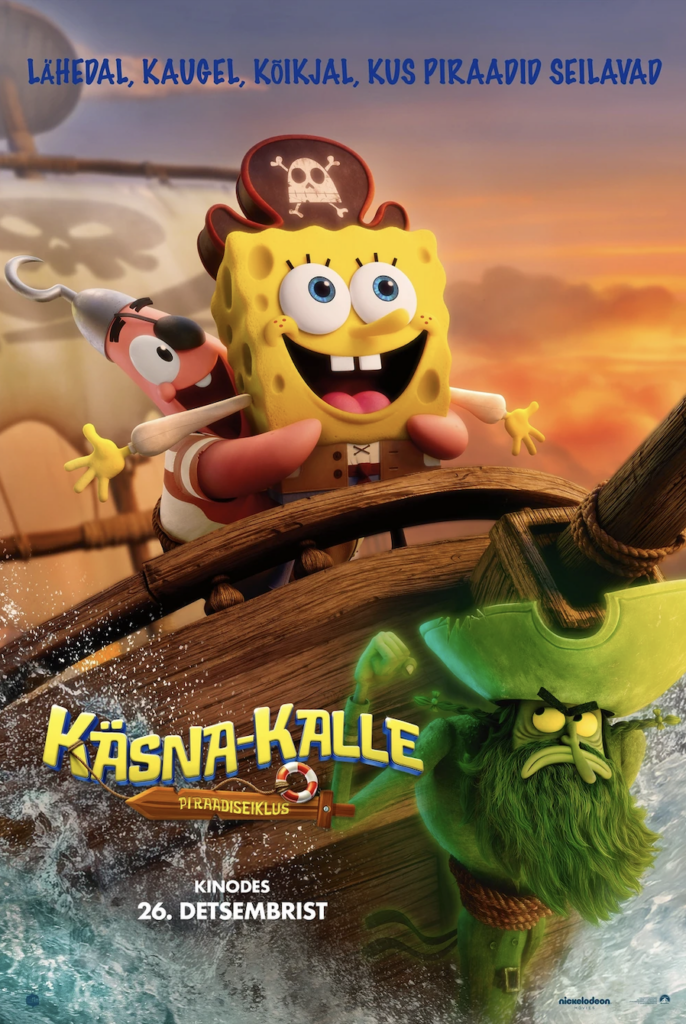
The film, Käsna-Kalle piraadiseiklus (The SpongeBob Movie: Search for SquarePants), arrived in Estonian theatres on December 26th, 2025. So “as long as these pants are square and this sponge is Bob/Kalle,” you can rent the latest film on the Go3 website. And if you’re looking to catch up on old episodes, a Telia subscription gives access to the series’ episodes in Estonian.