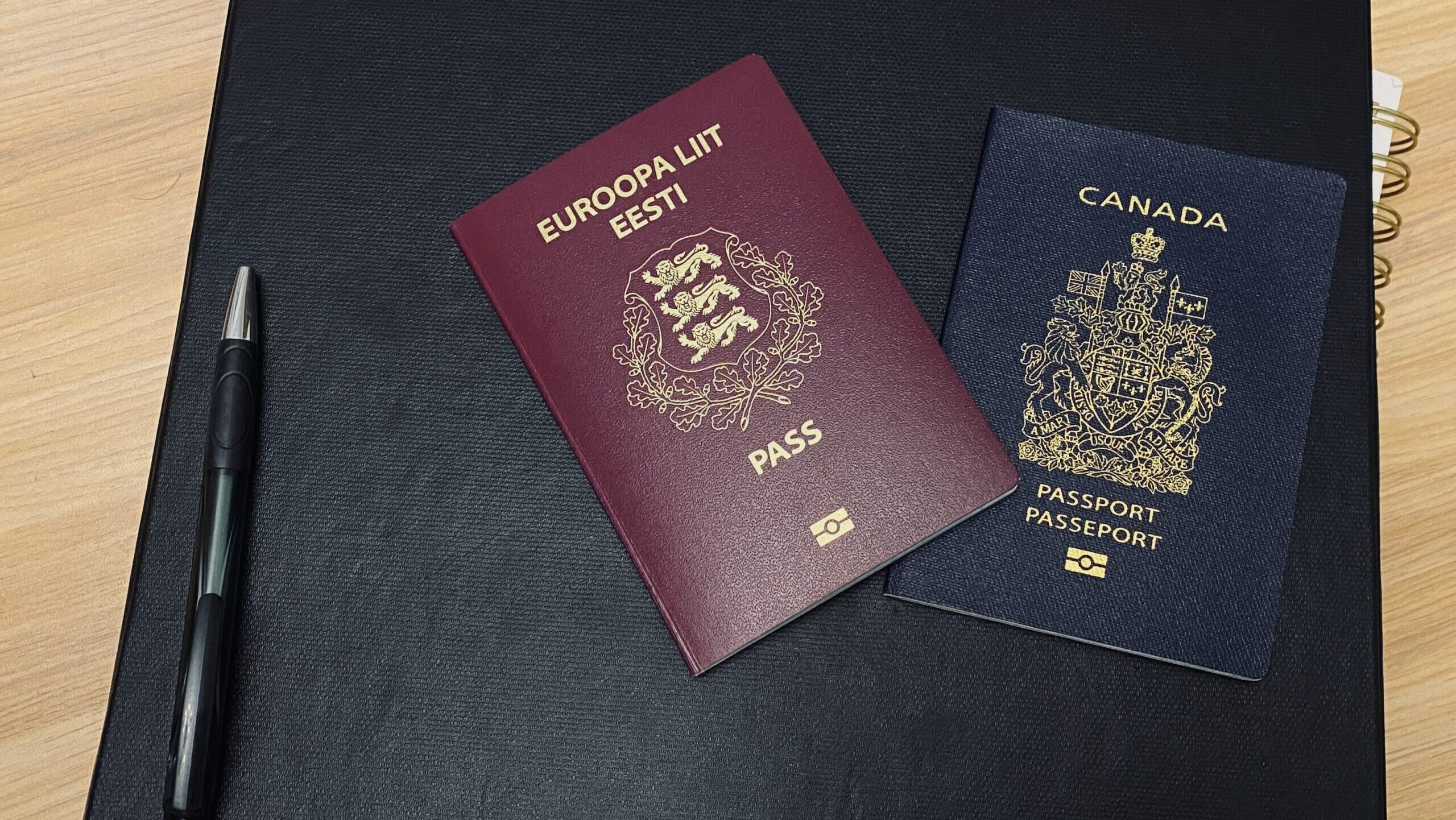
Our story begins with a Toronto-based company, EUROPASSPORT, which advertised a simple, fast, and cost-effective path to an Estonian passport through “Citizenship by Descent.” The firm’s slick marketing and a friendly, free “Discovery Session” projected an image of expertise and convenience, and our situation was deemed to be quite favourable in terms of the documentation we had in-hand.
For a “deposit” of $1,050 CAD, submitted along with an “Eligibility Assessment Questionnaire” containing private personal and family details, the company promised to credit the fee towards their future work handling the complexities associated with obtaining an Estonian passport, should the firm’s Estonian lawyer deem us to be eligible according to Estonian law. An appealing offer for those without legal expertise.
However, in my own research I identified a potential roadblock. EUROPASSPORT’s website claimed that Estonia allows Dual Citizenship, which contradicted what I read in the Estonian Citizenship Act, which specifically prohibits dual citizenship in multiple clauses.
Concerned, I flagged this discrepancy directly to the company’s CEO, who offered assurances that “You are already considered a citizen if at least one of your parents was born there” and “No one may be deprived of Estonian citizenship acquired by birth” according to the Estonian Constitution. Subsequently, he claimed to have “triple checked with his lawyers” and insisted there was a “loophole in the law.” He also asked whether my father had ever explicitly renounced his Estonian citizenship as an adult, to which I replied with certainty: “No, definitely not.”
Trusting the head of a firm purportedly specializing in this exact area, my sister and I proceeded on what I described to the CEO as a leap of faith.
This faith proved to be misplaced. The moment the non-refundable fee was paid, the experience soured.
The first major alarm bell was a significant privacy lapse. The company mishandled our private, personal information by e-mailing the contents of our “Eligibility Assessment Questionnaire” back to us unencrypted over the Internet, completely unnecessarily. As a cybersecurity professional, I recognized that this exposed us to potential identity theft, and flagged this to the company immediately.
The ultimate blow came shortly after. The core issue of dual citizenship, which I had questioned from the beginning, suddenly became an insurmountable obstacle, regarding our father.
In a confusing reversal, EUROPASSPORT’s own Estonian lawyer concluded that my sister and I were ineligible for citizenship, because our father (who was born in Estonia to Estonian parents), lost his Estonian citizenship by obtaining Canadian citizenship decades ago as a minor and not renouncing it by age 21, according to the Estonian Citizenship Act.
“Although the Estonian Citizenship Act states that dual citizenship is not permitted, the same law § 5 (3) repeats what is stated [in] the constitution – no one may be deprived of Estonian citizenship acquired by birth.”
(the Estonian Embassy in Ottawa)
This conclusion brings into serious question EUROPASSPORT’s legal interpretation of Estonian law as it applies to the descendants of refugees, based on the following official statement provided by the Estonian Embassy in Ottawa:
“An applicant for an Estonian passport must have an archive certificate confirming that their parent/grandparent was an Estonian citizen between 1918 and 16.06.1940. This grants that the applicant has a basis for acquiring Estonian citizenship by birth.
The fact that an antecedent acquired Canadian citizenship after 1940, or that the applicant holds Canadian citizenship, does not take away the right to apply for an Estonian passport. Estonian law does not require an applicant to renounce Canadian citizenship when issuing an Estonian passport.
The Constitution of the Republic of Estonia § 8 stipulates that “every child with a parent who is an Estonian citizen has the right to Estonian citizenship by birth. No one shall be deprived of Estonian citizenship acquired by birth.” So, by the constitution, Estonian citizenship obtained by descent is inalienable and cannot be removed by anyone other than the citizenship owner. Although the Estonian Citizenship Act states that dual citizenship is not permitted, the same law § 5 (3) repeats what is stated [in] the constitution – no one may be deprived of Estonian citizenship acquired by birth.”
Therefore, EUROPASSPORT’s legal opinion was both incorrect and contradictory to the CEO’s own initial claims. This, together with their mishandling of our personal information, were examples of clear “mistake[s] or wrongdoing from [their] side,” the very condition the CEO stated would warrant a refund.
Yet, when I demanded our money back, the CEO refused, claiming in another confusing reversal that Estonian citizenship by ancestry “is not an easy thing to get approval for,” and “is something in the realm of possibility under very specific qualifying conditions,” without specifying what these conditions were.
This serves as a stark warning: The allure of a simplified process offered by private firms can be outweighed by the potential for misinterpretation of a country’s citizenship laws, inadequate safeguarding of personal information, and lack of ethical accountability.
For those seeking Estonian citizenship, the lesson is clear: buyer beware. The safest, most reliable path to citizenship is through official channels, to avoid the financial loss and disappointment that we endured. Working with an Estonian consulate or embassy from the outset ensures that you are receiving accurate information based on a correct interpretation of the law, directly from the source. The path may require more personal time and effort, but knowledgeable and trustworthy help is readily available along the way.