L: Welcome to Estonia, Karl. I would like to speak about your filmmaking experience and your Estonian roots as well. You have made quite a few short films and one long film (Touched, 2017) which made you famous. This is your second feature film. How did it happen that you became a filmmaker? Was it your childhood dream?
K: I started writing and telling stories from a young age. That naturally turned into filmmaking which is another way of telling stories. So, it started early…
L: You are a storyteller. You tell stories through films.
K: Yes.
L: You have got a couple of degrees from different universities, on top of this you seem to be a world traveler – a very international man. You’ve even studied in China and you allegedly speak fluent Chinese.
K: Well, I was fluent before. I wouldn’t call it fluent anymore, but yes, I speak Mandarin.

L: You have so many different influences from different parts of the world, and also Estonian roots.
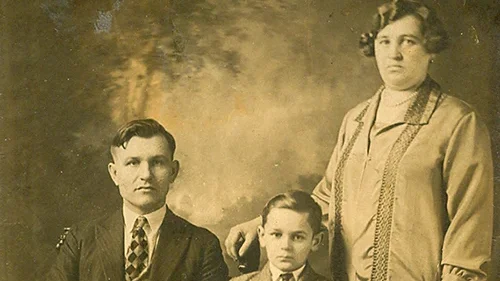
K: My father was born in Estonia. My grandfather took the family and fled Estonia during the war. They left when my dad was just six months old, and then they spent several years in a refugee camp in Germany until the war ended. Then they were able to go to Canada. What is very special to me is that this is my first time in Estonia. So to be coming back to Estonia with that history in the family, for the first time and being able to present my feature film world premiere in Tallinn, it’s very special. I would say, both for me and my family.
L: Do you have any relatives left in Estonia?
K: Most of my immediate family, they’re all in Canada, in Toronto and Montreal, and in the US. But we do have a lot of relatives who are still here. My father’s cousins and so on. One nice thing about this trip is that I’m gonna be getting a chance to meet a lot of them. We are gonna be traveling around a little bit, to where my father was born.
L: And where was your father born?
K: In Vändra. I know one song in Estonian. It’s “Vändra metsas Pärnumaal, juhhaidii, juhhaidaa…” I’ve been hearing that song from my dad since I was born. So, finally I’ll go there.

L: Did your dad speak Estonian to you when you were a child?
K: Not really. My mother is Irish, she is not Estonian. I grew up in Canada and I actually spent a few years in Ireland, going to school there. When we were in Canada, we were surrounded by my Estonian family there, so I heard a lot of Estonian. My father would speak Estonian with his siblings. But none of us learned Estonian, except the ones who had two Estonian parents. So I do have some cousins who speak Estonian, but us and the other cousins with one Estonian parent, we did not learn the language.
L: You saw the Estonian community from inside and also from outside. Is there something, perhaps some customs or habits, which are particularly Estonian?
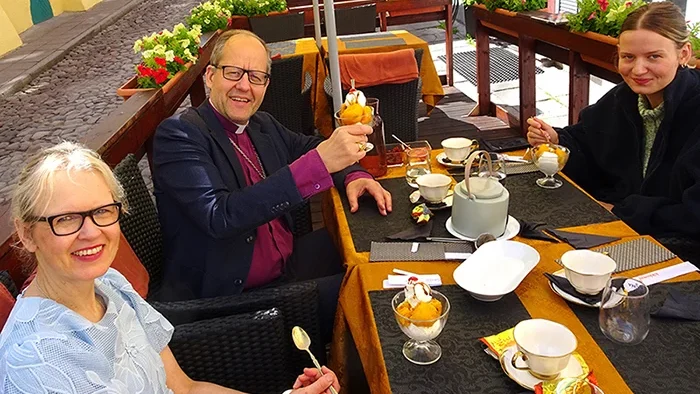
K: Sure, there are a lot of things. For example, my grandfather, his name was Karl also, the same as mine, Karl Raudsepp. He was the one who took his family out of Estonia during the war. They came to Canada with nothing. He was a priest, and he became the bishop of the Estonian Lutheran Church of Canada. So he became a very important leader of the Estonian community and he founded a church in Montreal. Even though we were not religious ourselves, we would go to that church for the Estonian bazaar every year. There would be a raffle and we would win prizes and we loved that. We would eat traditional Estonian foods. Some of them I remember the names: verivorst and rosolje. Our favorite thing to eat at Christmas time was my grandmother’s famous piparkoogid. All these little things, little cultural things and moments, all Estonian, have been a part of my life growing up.

L: Do you still keep in touch with all your cousins in Canada? I mean your Estonian half of the family.
K: Yes, we still see some of them. I had dinner with my cousin Mark just las week. He’s one of the cousins who speaks fluent Estonian because both of his parents are Estonian.
L: Are they all in Montreal?
K: Some, and others are in Toronto, or scattered around other parts of North America.
L: Did you go to the Estonian Sunday School or summer camps?
K: No. [laughing] I think those kinds of influences, again, if you only have one parent who is Estonian…
L: You can get away with it?
K: Yeah, exactly. No, we did not do anything like that. And we also didn’t go to church, so that’s obviously an interesting choice if your grandfather is a bishop. We did not always agree on religion.
L: You have also lived in Ireland, your mother is from there.
K: Yes.
L: How long did you live there?
K: About six years, off and on but not all in a row. We would go to Ireland each year when I was a kid. I spent every summer there. And then I went to elementary school there, and then I went back and worked there as well. So, I’ve certainly spent a lot more time in Ireland. The big difference is that my Estonian family, the close family, are all in North America, not in Estonia, but my Irish family, they are all still in Ireland. Only my mother left Ireland, everyone else is still there.

L: Have your Estonian roots also influenced you as a filmmaker? Or rather your European roots?
K: To be honest, I can’t say. Because if you asked me the same question about Ireland, I wouldn’t be able to say either. It is too difficult to know, because one half of my family is Irish, one half is Estonian, but I’m still more North American. I don’t have an Irish accent; I certainly don’t have an Estonian accent. And then on top of that, I spent a lot of time growing up in Quebec where the influence is French, and a lot of people who work on my films are Quebecois. So, that’s also a big influence. It’s very hard to pinpoint exactly what comes from where. But I’m sure all of these things do have some kind of influence.
L: Sure. And you are finally here. What were your first impressions about Estonia? How did it feel to be here?
K: My first impressions, well, one first impression was: we were met at the airport by two burly Estonian men driving Porsche turbos, and they said: “We are your family!” [laughing] So, I was like “Ok sure! What kind of family is this?” Yeah, my impression has been very nice. People have been very warm, very kind, very friendly. I’ve only been here, keep in mind, about 24 hours. I haven’t slept for two days. But I’m very happy, you know, because it is so amazing for me to be here. It’s been a great first impression, but it is still very new.
L: For not having slept for two days you look great! And thanks again for having this interview. But now let’s talk about your films. How would you define yourself as a filmmaker? Your first feature film (Touched, 2017) was a psychological thriller.
K: Yeah, something between a psychological thriller and a ghost story. The idea is that you’re not sure exactly what kind of film you’re in…
L: And now your new film, The G, is about social injustice, about old and vulnerable people who were forced to leave their home and trying to fight back. It sounds like a social topic.
K: It’s actually closer to the first film than it sounds. Yes, there’s a social justice aspect to it: It’s a real phenomenon that happens a lot and it’s about the exploitation and abuse of the elderly- vulnerable older people whose rights are legally taken over by guardians. And this phenomenon is very widespread in America where the film is set. But it also happens in Canada. So all of that is the context for the film but… it’s not a social-realism drama, it’s a dark thriller. There are genre elements in the film, so it is a mixture of these different ideas. At the same time, it is a portrait of this one older woman who is inspired by my real-life grandmother. She’s a very tough mysterious older woman who – when all of this terrible stuff happens to her – she refuses to accept that her life is over and she starts to fight back. And it becomes a kind of revenge movie. So it’s very unusual to have an older woman in the lead role in a film like this. It’s very different from the first feature I did, but at the same time, both of them are heavily atmospheric, both of them have a little bit of a genre element, so it’s not entirely different at the same time.

L: I see. Was it your Irish or Estonian grandmother who inspired you?
K: It’s my Irish grandmother.
L: Have you seen any Estonian films yet? What is your opinion about the Estonian cinema?
K: Not yet. I’m hoping to see a few at this festival.
L: Well. There are also some other Canadian films at the festival – documentaries, youth and children movies. How would you describe the current situation in the Canadian film industry?
K: I think that for English films in Canada it’s a difficult time in terms of raising funds. I can’t really say much more than that – I haven’t seen enough Canadian films recently to comment…
L: Thank you. After the festival for how long will you stay here in Estonia and what are your plans here?
K: I’m only staying at the film festival for about 4-5 days, then we are going to travel around Estonia. I’m looking very much forward to that. I don’t know exactly where we are going, my family here have planned it out. I know that we are going to Vändra though…
L: Thank you so much for the interview and I’m sure your film will get a very good reception.
***
By now, the film festival is long over and Karl has returned home in Canada. Here below are his impressions about the premiere:
First, the reception of the film was terrific. At the world premiere screening, I had my father come up and give a speech in Estonian for a packed theatre – it was very moving. I also had my “new” Estonian family join me for photos on the black carpet at PÖFF which was very cool. The audiences seemed to love the film and we got great reviews/mentions so far in Screen International, Variety etc, so… it was a great premiere, great trip.
I had such a great time in Estonia for so many reasons- I really liked my new family members and spent a lot of time with them, everyone I met was warm and friendly, there's a great energy and optimism in Tallinn and I felt proud of what Estonia has built and accomplished… basically I just loved the whole experience. Plus the premiere went really well, so… I hope I can return soon!
The distributor in Canada, LevelFilm will be releasing “The G” in theatres in Canada in 2024, so stay tuned for that! You can follow Karl R. Hearne on social media:
Lea Kreinin, Tallinn