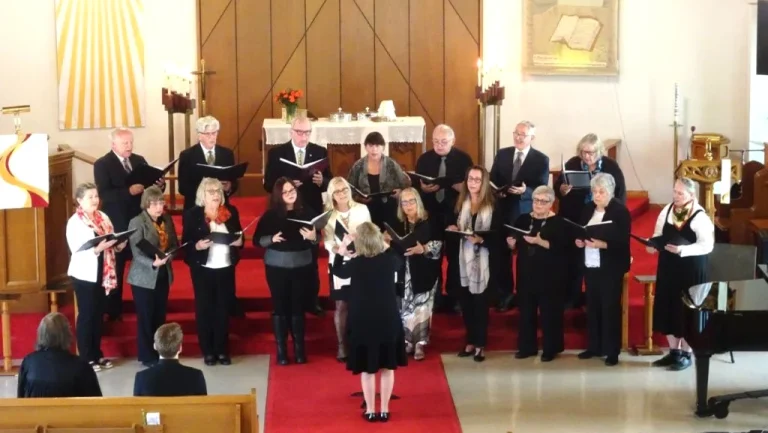
For more than 71 years the church has faithfully served both its congregation and the wider community.
As early as 2018, Toronto City Planning adopted the Midtown in Focus: Final Report, which included the Yonge-Eglinton Secondary Plan. As part of that study, a Cultural Heritage Resource Assessment identified 817 Mount Pleasant Avenue as a property with potential cultural heritage value.
On September 28th, 2020, after learning of the intended sale of St. Peter’s, a concerned congregation member, together with fifty-eight supporters, submitted a Heritage Property Nomination Form. Online Petitions calling for the preservation of the church gathered 1,361, while numerous individuals wrote to the City urging officials to protect the building. Articles highlighting the issue appeared in both Estonian and English-language newspapers.
Following several public hearings at which many speakers expressed strong support for heritage protection, 817 Mount Pleasant Avenue was listed on the City of Toronto’s Heritage Register in June 2023.
A property may be designated if it meets at least two of the provincial criteria for determining cultural heritage value or interest. Remarkably, 817 Mount Pleasant Road was found to satisfy five of the nine criteria!
The Designation Process
In June 2025, two years after its listing date, the property was technically removed from the Heritage Register in accordance with the Ontario Heritage Act. However, this did not prevent City Council from proceeding with the designation process, and Heritage Planning continued advancing a Notice of Intention to Designate in March of 2025.
Ontario Regulation 9/06 sets out the criteria for evaluating properties for designation under Part IV, Section 29 of the Ontario Heritage Act. These criteria assess a property’s design or physical value, historical and associative value, and contextual value. A property may be designated if it meets at least two of the provincial criteria for determining cultural heritage value or interest. Remarkably, 817 Mount Pleasant Road was found to satisfy five of the nine criteria!
The designation process then proceeded through the required municipal approvals. Heritage Planning presented a Notice of Intention to Designate (NOID) to the Toronto Preservation Board, where it was readily approved. The matter then advanced to the Planning and Housing Committee, followed by Toronto City Council, which officially adopted the designation. After the required 30-day appeal period, the by-law designating the property at 817 Mount Pleasant Road was enacted on June 25th, 2026.
Notice of Intention to Designate the Property
On April 28th, 2026, City Clerk John D. Elvidge formally issued the Notice of Intention to Designate the Property stating:
“TAKE NOTICE that Council for the City of Toronto intends to designate the property, including the lands, buildings and structures thereon known municipally as 817 Mount Pleasant Road under Part IV, Section 29 of the Ontario Heritage Act, R.S.O. 1990, c.O.18, as amended, as a property of cultural heritage value or interest.
Reasons for Designation:
The property at 817 Mount Pleasant Road is worthy of designation under Part IV, Section 29 of the Ontario Heritage Act for its cultural heritage value, and meets Ontario Regulation 9/06, the provincial criteria prescribed for municipal designation, under the categories of design/physical, historical/associative, and contextual value.
Description
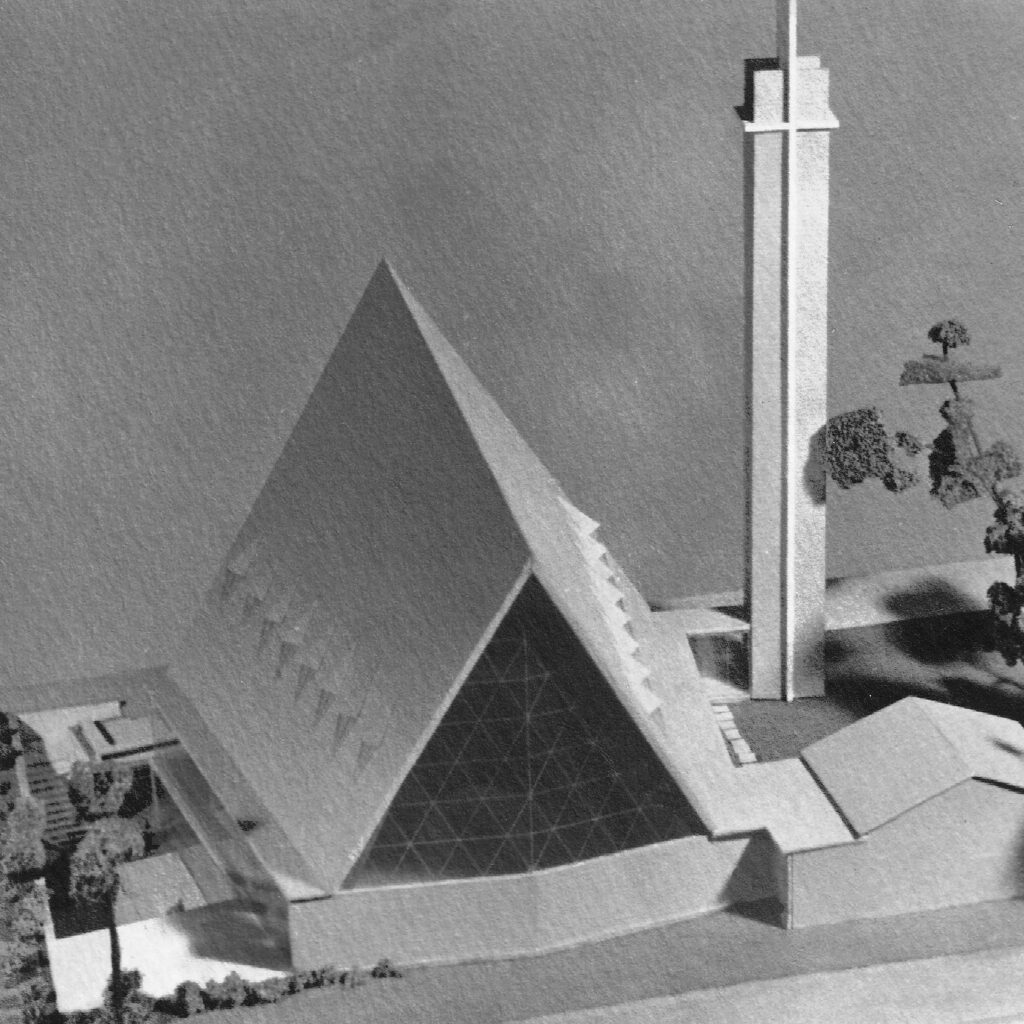
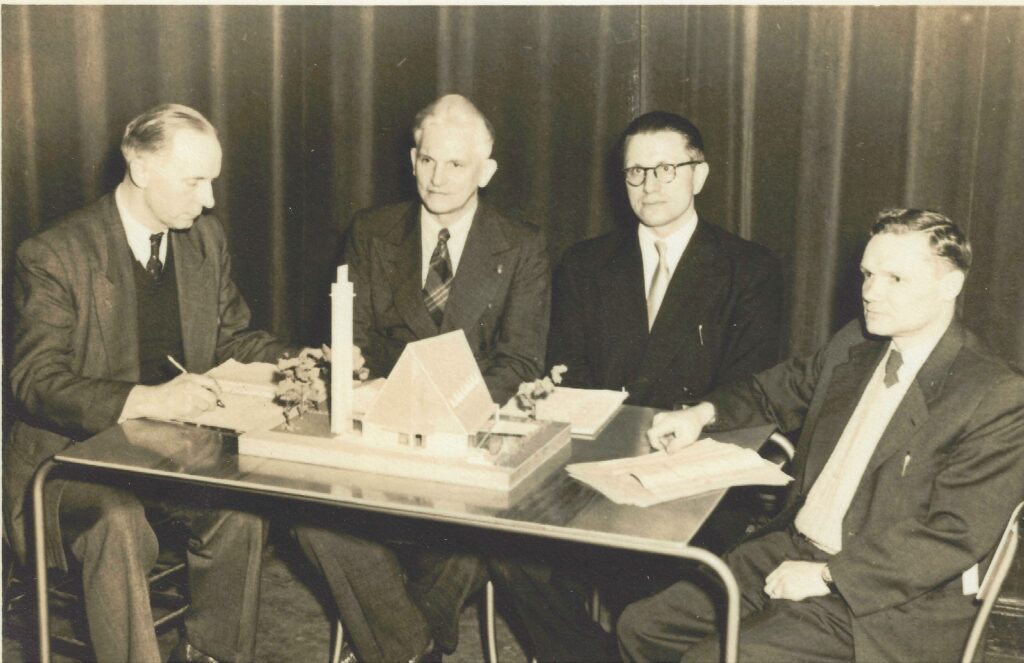
Located on the southeast corner of Mount Pleasant Road and Roehampton Avenue, St. Peter’s Estonian Evangelical Lutheran Church (817 Mount Pleasant Road) was commissioned by Estonian immigrants and designed by Estonian-Canadian architect and church member, Michael Bach. Erected in 1955 as a memorial to the thousands of Estonians who died in both World Wars, the Estonian War of Independence, and as refugees, it continues to serve as an active place of worship and commemoration for Toronto’s Estonian Evangelical Lutheran community and as a cultural hub for the broader Estonian-Canadian community. The property contains a Mid-Century Modernist style A-Frame Church with attached two-storey ancillary wing, a 1970 Modernist style freestanding, pre-cast concrete belltower, and columbarium. Based on Bach’s plan, fellow Estonian-Canadian architect and church member Ants Elken oversaw the addition of the Ladies Guild Room to the north wing, bell tower, and courtyard with garden wall, which were completed by 1970.
Statement of Cultural Heritage Value
Historical and Associative Value
The property has value for its direct association with Toronto’s Estonian-Canadian community. St. Peter’s Estonian Evangelical Lutheran Church was established in 1948 by Estonian immigrants fleeing Soviet occupation after the end of the Second World War. Following a brief period of worship at St. John’s Evangelical Lutheran Church at 274 Concord Avenue, in 1954 the church commissioned Estonian-Canadian architect and church member, Michael Bach, to design their own place of worship. Constructed and consecrated in 1955, the property has continuously served as a place of worship for the Estonian Evangelical Lutheran community and a cultural hub for the broader Estonian Canadian community.
The church also has value for its association with the noted Estonian-Canadian architect, Michael Bach (1916-1972), who is identified as a person of significance by Toronto’s Estonian-Canadian community. An instructor at the Faculty of Architecture at the University of Toronto, Bach was the first of a group of Estonian-Canadian architects to arrive in Toronto after the Second World War who would play an important role in advancing Modernism in Toronto. The subject property reflects the ideas of Michael Bach, which were heavily influenced by Scandinavian Modernist architecture. This is evidenced through its Mid-Century Modernist design, clean lines, and an emphasis on natural materials.
The property has further value for its association with acclaimed Austro-Canadian glass artist and painter Ernestine Tahedl, who created the property’s stained-glass windows between 1987 and 1990. With a career spanning over 60 years, her works include the coloured-glass windows for the Sanctuary building at the Canadian pavilion for Expo ‘67 (1965-1967) and the Salvation Army Sanctuary in Toronto (2023). Other notable works by Tahedl include the concrete and glass sculpture lantern at McGill University (1968), and the glass mosaics for the former Edmonton Post Office (1965), which were reinstalled at the Royal Alberta Museum in 2016.