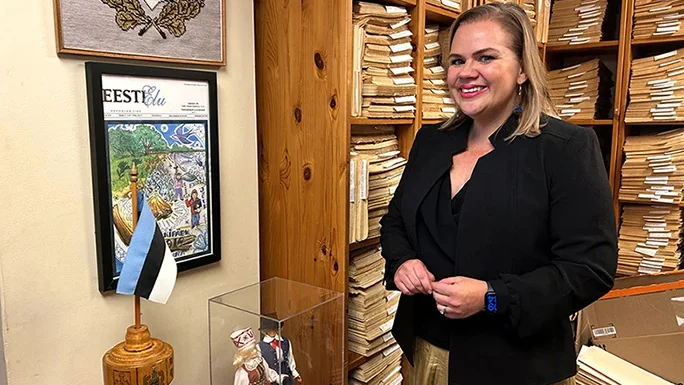
Maimets was born (1988) into a somewhat musical family. His father was an engineer and his mother was a doctor for whom music was a pleasant past-time. The parents decided that all of their children (Maimets has two older sisters) would learn to play two instruments. At age five, Maimets began to play piano, and at age six, the violin. And far earlier than usual, he began taking music theory lessons. He had fairly average musical teachers and never grew to love practicing either instrument but did so because this is what his parents demanded. He was fascinated by the names of composers at the top of his musical scores and liked to harmonize and play melodies by ear as well as improvise (in Estonian „klimberdamine“).
He was a bit nerdy and did not like sports. He has never tried hockey and dropped soccer as soon as he was allowed to.

But by grade nine, he was gripped by the power of German romanticist Richard Wagner’s operas. Maimets began playing his overtures and preludes and was struck by their beauty and harmony and uncompromising form. He learned that Wagner was the most polarising of all the composers and thus became his gateway into the world of music and composition. Maimets attended Earl Haig Secondary School in North York as a music major in the Claude Watson Arts Program (an enriched curriculum for students with special interests and talents in music, dance, drama, art, etc) and belonged to an orchestra and played music daily. In the final years of high school he learned composition with strings teacher Alan Torok.
As all of us who have grown up in Canadian or American families can attest, parents encourage their children to attend university and study subjects, like engineering or medicine, that will help them find well paying jobs. But Maimets did not know what he wanted to study at university. Perhaps economics at Queens University in Kingston?
In his youth, Maimets had visited Eesti a number of times and developed a deep affection for it. He had famous relatives like Jaan Kross and Toivo Maimets. As fate would have it, Maimets’ sister had invited Estonian composer Helena Tulve to stay at their family home. There, Maimets showed Helena Tulve some rough sheet music he had put together, and Helena Tulve (who was also a lecturer at the Estonian Academy of Music and Theatre) encouraged him to apply to the Estonian Academy of Music and Theatre in Tallinn. Although it was already the summer of 2006, Maimets applied to the university-level Estonian Academy of Music and Theatre and was accepted to begin university in fall 2006. As Maimets was also an Estonian citizen, he was not required to pay tuition.
He described Estonia as supportive and nurturing and a good place to begin this journey of self-discovery. At this point in his career, Maimets struggled with wanting to be liked as a composer and thought music needed to be beautiful.
I asked Maimets if he was frightened about attending university in Eesti. He replied: “I was more frightened of attending university in Canada and less frightened about going to university in Eesti.” I asked Maimets if it was difficult to write in the Estonian language. He said “yes,” but as many students were Russian, his Estonian was better. He lived in a Soviet-era student dormitory, sharing a room with another student. Although he described himself as socially anxious, insecure, and a loner, as music was collaborative, he made friends at university and graduated with a B.A. in composition in 2010.
Maimets said the great thing about studying music was to learn who you are, your true self. He described Estonia as supportive and nurturing and a good place to begin this journey of self-discovery. At this point in his career, Maimets struggled with wanting to be liked as a composer and thought music needed to be beautiful. Looking back, he said that at that time, he did not understand that great art is not always pleasant and often explores deeper, more complex, and difficult parts of the human experience.
When he graduated with his B.A., he returned to Toronto to do his Master’s degree in composition at the University of Toronto (2010-2012). In his own words, “I was so lost, I was trying to figure stuff out.” Returning to Toronto, he was ”profoundly disappointed,” missed Estonia, and missed old Europe. He had an affinity for early choral and early sacred European music, which was held in high esteem in the Estonian classical music scene. He found this sacred music missing in Toronto, but looking back today, adds that he “did not know how to access good art in Toronto and missed out on what Toronto had to offer.” He goes on to say ”I cared too much about what people thought of my music and wanted them to like my music.” Today, an older and wiser Maimets adds: “You should not care whether people like your music, it is important to be authentic and do what you believe in.”

This return to Toronto was a difficult time for Maimets. Although he was awarded scholarships, he felt he was “kind of faking it,” was in the wrong place and did not know who he was as a composer.
Next, he was accepted into the very prestigious Curtis Institute of Music in Philadelphia (2012-2014). He was curious about living in the US. Yet, he was once again disappointed. Maimets: “The school had a success-driven atmosphere that was probably not the best fit for someone searching deeply for their voice.” Upon reflection, he thinks he may have not been the best fit, but he is still very grateful for the opportunities that the school made possible. As Maimets was trying “to find himself,” he stated that he was “writing bad music.”
One of his close friends told him to return to Estonia where he would be happier. Another close friend, Kaia (his now-wife) recommended that he write to the Estonian Academy of Music and Theatre and ask them for a job.
They found him one as a music theory lecturer. Maimets’ parents were supportive of him returning to live and work in Estonia.
Maimets was not happy with his compositions during the period 2014-2020. During the Coronavirus pandemic (specifically 2019-2020) he said composing music was torture. He could not understand why composition was so unpleasant. He had been commissioned to write a concerto for flute, harp, and a full orchestra. But he could not write.
All of this changed with two events. His marriage to Kaia in 2022 and the birth of their first child (they now have two children). Suddenly, he enjoyed writing music and did not care what people thought about his art. This took him forward as a composer. In 2022, he wrote his first “good piece” for flute, harp, and orchestra. He said he felt the music was authentic, he was not looking for beauty, and did not care what people thought. He said he no longer had anxiety, felt secure, and was in a better place.
Eesti Laulupidu (the Estonian Song Festival)
The author asked Maimets to comment on Laulupidu or Estonian Song Festivals in general. Maimets sang in his first Song Festival in 2004 and composed a piece for the wind orchestra in the most recent song festival (XXVIII Laupupidu, “Iseoma”).
Maimets: “I believe Laulupidu is still trying to find itself. When I attended my first Laulupidu, most of the songs sung were by foreign composers, and mostly by English composers.”
While one may see Laulupidu as an expression of an old nationalism, Maimets instead regards it as a powerful expression of anti-colonialism… This is a topic that speaks to Maimets and he views his own journey as one of decolonization.
Maimets continued, “Laulupidu is complex. It is both a relic of the past, clinging on to tradition, yet it still needs to be fresh, new, and evolving. It may seem quite anachronistic at times, but it also reflects very powerful and current emotions and aspirations of Estonians. It is burdened by the past and provides a very specific and unique challenge for a composer like myself. It is very complex to find the right balance between old and new, the familiar and the unfamiliar. Writing for amateur singers is very difficult, because it severely limits your means of expression. One must strike a balance between freshness and observing the rituals of the past.” Maimets found the process of writing for Laulupidu anxiety-inducing. One is giving up some authenticity in order to fit a very specific mold.
While one may see Laulupidu as an expression of an old nationalism, Maimets instead regards it as a powerful expression of anti-colonialism. Estonian singing can be seen as an assertion of native rights. This is a topic that speaks to Maimets and he views his own journey as one of decolonization.
Maimets sees that the West helped Estonia achieve true independence and join the EU and NATO but sometimes finds Estonians too blindly accepting that everything that comes from the West is good. Some skepticism is necessary.
As a closing comment; Maimets liked the innate curiosity in the arts community in Estonia towards other Estonian artists. In Canada, he felt an artist needed to earn the right for people to be interested in them.
Maimets is very busy these days with two small children at home, being a lecturer at Estonian Academy of Music and Theatre, and writing music.