Estonia was represented by team Ralf Saarmets/Gregor Siimon/Robin Merisalu with the project ENEV006T - DEEP: Deep-sea Ecosystem Evaluation Platform. Inspired by deep-sea coral restoration efforts, they developed an autonomous device capable of real-time monitoring at depths up to 11,000 metres. Their multi-sensor probe measures pH, salinity, temperature, dissolved oxygen, and calcium carbonate. It has a hybrid power system sustained by betavoltaic energy supercapacitors and is capable of acoustic data transmission. Their full abstract is available at: isef.net/project/enev006t-deep-deep-sea-ecosystem-evaluation-platform
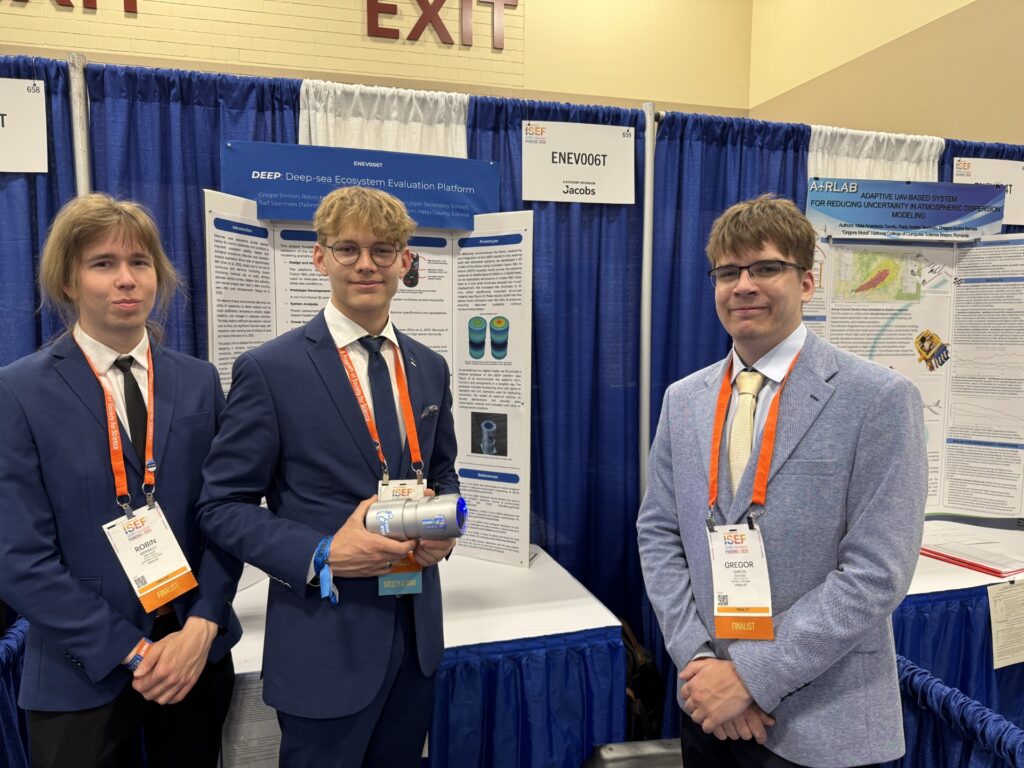
As summarized by Ralf Saarmets, they also “ran hydrostatic pressure simulations in Fusion 360, testing different shell thicknesses until we confirmed the design could withstand over 100 Mpa (Megapascals). We also modelled each component’s power consumption individually to make sure the betavoltaic and supercapacitor hybrid could actually handle the system’s demands. The device is still in a conceptual stage, though. We have not tested it in the ocean yet. Partly because of funding, partly because the Baltic Sea is too shallow for deep-sea coral anyway. But we believe DEEP has real potential given the ecological and economic importance of deep-sea coral ecosystems. Deep-sea corals support critical fisheries, protect coastlines, and are actively being restored, where poor monitoring remains one of the main causes of restoration failure. We are open to collaboration and very much hope for the chance to continue developing it. A patent and startup path are both things we have thought about and would love to explore with the right support, since even limited European patents are costly.”