(Anne Remmel, an artist with a Ph.D. in Education Theory, has aptly captured the interplay between family heritage and Canadian reality in this third installment of her forthcoming book “My Hyphenated Life”).
(Part two can be found here.)
Instead, I find a very special and small moss-covered area under the hickory tree at the back where I will build my little farm with plastic farm animals. The moss is soft and the perfect yard for my little farm. There is a big rock beside my little farm, which I think is really a mountain.
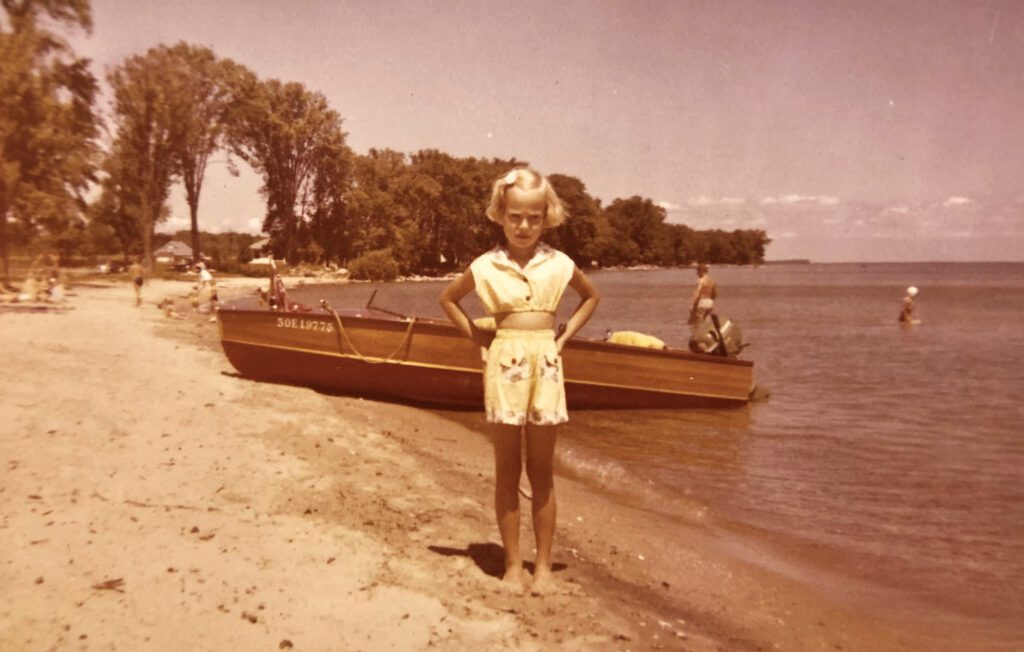
This is a unique cottage in that Aunt Hilda and Uncle Volli live on the other side of the dividing middle wall. My mother and aunt have convinced their husbands that this way, we are separate, yet together. It is a Viceroy, pre-cut building which gets assembled by builders in rapid order. There is a living area, tiny kitchen and one bedroom. Mother and I sleep in one bed, father sleeps in the kitchen. His snoring resounds, as usual, through the whole building. There are also two separate outhouses. These are pretty gross, especially as summer gets hot and the smell, even when mixed with lye, is overpowering.
I am not allowed to go next door, ten feet away, unless invited by my aunt and uncle. I have the impression that Uncle Volli may not like children, but he buys me encyclopaedias and other books. So we live two separate lives. At the back of the cottage is a picnic table used only when visitors come. There really isn’t any room in the little building for visitors.
In this cottage arrangement, my mother and Aunt Hilda come as close as possible to replicating their Estonian childhood experiences. Mother tells me, “This is how we did dishes together when we were growing up in Estonia.” Now they have a new version of the summer kitchen, complete with two outdoor dishwashing tables. The tables are close to the well on either side of the imaginary property dividing line.
Before we go to the cottage, mother and father pack up everything we will need and then we travel with either Uncle Viktor or with Uncle Volli. We don’t have a car, and so we sit in the back seat: mother, father and me. Uncle Viktor smokes in the car and I feel noxious, as the second-hand smoke drifts through the car. He is a good driver, I like how he drives, while Uncle Volli’s driving makes me nervous. When we get to the cottage, mother transforms into a different person. She loves the country and this is her element; while father remains more at home in the city. However, father does a lot of the heavy work, cuts down trees, plants hedges, and cuts lawns.
When we arrive at the cottage, we have a ritual where we go to the well and hand pump two buckets of water. I learn how long it takes with hard pumping before the water comes gushing out. One bucket goes inside into the tiny kitchen, the other is outside on the dishwashing table by the well. We wash ourselves at another little outside table with cold well-water—rarely with a pot of hot water added when mother washes my hair. Doesn’t everyone live like this in the summer? I assume they do. Every year I can hardly wait for June to arrive.
As the construction on the cottage begins, so does planting of the hedges. There must be an Estonian gene that likes clearly defined boundaries. My parents drag thousands of little cedars, hand dug, from the back forests to our property and build hedges all around. I walk in the forest behind Uncle Viktor’s place and help them find the trees that are straight and the right size. No other cottagers on our road have a cedar hedge. However, when we visit other Estonians, we find more hedges. The words of Robert Frost, in his poem, “Mending Wall”, come to mind:
‘Good fences make good neighbours”
Complete Poems of Robert Frost, Holt, Rinehart and Winston, 1916.
One day, I am particularly grateful for the hedges. My mother and aunt decide to “take the sun” i.e. the literal translation from Estonian for sunbathing. However, this is not ordinary sunbathing, this is topless. There is a European freedom about naked bodies which my family embraces. Estonians like to go naked into saunas and then skinny dip. We don’t have a sauna, but the topless sun bathing is enough to worry me. I am embarrassed and afraid that some Canadian neighbour is going to see my mother and my aunt. They actually set up a little shield with lounge chairs, but what if the English pastor across the road could still see them? What if my friend Debbie, a few cottages away, came over? These Estonian habits would be hard to explain.
We know of at least ten other Estonian families along the west coast of the lake; Heyduck, Sippa, Saarna, Sarna, Kilgas, Roiser, Valberg, Holmberg, Riismaa. We pass the signs in front of the cottages when we walk in the neighbourhood and recognize the Estonian names. Our lot on Lakeshore Drive, Oro Line 7, has a view over the lake and my mother says the view reminds her of her Rannamōisa home looking down and out over the sea. We have two large birch trees and we string a hammock between them, which also reminds mother of “home”. There are three huge elms, lots of maples, and a wild forest of poplars and brush behind the cottage. Gradually some of the magnificent elms have to be cut down as Dutch elm disease wreaks havoc on the species.
Summer escape from the city runs deep in all of Northern Europe. Estonians in Canada continue the tradition and Estonian cottages spring up like mushrooms dotting many northern Ontario lakes. Lake Simcoe is a popular destination, as it is an easy hour drive from Toronto. Muskoka is further away, as are the Kawarthas, where separate colonies of Estonians built cottages. All these cottage destinations have lots of Estonian names popping up in the 1950s.
Another summer tradition is that the women and children stay at the cottages for the whole summer. The menfolk only appear on weekends to bring food and the Estonian newspaper. Mother, my Aunt Hilda, and I spend every summer living in the country with very few interruptions. When I am age nine, the cottage is extended out at both ends, enlarged into one longer building, but still with a dividing centre wall down the middle, and still with no indoor plumbing or running water. The routine of pumping well water continues but a tiny washroom is added on both ends of the building. The differences between my family and my aunt and uncle’s family comes to the fore when these extensions are built. The two families cannot agree on the width of the eaves. So, at the mid point of the house, the standard one-foot eaves on our side stop, and the roof juts out to three-foot wide eaves starting at the centre diving line. Our extension is built by my mother’s cousin’s husband, “Sass” Randsalu. My mother and “Sass” argue over many details and it seems very awkward when you hire a family member. Father and I do the eavestroughs and I learn how to solder.
We do not eat together as two families. My father keeps himself separate from his brother-in-law. There is no animosity, just no interest to socialize together. The socializing is all on the part of the inseparable sisters, Helene and Hilda. They do the dishes by the well together, they sunbathe together, they spend every evening on lounge chairs, talk until dusk together, or go for long walks. Often, they are hashing through their past lives, Estonia, the war, the relatives left behind. It is really boring for me to listen to it. Usually, I have my transistor radio on with the earphones in place.
Fortunately, there are other children for me to play with at the cottage. Estonian children, Ruth and Maie Heyduck, come over on their bikes or I spend all day on the sandy Oro Memorial Park beach with them. We are constantly on the go as we explore the back forests, bicycle, catch tadpoles in the creek, rearrange the hay bales of the local farmer into forts. I practically live in the water and I think that all families live like this. City in the winter, cottage in the summer. And most of my Estonian friends do just that.
The summer solstice is a special time. The tradition in Estonia is to build huge fires, even to jump over them. At our cottage, the solstice comes around the time of my mother’s birthday which is in the first week of August. Friends gather, there is a fire. Mother makes lots of little egg and herring sandwiches on dark rye bread. Sometimes there is rosolje (beet salad) or potato salad. And always there is “kringel”, coffee bread. Everyone takes a “Naps” a shot of hard liquor, or two and gives a toast. Straight vodka is the preferred drink. After many “Naps” I notice that some guest start to sing, some start to argue, and some walk funny. The ladies usually try to get their respective men to go home after many “naps”. Mother has a huge wreath made of branches around her neck as this is another Estonian tradition for the person celebrating the birthday. I don’t know that this solstice celebration goes back hundreds of years in Estonia.
One summer, my parents invite an Estonian family with four boys to stay at our cottage. My excitement bubbles over at the prospect of playmates, even though it means that my mother and I must vacate our two bedrooms and sleep on my aunt’s side of the cottage. If I had shown signs of becoming a tomboy, this was all the encouragement I needed. Anything the boys can do, I can do. At age ten, I have another ten-year-old and a nine-year-old to play with. The fifteen-year-old is way too cool to associate with me. We cut down saplings, whittle our names into the wood and create personalized walking sticks. We play darts until someone gets a dart in his arm and we have a pie eating contest. The bakery delivery truck comes through the neighbourhood, twice a week; the milkman, every day. Most of the cottagers are without cars, and the delivery system keeps us in basic supplies. The pie eating contest comes about as we seem to be always running out of sweets.
The adults promise that we will each have our own pie and we create a competition that we have to finish our personal pie at one go. Half-way through my cherry pie, I can hardly face the prospect of another slice. The final mouthfuls are gagging, sweet, forced down my throat as my stomach starts to ache. Why do I have to agree to these things? “ Anything they can do, I can do”. This time it seems like a really dumb idea. I don’t want to see cherry pie for a long time afterwards. But competing with boys continues.
The big adventure is going to Forbes Snack Bar, across from Oro Beach and buying comic books or blackballs. Prior to the boys arriving, I have never had any interest in blackballs nor especially in comic books. Superman comics are usually not allowed in our house. Also, my parents and I have never had peanut butter and jelly sandwiches on Wonder Bread. The boys come with a good supply of this “Canadian” food. My mother has never tasted peanut butter before and she isn’t convinced that it is really a food. Somehow we manage, considering that the youngest boy is a baby in a carriage and we have no running water, and only an out-house. I am too busy competing with the boys to notice how the adults are managing.
Fishing with the boys means that I bravely put my own squirmy worms on hooks, then unhook my catch, and compare what size and how many fish each of us haul in. We also compete to see who can cast the furthest from the shaky dock. I wind up for a great cast and bend into the movement only to plunge head first into the water. That day, as luck would have it, I am wearing a fuzzy, mohair, baby blue sweater. The boys can hardly contain their laughter. At the end of the two-week visit with the boys, my mother is so concerned about my growing tomboyishness, she buys a craft kit and I have to do needle point. I really didn’t mind the craft, but I know that I can do all of the “boy” activities as well. I have proven myself. When they leave, I am back to my regular girlfriends.
I know that there are even more intensely Estonian summer options, several “summer colonies” of Estonians who live in close proximity to children’s summer camps. I beg my parents to let me go, but I am not sent to camp. Jõekäaru (Riverbend in English) and Seedrioru (Cedarvale), are where hundreds of Estonian children spend part of their summers, immersed in Estonian language, traditions and food. Forward thinking community members have purchased huge tracts of land for scouting and summer camps shortly after arriving in Canada. However, my parents maintain that since we have a cottage, there is no need for me to go to camp. I lose that battle and miss out on this iconic childhood Estonian cultural experience. The closest I get to camping is with the Toronto Estonian Baptist Church long- weekend camps. My parents even buy a tent for me which smells heavily of wax on its canvas, and is barely waterproof, but still it is a real tent.
The church runs long-weekend tenting camps, where all the church families pitch their tents. We raise the Estonian and Canadian flags, sing both national anthems, and do morning calisthenics. After announcement, we line up at the communal kitchen for porridge. Then we sit on our folding camp chairs or on blankets and listen to special guest speakers from other parts of the world, enjoy lots of lively music, sing in choirs, and bond as a “church family.” The “regulars” have their customary tent spots with their friends as neighbours. Afternoons are usually designated “free time” and we, the children, play endless games of volleyball, swim and plan how to sneak out at night with boys. This is the big challenge in these very restricted, closely supervised weekends. How to get out of the camp and not end up on KP duty(Kitchen Patrol.) If caught leaving the tents, or meeting up with boys, the punishment is peeling potatoes—for a few hundred people.
The more exciting Young Peoples Camp weekends, with teenagers and young adults only, are without parents. So the summer schedule includes several of these long-weekend camping experiences. We are not completely free to do whatever we like, but there is always an adult patrolling “lights out” and no visitors. At one of the first of these weekend Young Peoples Camps, my tent mate tells me that “the boys” are coming over later at night to our tent. I am 14, and trying hard to act 18. I don’t quite know what the boys will be up to, but I have to act knowledgeably, pretend that I am excited by this prospect. I am not. My tent mate has a crush on the boy coming to visit her, while I have only just met this group of teenagers.
Later that night, I hear voices and two boys appear at the tent, a few years older than us, good Estonian boys. Their plan is clearly to try out their seduction skills and who knows what else. This is the first time I am spending time away from my parents, at camp, unsupervised, as naive as they come. I protest that I don’t want to snuggle up with this person I hardly know who has groping hands. I clearly don’t want to be touched, never been kissed and I am hugely relieved when Arnold, the adult monitor with the flashlight, arrives. Very sternly, he chases the two boys out of the tent, sparing me an early groping encounter in the dark. Any teenage necking experiments will have to wait.
On another of these weekend retreats, I am sharing a tent with Margi and Ruth. The tents are pitched in a farmer’s field behind the Welin’s cottage near Meaford on Georgian Bay. My tent mates and I decide that we will have a little marshmallow roast over a candle, in the tent. Things do not go well. The candle overflows, the hot wax spreads and as I lift the burning mess and carry it outside, the wax drips and solidifies and burns my hands. These are the kind of memories of teenage stupidity that stay with you. The nerve endings in my fingers will never be the same and I spend the next two days in agony with a Noxzema jar of ointment for my burnt fingers. It could have been much worse. We didn’t really think about the danger of building a fire inside a tent. We are teenagers. We are invincible….and sometimes just plain stupid.
As campers, we all speak alternately in Estonian and English, but mostly English amongst ourselves. However, we sing Estonian songs and listen to Estonian speakers. We swim, go to the sauna, waterski, play volleyball, and continue the challenge of escaping, undetected off-site at night. Little teenage romances begin to develop. I now have a budding crush and plot to have a walk together at night.
The meeting is set up and as we are sneaking out, the dreaded flashlight patrol appears. We duck into nearby bushes and the danger passes while we make it out of the camp grounds without being detected. It is only the next morning that I discover that I have ducked into a patch of poison ivy. I’m lucky because the rash appears only in a few places on my shoulder. The long walk with the boy was just that: a long walk, discussing whatever was very important at age 15. It was a sure sign that I liked him, since I ignore him totally whenever I see him for the following year.
When school starts in the fall, my Canadian friends ask me, “What did you do over summer?” I cannot really explain any of my summer adventures to my Canadian school friends. I say, “Oh not much, just went to the cottage.” They have no comparable experiences of church families camping together nor of Estonian immersion. I keep my two worlds carefully separated. The Estonian world and my Estonian identity is in one compartment, my Canadian identity is in another. Summer, Estonian style suits me fine. I just don’t talk to my Canadian friends about it.